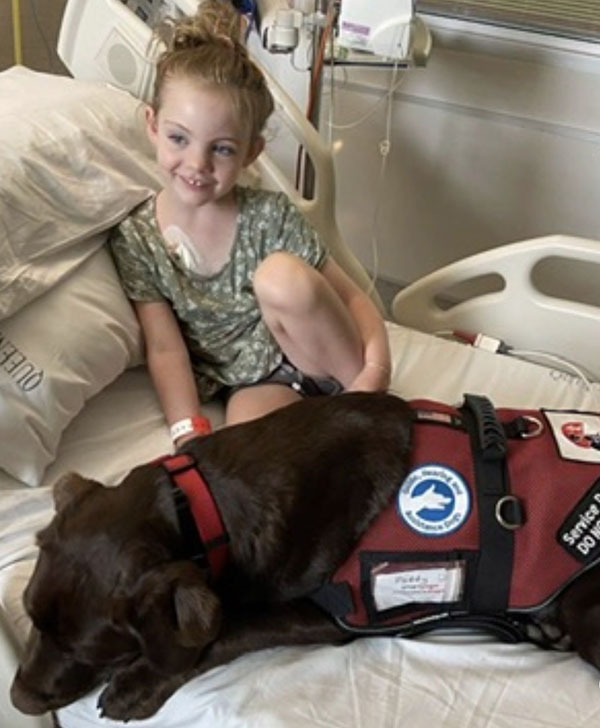
 Image: Marleigh and Paddy.
Best-selling author, speaker, podcaster and health sociologist Kate Fisher wears many hats. But the one she never takes off is that of mother to “three beautiful little humans”.
The youngest is Marleigh, a bubbly blue-eyed 10-year-old with a taste for strawberry milkshakes, who has inspired a global movement.
Seven years ago, Marleigh was critically ill with a rare, life-threatening autoimmune condition. The only thing that kept her alive was an intravenous immunoglobin infusion made from donated blood and plasma.
“She was having massive seizures that lasted up to 39 hours and we could only prolong her life for 10 days at a time with this treatment. Marleigh is with us today thanks to the altruism of complete strangers – Australian blood donors,” says Kate, a UNE Bachelor of Arts (Sociology) graduate. “And this is why I’ve become such a staunch advocate for blood donation.
“There are persistent critical blood shortages in Australia and throughout the world. Blood cannot be manufactured or stored for long periods and Australia spends something like $600 million annually importing plasma. People agree that blood donation is a great idea, but everyone thinks that someone else is doing it. Only one in 30 eligible people in Australia donate blood.”
Now Kate is reminding us that one in three Australians will need a blood donation in their lifetime. Her advocacy has produced a popular children’s book Milkshakes for Marleigh, a Tedx Talk, a podcast series that shares life-giving stories and registered blood donations over the past three years that have saved 15,000 lives.
“At UNE, I learnt that no dream is too big. I learnt to stand up and, as a country girl, I guess I’ve never backed down from a fight. I hope the children and parents reading Milkshakes for Marleigh and learning about our work will become our future blood donors. Anything else is just cream on top.”
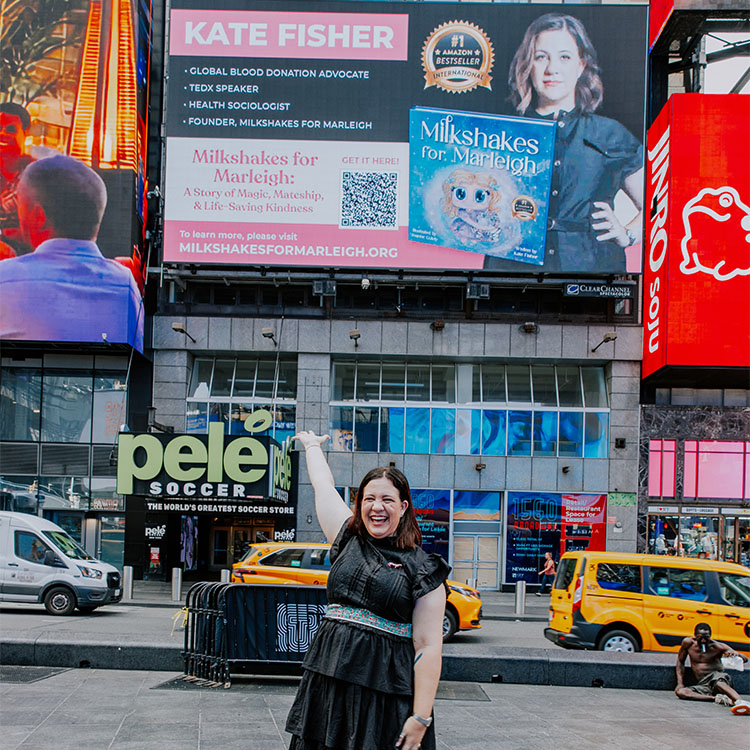
Like the thrill of seeing the book recently promoted on giant billboards in New York City’s Times Square.
“There’s a lot of talk about whether paying for blood donations would change donation rates in Australia, but I’ve visited the US, which has part-voluntary and part-paid donation and the rates are lower than they are in Australia. It’s an international crisis,” says Kate. “Blood donations sustain our health system. They have economic, social and public policy implications.
“On the personal level, giving blood demonstrates that you are a team player, that you care about others. There’s no better demonstration of humanity and mateship. I hope we are helping to shift the conversation.”


