
On 8 October 2026, an email landed in Paul Rodgerson's UNE inbox. Two distinctions and a credit. His Bachelor of Laws was complete.
"It's over, I did it, and I officially achieved what I set out to do," he said.
It is a sentence that carries more weight than most graduation announcements. Paul completed the bulk of his law degree while serving nearly five years in a Victorian prison, moving through five different facilities, fighting bureaucratic resistance at almost every turn, and studying with one supervised hour of internet access per week.
Out of Sight, Out of Mind
He had been a builder before prison. He had no university qualifications and had attended three different high schools, just passing Year 12. Law was not something he had ever thought about.
"Before I went to prison I had no interest in the law at all," he said. "It was out of sight and out of mind, the same way prisons are for most people. Unless you've had to deal with the justice system you don't give it a second thought, and I never did."
Before I went to prison I had no interest in the law at all.
That changed once he was on the wrong end of it.
"What happened to me didn't feel anywhere near as fair as people assume the system is. Once I was inside I kept hearing story after story from other prisoners about the police, the courts, their lawyers and the prison. I wanted to see for myself what the law actually said."
It was Paul's family who contacted UNE to ask whether he could study from prison. He enrolled in 2022, but getting there required clearing a series of hurdles that most students never face. Before he could enrol in anything, he had to pass Corrections Victoria's own competency test to study externally, then complete a pre-tertiary course. Even then, Corrections Victoria controlled what he could study and how many subjects he could take.
When he was told he could not enrol in law, he found a way around it.
"I chose legal studies instead, thinking it would get me around the rule, and they accepted it. Then I picked subjects I knew would count towards a law degree later. Corrections Victoria wouldn't let me study law, but they were letting me do subjects that went straight towards a law degree. It was all above board. I'd just found a way around a rule I thought was ridiculous."
The practical obstacles were relentless. His internet access was capped at one supervised hour per week, and for much of his sentence he was not even permitted to use the keyboard and mouse himself.
"I sat in front of a monitor showing the education manager's screen and told them what to type, where to click and what document I needed. So you've got one hour to do a week of legal research. You're watching someone else do the clicking at about the speed your mum and dad go when Netflix asks for a password they've forgotten."
You're watching someone else do the clicking at about the speed your mum and dad go when Netflix asks for a password they've forgotten.
Referencing became its own ordeal. Without internet access, he relied entirely on his hard copy of the Australian Guide to Legal Citation.
"I lost marks for a full stop in the wrong place and for not knowing how to cite a government website. Students now can look up an example online or ask AI and get it in seconds. I was sitting in a cell flicking through a book trying to work out where the bloody punctuation went."
Near the end of his sentence, Corrections Victoria initiated a review of his studies. It ran past UNE's enrolment deadline, costing him six months of study in the final stretch.
"I argued, I put in complaints and I kept asking for answers, and none of it made any difference. UNE was ready to keep teaching me and I'd shown I could do the work. I still lost six months because a review wasn't finished in time."
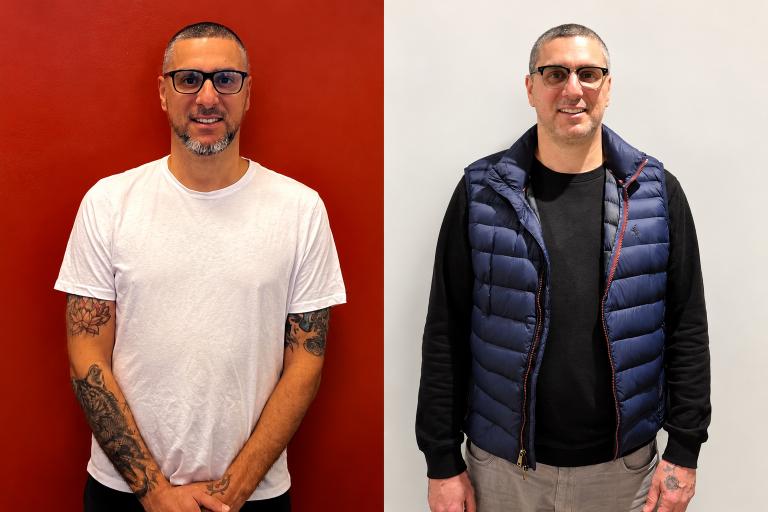
Image: Paul Rodgerson at Loddon Prison, Victoria, 2025 (left), and in 2026 (right). He completed his UNE Bachelor of Laws while incarcerated, receiving his final results in October 2026 and set to begin Practical Legal Training in December.
UNE was ready to keep teaching me and I'd shown I could do the work. I still lost six months because a review wasn't finished in time.
He is clear about what got him through, and equally clear about what did not.
"My family backed me, UNE gave me the chance and I did the work. I did it with all of that in the way. That's why I want to be clear that my education is not a Corrections Victoria rehabilitation success story."
My family backed me, UNE gave me the chance and I did the work. I did it with all of that in the way.
Inside the Walls
His family organised his textbooks every trimester. Law books are expensive, and Paul had almost no money. His sister would hunt for second-hand copies, and the two of them turned it into a running joke.
"I'd still complain that I hated books with someone else's notes and highlighting all through them. That's pretty ridiculous when you're sitting in prison with no money. Then when she finally found one that looked new, it would turn out UNE had moved to the next edition."
Inside prison, Paul became what is known as a prison lawyer, helping fellow inmates understand their paperwork, appeals and the decisions being made about them. He was never qualified and never claimed to be, but he was trusted.
"Prisoners are pretty good at working out who's genuine and who's full of shit, and people trusted me because I was honest with them. If I thought someone had something worth chasing I told them. If I thought they were wasting their time I told them that as well."
He also never judged anyone by the offence on their paperwork.
"Some of them had done terrible things, but they were still a human being sitting in front of me asking for help. People don't always need someone who promises to save them. They need someone who'll listen, look at it properly and tell them the truth."
People don't always need someone who promises to save them. They need someone who'll listen, look at it properly and tell them the truth.
Justice Up Close
Since his release in June 2025, Paul has continued that work. He has been assisting friends and contacts with research and preparation for criminal appeals, trials and post-conviction matters, including submitting a petition of mercy for a friend challenging his conviction.
"I've had to go back through the original case, get across some complicated forensic issues, research the law and contact experts overseas. Not many law students get the chance to work on something like that and I don't take it lightly. This is a real person's conviction, his freedom and his future."
The area of law that most reshaped his thinking is administrative law, and not in a comforting way.
"It showed me that something can be obviously wrong and a court still might not be able to do anything about it. I know what it's like to have big decisions made about you by people who know almost nothing about you. All they've got is what's on the paper in front of them."
He has a pointed view on access to justice.
"Too often we tell people they've got rights and then make those rights so complicated and expensive that they can't use them without a specialist. Getting justice shouldn't depend on whether you can keep paying lawyers until somebody listens."
Getting justice shouldn't depend on whether you can keep paying lawyers until somebody listens.
He is also candid about the political economy of prison reform.
"You don't win an election by promising prisoners better education or rehabilitation. It's a lot easier to get a headline by promising tougher sentences and more prison beds. People that society doesn't like are easy to ignore."
What Comes Next
Paul is now enrolled in Practical Legal Training with Leo Cussen, starting in December 2026. He is looking for the right placement, not just somewhere to tick a box.
"I want to learn from people I respect, somewhere that sees my experience as useful and not as something I should hide."
He remains on parole until April 2027 and is candid about what that feels like.
"I'd be lying if I said I didn't sometimes feel watched like a hawk, like someone is waiting for me to stuff up. That's just what being supervised can feel like when you're trying to get on with your life and the sentence is still following you around."
I'd be lying if I said I didn't sometimes feel watched like a hawk, like someone is waiting for me to stuff up.
If his application for admission is successful, he hopes to have a practising certificate around May 2027. His longer-term ambition is a criminal defence practice built on the relationships and experience he already has.
"If a bloke who did nearly five years in prison ends up a practising lawyer, I don't think my phone is going to be quiet. That's not because I'll be the best lawyer in town. It's because I understand where they're coming from and a lot of them already know me."
If I Can Do It, Anyone Can
His advice to aspiring lawyers in criminal defence is direct: learn to talk to people before you worry about showing them how much law you know.
"I've met brilliant lawyers who can quote cases and legislation all day long but can't have a normal conversation with the person whose freedom is on the line. In criminal defence that loses you the client's trust before you've even started on the case."
And to anyone who thinks their circumstances make studying law impossible, his message is just as plain.
"Don't wait for your life to be perfect, because mine definitely wasn't. Sometimes you have to find a way around the people and the policies telling you it can't be done. If I can do it, anyone can."
"Don't wait for your life to be perfect, because mine definitely wasn't.
UNE's commitment to flexible, distance education made Paul's journey possible. He has not forgotten that.
"They treated me with respect, took me seriously and saw me as a student, not as a bloke sitting in a prison cell. It's been a privilege to study with them. I never would have thought that asking questions about the system from inside prison would end with me working towards becoming a lawyer."


