
Research Impact
About the Impact Module:
Research impact is the difference your work makes beyond the academic literature — in communities, industries, policy, health, the environment and more. Pure's Impact Module gives you a dedicated space to record, track and showcase that difference as it develops over time.
Through Pure, you can document how your research has moved through engagement with stakeholders, influenced thinking, been translated into practical tools, and ultimately adopted to deliver verifiable real-world benefits. You can also capture alignment to the United Nations Sustainable Development Goals, connecting your work to global priorities.
For personalised support with entering Impact data into Pure, contact Fiona Pearson directly — fpearson@une.edu.au or 6773 1137.
Benefit for Researchers:
Grant Credibility Major funding bodies, including the Australian Research Council (ARC) and the National Health and Medical Research Council (NHMRC), place significant weight on real-world research impact during application evaluations. Pure provides a structured way to record and maintain these records over time.
Evidence Gathering Pure links publications, grants and non-academic activities in one place, making it easier to draw on verifiable data when developing grant proposals — including impact narratives and curated output summaries.
Public Visibility via the UNE Research Portal In due course, impact summaries and data marked as public in Pure will be surfaced on UNE's Research Portal, increasing the discoverability of your work through search engines.
Relational Mapping Impact records link directly to underlying research outputs, funded projects, public activities and media coverage held in Pure.
Funder Reporting Supports compliance with grant requirements where funders request structured reporting on how research has influenced society or policy.
Career and Institutional Support Compiled impact records and narratives can be drawn upon to support promotion applications and institutional reporting.
Living Impact Record Pure can be maintained as an ongoing impact diary, allowing metrics and narrative detail to be updated as a project evolves from initial activity through to documented real-world change.
Pure Impact Definitions:
Impact Categories:
The primary sector or domain where the research caused a real-world shift.
Cultural Impacts: Preservation of heritage, revitalisation of languages, or changes to creative and artistic practices.
Economic: Financial gains, cost savings, business growth, or job creation.
Education Impacts: Overhauls to teaching curricula, improved pedagogical standards, or enhancements to learning equity.
Environmental: Advancements in sustainability, biodiversity, climate resilience, or resource management.
Health / Clinical: Better patient outcomes, improved healthcare delivery, or new clinical treatments.
National Security Impacts: Improvements to border protection, cybersecurity frameworks, or critical infrastructure resilience.
Other Impacts: Unique or unexpected real-world benefits sitting completely outside standard definitions (e.g., sport governance or charity auditing frameworks).
Public Policy / Services: Influencing government legislation, statutory regulations, or public sector guidelines.
Quality of Life Impacts: Better individual well-being, increased physical accessibility, or improved living standards for vulnerable groups.
Science Impacts: Creation of international methodology standards, open-source research infrastructure, or cross-disciplinary practices.
Societal Impacts: Shifting public attitudes, enhancements to human rights, or broader civic and community behavioural changes.
Technological Impacts: Development of patented materials, commercial software systems, or advanced manufacturing processes.
Impact Pathway Stage
Impact Pathway Stage tracks the logical chain of events as the academic research transforms into real-world change. Select the highest stage the project has fully achieved.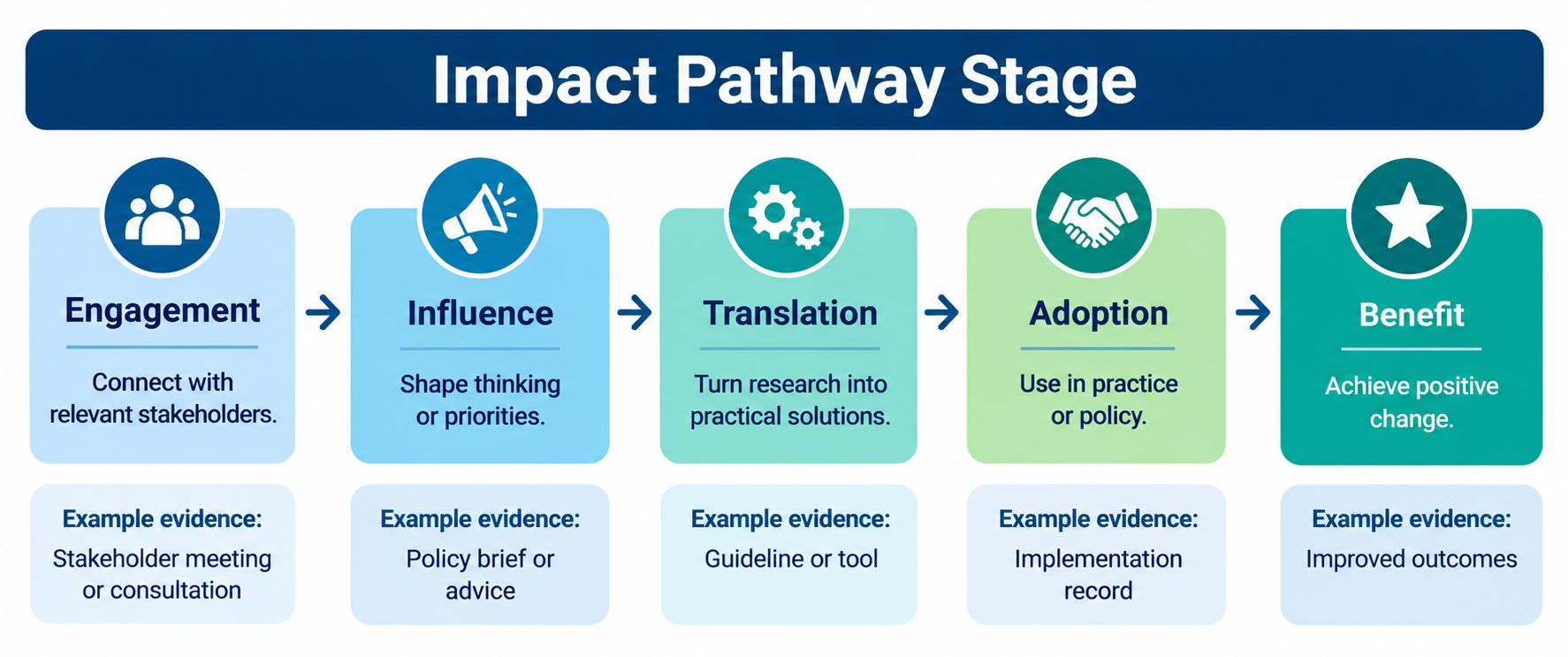
Stage | What it means | Example Evidence to Upload |
1. Engagement | Active, two-way consultation, workshops, or co-design occurring between UC researchers and external end-users. | Workshop agendas, co-design attendance lists, signed MoUs, or taskforce appointment letters. |
2. Influence | Your research or translation assets have successfully shifted mindsets, informed thinking, or shaped public or industry debate. | Citations in public consultation papers, Hansard records, or media coverage requesting your expert commentary. |
3. Translation | Practical tools, policy briefs, prototypes, or resources created specifically for external end-users. (Note: Standard journal articles do not count here). | Copies of policy briefs, downloadable toolkits, industry guides, or software prototypes. |
4. Adoption | External stakeholders have formally integrated, deployed, or implemented your findings into their own policies, products, or professional practices. | Published legislation explicitly citing your work, commercial licensing agreements, or new corporate/clinical protocols. |
5. Benefit | The ultimate destination. The adoption of your research has delivered clear, verifiable, and positive changes to lives, the environment, or the economy. | Quantifiable data (e.g., cost savings, reduced emissions, improved health metrics) or high-level external testimonial letters. |
Impact Maturity
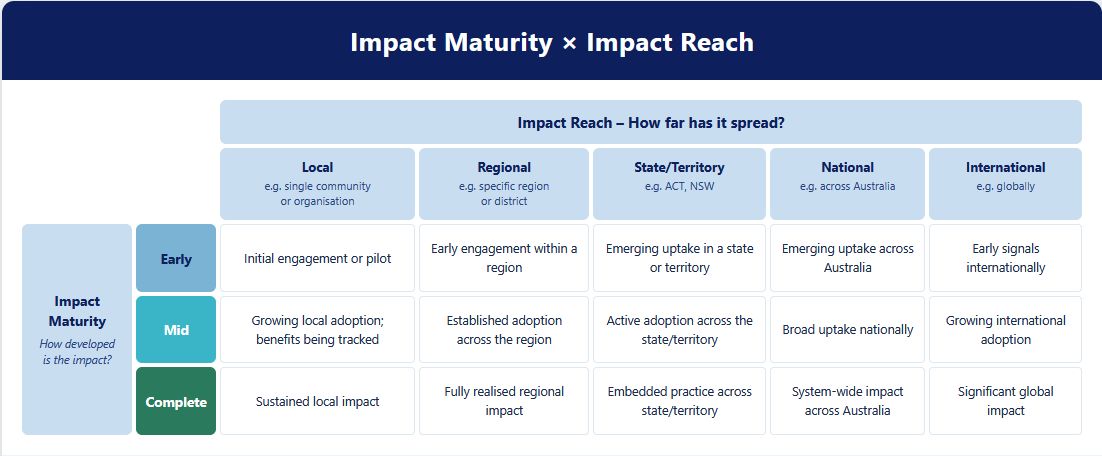
Tracks the developmental lifecycle of the research impact. This field identifies whether the real-world benefit is in its foundational phases (Early), actively demonstrating growing adoption or systemic change (Mid), or has reached a fully realized, stable, and verifiable endpoint (Complete).
- Early Maturity: Knowledge transfer or stakeholder engagement has successfully begun. Can demonstrate great real-world traction, but long-term systemic benefits are not yet proven or quantified.
- Mid Maturity: External stakeholders have actively adopted and embedded your findings into their operations, and preliminary tracking of real-world benefits is successfully underway.
- Complete Maturity: The impact has reached a stable endpoint. The Impact is heavily evidenced and fully realized with clear, quantifiable metrics.
Impact Reach
Measures the furthest geographic scale or boundary where the research benefit, adoption, or engagement was felt or implemented. You can list multiple values to show transition eg from local to State to National.
- International: The benefit or adoption spread across global borders or multiple nations.
- National: The impact has a widespread footprint across Australia.
- State/Territory: The benefit is explicitly realized across a specific state or territory (e.g., ACT, NSW).
- Regional: The change is concentrated within a specific region, district, or ecosystem.
- Local: The impact is tightly focused within a distinct local community, suburb, or single organization.
Key Impact Metrics
Select 1–3 key metrics that capture the scale of your impact as powerfully as possible.
Prioritise figures that reflect the widest reach or greatest magnitude — such as population size, national or global scope, or significant monetary or social outcomes. Include both the figure and a brief label for each metric eg $4.2 billion economic impact, 50,000 platform adopters, 42 countries, 6 State Governments.
The following fields/data are required: Title Description Year Category of Impact (select one or more from the drop-down list) Impact Pathway Stage (select the highest stage the project has fully achieved by selecting from the drop-down list.) Organisations affiliated with the Impact. Persons associated with the Impact Managing Organisational Unit (the UNE School/Research Centre) Impact Maturity (select one from the drop-down list) Impact Reach (select one one or more from the drop-down list) Sustainable Development Goals (SDGs) (add one or more SDGs from the drop-down list) Beneficiaries (free text keywords. Add as many as applicable) Key Impact Metrics (free text keywords. Add as many as applicable) Relations: in this section you can relate the Impact to your other content in Pure eg research outputs, projects and activities. Visibility: in this drop-down select ‘Public-No restriction’ if you want your Impact to be visible via the Research Portal and your Pure Profile. The following fields are available in Pure and information for these is voluntary: Socio Economic Objectives (SEO) codes Fields of Research (FoR) codes Documents and Files Images Evidence No. Recording evidence in Pure is voluntary. Pure gives researchers the ability to capture and categorise the type of evidence. Any information added under the impact evidence section is not made publicly visible, i.e it is kept in the back end of Pure only. Researchers are welcome to use Pure to capture relevant evidence. Please note that evidence information is not used for reporting purposes. Research impact refers to demonstrable benefits or changes beyond academia that can be attributed to your research. This includes — but is not limited to — changes to policy, practice, health outcomes, economic activity, environmental outcomes, community wellbeing or public awareness. If your research has influenced how something is done, understood or decided in the real world, it is likely suitable for recording as an impact in Pure. Yes. This is a significant benefit of Pure as it allows you to display all related content. Your funded project, the research publications and activities that are relevant to the impact can all be linked. As UNE makes other Pure functionality available you will be able to link those too eg Facilities/Equipment, Prizes/Awards and Press/Media. Impact entries will become publicly visible via the UNE Research Portal once the new portal platform is live. Yes, Impact will continue to grow and change and Pure allows you to capture those changes as they occur. Your impact might move from Australia to an overseas country (as an example) so you can edit the impact to reflect the extended reach. New publications can be added as related content as they are published and more recent activities furthering the impact stage can be captured. Impact metrics can also be updated over time to accurately reflect the growing significance of your work. Contact Fiona Pearson, Executive Manager Research Performance for support. Fiona can provide advice on entering data into Pure or for questions. Fiona can be contacted via email on fpearson@une.edu.au or by phone: 6773 1137 A research output in Pure records what you produced — such as a journal article or report. An Impact record captures what happened as a result — the real-world change, benefit or influence that followed from that work. The two are complementary and can be linked to each other within Pure. Yes. Each distinct impact should be recorded as a separate entry in Pure. However, where a single body of research has generated impact across multiple areas — such as both policy and practice — this can be captured within one record by selecting the relevant categories. Separate records are more appropriate where the impacts arise from genuinely distinct research activities or projects Key Impact Metrics are free-text keywords used to capture the scale and significance of your impact in a concise, evidence-based format. Aim to provide one to three metrics that best represent the reach and magnitude of your impact. A short figure with a brief label works well — for example: 2.3 million people reached, $4.2 billion economic impact, or 142 countries. These metrics will appear on your public profile, so precision matters. You can control the visibility of each impact record individually. If you do not want an entry to appear on your Pure profile or the Research Portal, simply select a restricted visibility option in the Visibility field. Research Services can advise on visibility settings if needed. Yes. If you would prefer support with data entry, Research Services can assist directly. Contact Fiona Pearson to arrange this. Yes, there is an approval workflow in Pure to support promotion of Impacts. Before impact records are made publicly visible, the Research Performance Team conducts a brief review to ensure data fields are complete and correctly configured — supporting both accurate institutional reporting and the best possible presentation of your work.Frequently Asked Questions
