No dream is too big for Kate
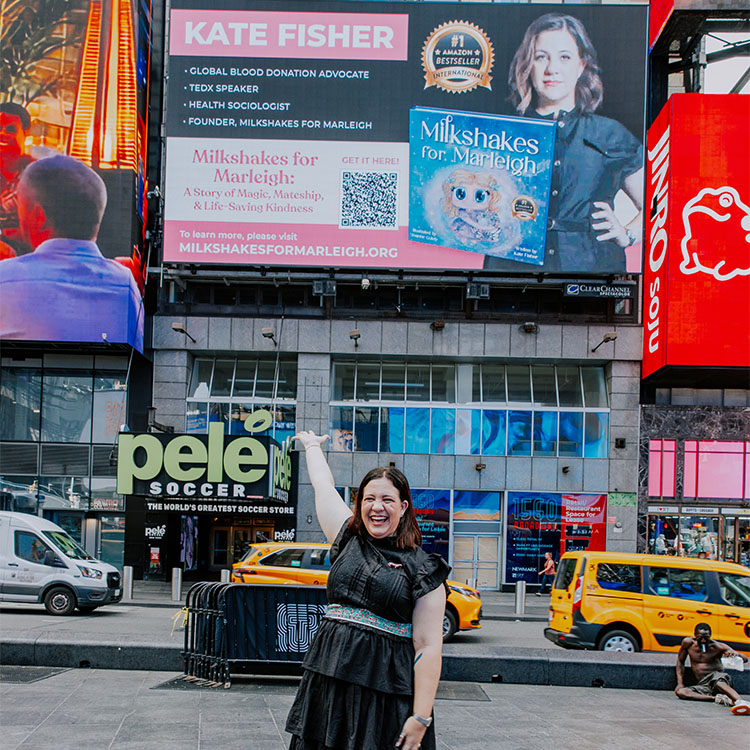 Image: Kate Fisher in Times Square.
Looking back, the initiative that then Senior Resident Fellow Kate Fisher (née Turner) organised at Earle Page College back in the early 2000s was prescient.
“I arranged for our leadership group to give blood as a team, as part of our community service and to encourage other students to become regular donors,” Kate recalls. “Then I intermittently gave blood between graduating and having our three children. Of course, back then, I had no idea how important blood donations would become to our family.”
That’s because Kate’s youngest child, Marleigh, became critically ill seven years ago with a rare, life-threatening autoimmune condition. The only thing that kept her alive was an intravenous immunoglobin infusion made from donated blood and plasma.
“She was having massive seizures that lasted up to 39 hours and we could only prolong her life for 10 days at a time with this treatment. Marleigh is with us today thanks to the altruism of complete strangers – Australian blood donors,” says Kate, a UNE Bachelor of Arts (Sociology) graduate. “And this is why I’ve become such a staunch advocate for blood donation.”
Walcha-born Kate lived in Earle Page for the four years of her studies, meeting friends who remain “some of the closest people” in her world. It was two of those firm friends who helped the Fisher family orientate themselves when they loved from Canberra to Queensland during the COVID-19 pandemic, to be closer to medical care for Marleigh. And it was the wider Earle Page community that helped again when the family was looking to buy a seizure response dog for Marleigh.
“The college community was phenomenal at that time, sharing through social media our fundraising for Paddy, who has saved Marleigh’s life more times than I can count. People who had attended Earle Page years before me, who I had never crossed paths with, helped us financially.
“No matter where I have gone in life, the relationships I developed at UNE and Earle Page have served me so well. I have such fond memories of my time at Earle Page and what it taught me about myself and being part of a community.”
As a new university student, Kate was unsure what her future career might look like – perhaps law or teaching.
“I just knew that a good education was key to it, and the beauty of being in a college environment and at a uni with such a diverse range of courses was that I didn’t feel locked in. My attitude was that I would study for 12 months and consider what was on offer. I say to my kids now, it’s not what you want to do when you grow up, but what you want to do first.”
At UNE, initially studying law, Kate says she learnt to “gather evidence, create an argument, and reason and write properly”. That was very useful when she entered the Commonwealth Department of Health’s graduate program and throughout a career in public health policy development.
But persistent critical blood shortages in Australia really hit home when Marleigh became so dependent on donations. Again, some of the leadership and advocacy skills she developed at Earle Page College and UNE came to the fore.
“I had developed skills in advocating for myself and what I believed was right. At UNE I learnt that no dream is too big.
Today, Kate is a health sociologist and acting CEO of the Queensland Endometriosis Organisation but her personal advocacy role is to encourage the blood donations that one in three Australians will require in their lifetime. Her family’s experience has inspired a best-selling children’s book Milkshakes for Marleigh, a Tedx Talk, a podcast series that shares life-giving stories and registered blood donations over the past three years that have saved 15,000 lives.
“Only one in 30 eligible people in Australia donate blood, yet every donation can potentially save the lives of three people,” Kate says. “There’s no better demonstration of humanity and mateship.
“I hope the children and parents reading Milkshakes for Marleigh and hearing about our work will become future blood donors as we help to shift the conversation.”
