
In 2003, Associate Professor Susan Watt met Warwick Olphert when he was already 78 and officially retired. Yet retirement did not keep him away from campus. As an honorary member of UNE’s School of Psychology, Warwick still came to work most days. Even into his early 90s, he continued teaching a reading course in personality, quietly supporting students and colleagues with the same unassuming dedication he was known for across decades.
Warwick joined UNE as an academic in 1961, after time at Melbourne University and an earlier move from New Zealand to Australia. He spent nearly 30 years in Education, serving as Head of School and later Dean, before retiring. Then, true to form, he took up an honorary role in Psychology around 1990, staying closely connected to the intellectual life of the University.
Outside UNE, Warwick’s contribution extended deeply into the community. He served as president of Challenge Armidale, supporting disability services, chaired the New England North West branch of the Australian Psychological Society, and ultimately became a life member. Within the School of Psychology, he was also a familiar face at almost every talk, from Honours presentations to public lectures, often helping coordinate local APS events in the Paul Barrett Lecture Theatre.
When Warwick passed away in 2023 at the age of 98, he left a generous bequest. UNE’s response was to honour not only his legacy, but also what he valued: learning, conversation, and thoughtful debate.
“Each year, we aim to bring to Armidale a prominent intellectual who is making a distinguished contribution to psychology research and knowledge,” Susan says. “This will add to the vibrancy of UNE and Armidale by bringing new ideas and debate.”
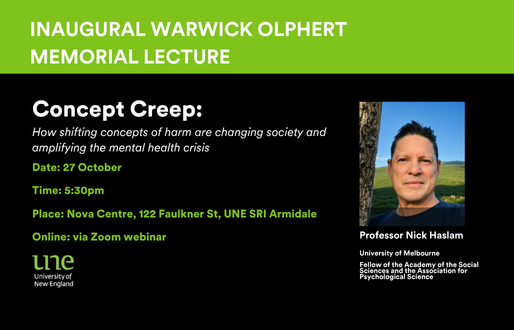
 That vision begins this year with the Inaugural Warwick Olphert Memorial Lecture, featuring Professor Nick Haslam, Professor of Psychology at the University of Melbourne.
A timely topic: “concept creep” and the mental health conversation
Professor Haslam’s lecture explores a phenomenon he calls concept creep, the tendency for words related to harm to broaden their meaning over time.
“Concept creep is the tendency for words related to harm, such as bullying, trauma and mental illness, to broaden their meanings over recent decades,” Professor Haslam says.
His research uses natural language processing to track how language changes across historical texts, and the scale of the shift has been striking.
“I was surprised to see just how much more prevalent the language of harm has become in recent years, and how much some harm concepts have expanded their meanings.”
In everyday life, Professor Haslam sees mental health terminology as one of the clearest examples.
“Concept creep shows up in many areas of life, but the rising use of mental health terminology, such as diagnostic labels, is perhaps the clearest case.”
Susan says the conversation is especially relevant for universities and regional communities, where mental health supports are already under pressure.
With words like “trauma”, “anxiety”, and “depression” expanding to include milder emotional experiences, “regional communities and universities like UNE are seeing increased demand for mental health services,” she says.
At the heart of the lecture is a careful balancing act. Increased awareness can reduce stigma and encourage help seeking, but there is also a risk in applying clinical labels too broadly.
 “There is a risk that our growing awareness of mental ill health, or at least the increasing attention we are paying to it, is leading us to use mental illness labels too liberally,” Professor Haslam says. “We need to increase awareness but do so in a way that boosts accurate knowledge rather than pathologising everyday experiences.”
His message for the community is practical as well as thought provoking.
“We need to be more cautious and reflective in how we use the language of mental health, because how we conceptualise and speak about distress has implications for how we experience it.”
A lecture designed to build connection, not just an audience
A key part of the memorial lecture format is that the speaker comes to Armidale in person and stays for several days.
“That way, we can introduce them to the University, and have conversations and networking that will deepen our mutual connection,” Susan says.
Susan encourages anyone with an interest in mental health to attend, especially those studying or working in psychology, counselling, education, social work, medicine, psychiatry, and mental health nursing. She also notes the topic will resonate with teachers navigating how young people describe distress and self diagnosis.
Event details
- Date and time: Tuesday 27 October, 5:30pm (NSW time)
- Venue: UNE SRI Nova Centre, University of New England Smart Region Incubator, Nova, 122 Faulkner St, Armidale NSW 2350
- Attend: In person or online via Zoom
- Reception: Light snacks provided


