Many research teams talk about integrating valuable lived experience into their projects. In practice, however, the input can be limited or tokenistic.
Now, a University of New England-led study is setting a new benchmark for genuine inclusion and collaboration.
The Rural Compass project seeks to better understand the challenges older rural people with intellectual disability face accessing healthcare. And to truly interrogate these challenges, the research team has appointed two lived experience representatives as co-researchers, as well as a support worker to facilitate their transition into academia. For the duration of the five-year Medical Research Future Fund-funded study, the co-researchers will have input at every stage – from the design of surveys, interviews and focus group discussions through to data analysis and the dissemination of findings.
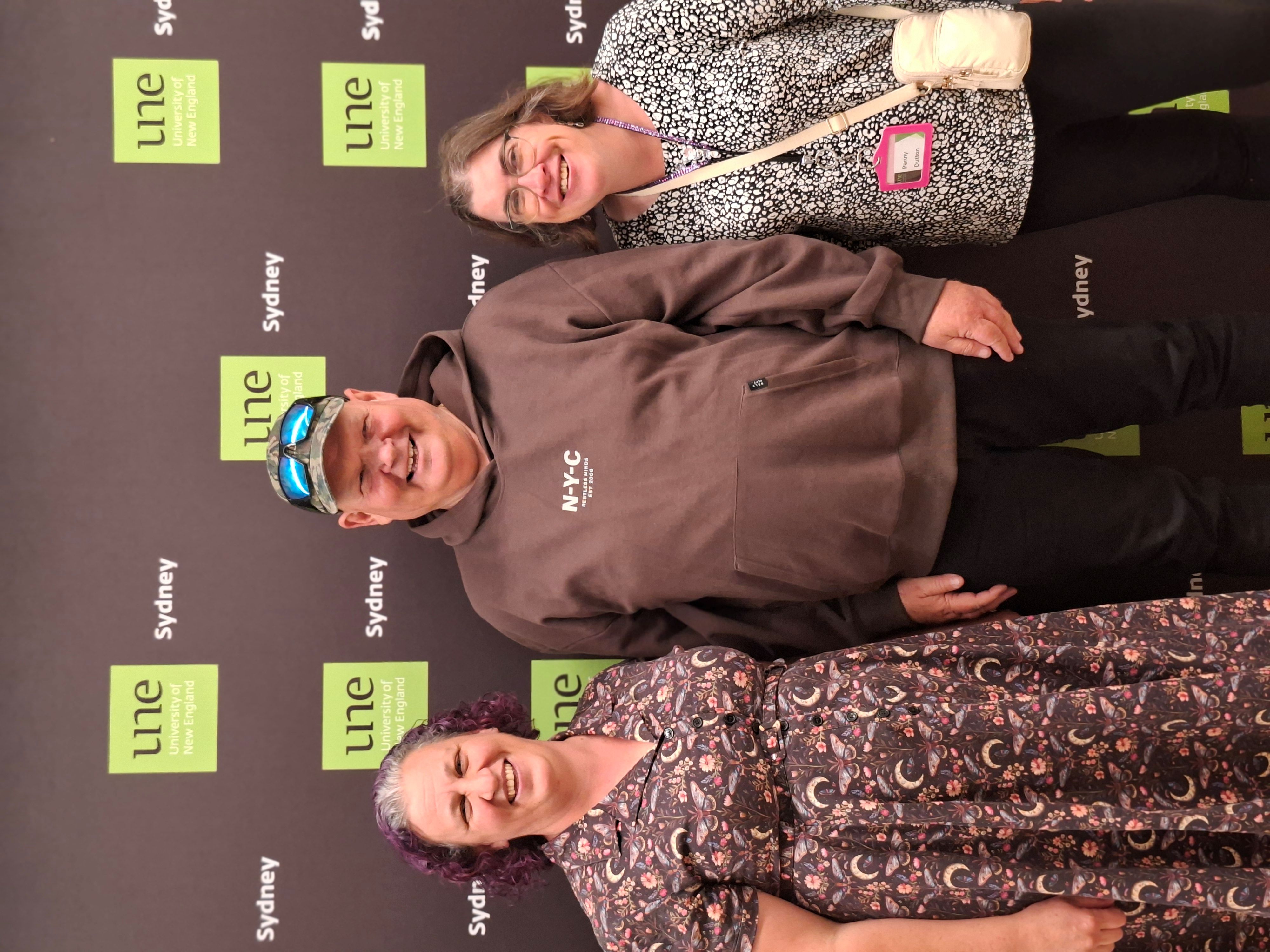
Penny Dutton and Michael Parker believe their involvement will help ensure the research is accessible and that any subsequent healthcare recommendations are relevant.
“I decided to contribute to this research because l believe the topics are important. I wanted to share my thoughts and experiences of what people actually go through in life … to help researchers better understand people with intellectual disability,” said Penny, who is based in NSW. “It’s a chance to have my voice heard and to contribute to positive outcomes for people who might be going through something similar.”
For Western Australian Michael, it’s an opportunity to speak for those who may not be enjoying a good quality of life.
“They rely on healthcare but sometimes can’t speak for themselves, which can be frustrating. I really like helping people and being honest with people and hope the research will help make others happier in life,” Michael said. “By being courageous and part of the research, I hope I encourage others to be involved, too.”
Project Manager Dr Hannah Ford said embedding the lived experience in Rural Compass from the start means that all surveys and resources are well designed for people with intellectual disability, ensuring they are accessible and usable.
“It grounds our project in reality and helps ensure we are asking the right questions and getting the data we need,” she said. “We are particularly interested in the early intervention care that’s getting missed and which can result in unnecessarily lengthy hospital stays.”
Improvements to healthcare have resulted in longer life expectancy for people with intellectual disability, however they typically show earlier signs of ageing and an earlier onset of chronic disease. In identifying the barriers to accessing health services in rural settings, the research team hopes to develop strategies for better supporting the physical and mental wellbeing of people as they age.
Support worker Miranda Vanry said the opportunity to be part of real meaningful inclusion was a key reason she agreed to join the project.
“Knowing Michael and Penny would be paid the same as me showed their lived experience was valued equally to the skills and knowledge of others on the team,” Miranda said.
Dr Ford said some people with intellectual disability cannot communicate, so they commonly are forgotten or excluded from research, because it’s just too hard to include them. “Having Penny and Michael as co-researchers gives us the very best chance of ensuring that the voices of people not traditionally consulted are captured.”
The Rural Compass team features collaborators from Southern Cross University, Western Sydney University, Charles Sturt University, Central Queensland University, Notre Dame University and Trinity College Dublin. It is also working closely with service partners Enable WA, Lifely, Microboards Australia and Sunnyfield.
Lead chief investigator, Professor Stuart Wark from UNE’s School of Rural Medicine, said genuinely shifting from research done to people with intellectual disability to research done with people with intellectual disability and towards research done and led by people with intellectual disability is imperative.
“This is best-practice research,” Professor Wark said. “It gives people with a practical understanding of living with intellectual disability input into research that’s ultimately designed to help them. Penny and Michael will directly impact the direction our research takes, help us to overcome acquiescence bias and enable us to gather richer data and devise more relevant interventions. At its heart, this is about valuing their experiences and expertise.”
This month, Penny and Michael presented on the importance of co-researchers at a conference hosted by UNE and the Australasian Society for Intellectual Disability. They have already co-written two published journal articles.
“I hope our research project is a stepping stone for Penny and Michael into future research,” Professor Wark said.
The first (online) Rural Compass survey has been launched across Australian states and rural people with intellectual disability aged 40 and over are encouraged to participate via https://redcap.link/ruralcompass. Responses are welcome from individuals, those supported by a carer, as well as proxy respondents (carers, family members and friends).
The Rural Compass research team will collect information from individuals each year for three years, to learn how their health changes over time, their preferences for treatment and what support is available. By making this information available to disability organisations, service providers and governments, the researchers hope to contribute to better integrated, timelier and community-embedded care.

