Professor Lynette Riley AO - 2026 Distinguished Alumni Award
In recognition of her distinguished leadership in Indigenous education and reconciliation, and her foundational role in establishing UNE’s Oorala Aboriginal Centre.
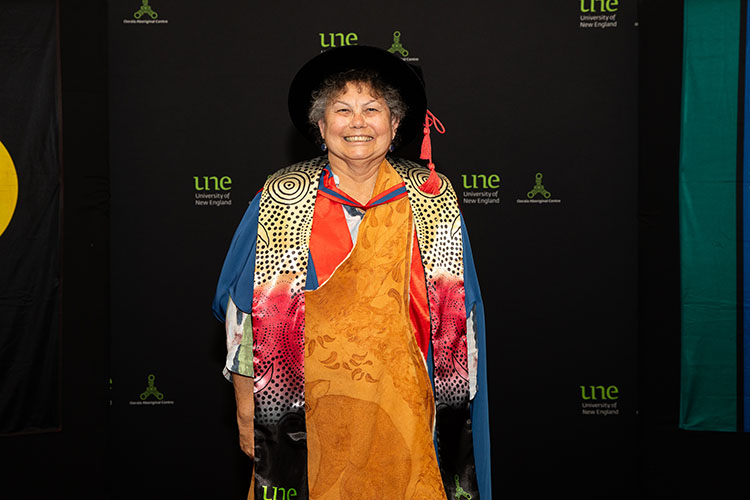
During a distinguished career in education, community engagement and Reconciliation, trailblazing Wiradjuri and Gamilaroi Elder Professor Lynette Riley AO has earned a reputation as a change maker. For getting to the heart of what’s needed and delivering it.
She is one of Australia’s most respected Indigenous scholars, educators and leaders, whose distinguished career has “transformed Aboriginal Education, Indigenous curriculum development, language revitalisation and community engagement”, according to Kelly Freebody, Head of the Sydney School of Education and Social Work at the University of Sydney where Lyn now works.
“Professor Riley has consistently worked to improve educational opportunities and outcomes for Aboriginal people while challenging deficit narratives and advancing Indigenous knowledge systems within schools, universities and government institutions. Her contribution spans teaching, research, policy development and community leadership, creating lasting impact at local, state and national levels.”
Widely known as a good listener who consults widely to develop practical solutions, Lyn is also the first to admit she’s a “good talker” with a burning passion for preserving and strengthening cultural knowledge and achieving social change. It’s a commitment that takes courage, compassion and collaboration, but also patience and grace.
“There’s a time and place for slapping the table and calling people out. And I’ve done that a couple of times,” Lyn says. “But you can’t be angry all the time, because the next day you have to come back in and work with people.”
Enduring relationships with communities and Country serve as Lyn’s North Star. They have guided her every move, in senior positions across government, higher education and broader society – from establishing UNE’s ground-breaking Oorala Aboriginal Centre, through to foundational work in the NSW Department of Education’s Aboriginal Education Unit (where she co-created Australia’s first Aboriginal Education Policy, in 1982) and shaping institutional practices within universities.
Lyn’s leadership, says Kelly, is “thoughtful, inclusive and transformative”, integrating research, teaching and community engagement in innovative and impactful ways. Lyn’s expansive research interests – which have included Aboriginal incarceration, family group conferencing and foster care as well as Aboriginal Education – are borne of necessity.
“I go where I’m led; where the need is. I don’t see the sense of doing things that don’t have practical outcomes,” Lyn says. “When I founded Oorala, I didn’t have a vision – I asked the community and other people at UNE what they wanted. I took that process of consulting stakeholders and giving them ownership to my next role as an Aboriginal Development Manager with the Western Institute of TAFE. As at Oorala, a lot of the things I put in place are still there, 30-40 years later, and that makes me smile, because it has given people a voice and that voice has been sustained.”
The internationally recognised Kinship education modules that Lyn first began developing while at Oorala – an invaluable resource today for non-Aboriginal educators, social workers, health professionals and others working in Aboriginal communities – exemplify this practical approach. A new online version now being used in schools, TAFE and universities has been accessed by more than 250,000 people in the past five years alone.
“Kinship systems and structures are the foundation for all Aboriginal relationships, and you need to understand them if you’re going to work with Aboriginal people,” Lyn says. “Much of my work has been to help educate non-Aboriginal people. I never seek to be confrontational because that just turns people off – and we want them to be allies.
“I teach mandatory Aboriginal Education units to our early teacher educators, most of whom are non-Aboriginal and have never met an Aboriginal person. It’s up to me to break down the stereotypes and provide information and evidence. They’re going to be teaching our kids, so I have to make sure they have the tools they need.”
When she received the Order of Australia Medal in 2025 – which acknowledged Lyn’s distinguished service to education – she was thrilled that her colleagues from the Aboriginal Education Council and the Research Centre for Children and Families had gone to the trouble of nominating her.
“I don’t do what I do to get accolades. I’m just a little slogger who works in the background to make things happen for Aboriginal people. And I think others relate to me because I’m teacher trained, I’ve been a senior executive, but I’m also a Mum and an Aboriginal community member.”
Still, the Indigenous curricular and support programs Lyn has developed have paved the way for countless First Nations students to complete TAFE and university studies. In addition to chairing Aboriginal Education and Indigenous Studies at the University of Sydney, Lyn is co-chair of the National NAIDOC Committee, has been an advisor to the OCHRE Steering Committee, and on the inaugural Board of the NSW Aboriginal Languages Trust.
But, she says, there remains plenty of work to be done.
“The 2023 National Referendum result, which rejected constitutional recognition for the First Peoples of Australia, almost broke me. How could 60 percent of Australians not see that we want our own voice? It taught me that there’s a lot more education to do; that there are still big challenges ahead.”
So, despite having just turned 70 and with 16 grandchildren beckoning, this pioneering educator and leader is not ready to retire yet.
“One of the key things for me is ‘whose coming next?’ and how do I support more younger people to get involved in this work. That’s really important to me and my next focus,” Lyn says.
It’s also a necessity, to address the challenges that persist.
“At heart, I believe non-Aboriginal people want to do the right thing; many just haven’t had the necessary or appropriate education, to understand that our systems remain very Western. We have to continue to break the systems down, not just for Aboriginal people but for lots of cultural groups in Australia, and women as well.”


