
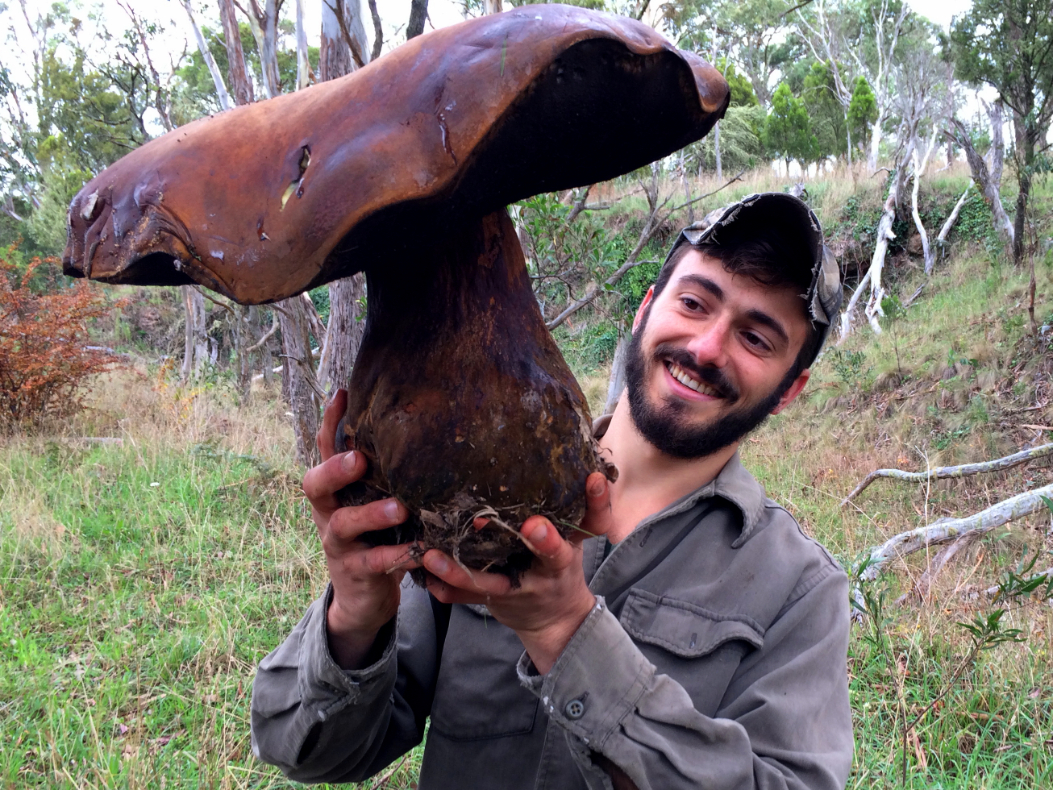
While many of us see mushrooms as a kitchen staple or an occasional forest find, for University of New England (UNE) alumnus Dr Todd Elliott, they are the invisible architecture of our natural world.
This vital work has now been recognised on the global stage, with Dr Elliott named as one of only five biologists worldwide to receive the prestigious 2026 Maxwell/Hanrahan Foundation Award in Field Biology.
The award, which focuses on field-based researchers at critical career stages, aims to elevate diverse perspectives in under-appreciated fields.
“Field biology in general often feels like the ‘silent partner’ in important research, as so much of what is shared with the world is compiled and fine-tuned in the lab or at a computer,” says Dr Elliott, who studied a PhD within UNE’s School of Environmental and Rural Science and continues to work with the university as an Adjunct Research Fellow.
“It's so important for awards like the Maxwell/Hanrahan Field Biologist Award to draw attention to such critical but under-recognised science, and I am incredibly honoured to have been selected as a 2026 recipient.”
Dr Elliott’s research centres around understanding interactions in the natural world, particularly the interface between fungi, plants and animals.
I don't necessarily have an end goal; I'm just excited about all the ecological questions to be asked along the way that will hopefully help deepen our understanding of ecosystems and positively impact conservation.
This work is especially relevant to conservation, endangered species management, fire ecology and the restoration of landscapes.
“I have worked in Australia on the interconnections between Eucalyptus trees, the symbiotic fungi (often truffles) that form mycorrhizal associations with these trees, and the animals that eat and disperse the spores of these fungi,” he says.
“I'm also especially interested in the long-distance dispersal that happens when apex predators ingest primary fungal consumers and how this impacts adaptability of belowground fungal communities.”
Looking ahead, Dr Elliott hopes to continue exploring these interconnections and expanding fungal taxonomy, as many ecologically vital species remain unknown to science.
“I don't necessarily have an end goal; I'm just excited about all the ecological questions to be asked along the way that will hopefully help deepen our understanding of ecosystems and positively impact conservation.”
As for his advice to the next generation of students and researchers, he has one tip:
“If you get stuck behind a computer or a desk for longer than you’d like, remember to step outside and draw inspiration from the myriad of ecological mysteries just outside your door.”
Find out more about Dr Elliott and his work here


