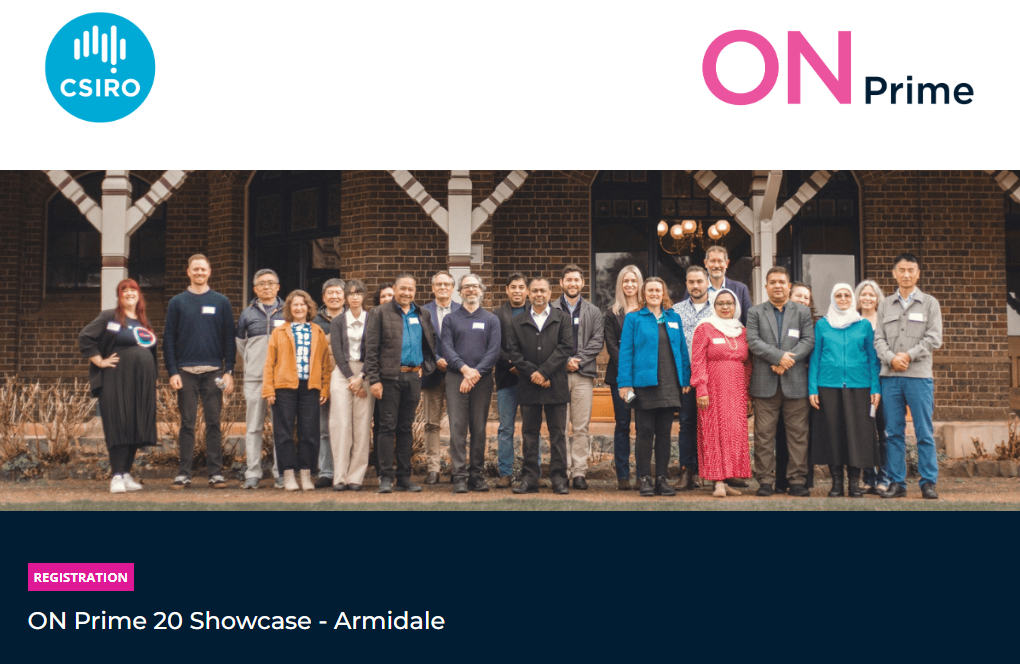
The research teams are working within CSIRO ON Prime, a program designed to teach researchers the skills, networks and confidence to unlock the full potential of their research. UNE’s SMART Region Incubator (SRI) has partnered with ON Prime to equip researchers with the knowledge to identify community partners and pathways to create impact from research.
The cohort was brought together by Cameron Turner, Director of the SRI, who saw an opportunity to draw some of the outstanding research undertaken at UNE out of the realm of theory into practice.
Cameron has been involved in the CSIRO’s ON Prime program since its inception in 2017. ONPrime takes researchers through a structured process of 100 stakeholder and customer interviews, helping them identify who their work is ultimately for, and building those relationships early in the research process.
“The real challenge for universities is that they do lots of really good research – all of them do – but often no one knows about it,” Cameron says.
“Going through the ON Prime program can help researchers embed a connection to community, to industry, to the marketplace, right at the start, rather than doing research for three or twenty years and then trying to find out who cares about it.”
After a few months leading the SRI, Cameron is broadening the organisation’s scope. He is opening up the SRI’s initial brief, moving it from a classic business incubator to acting as an interface between good ideas – whatever their orgins – and the realisation of those ideas in ways “that benefit as many members of our community as possible”.
Introducing researchers to the ON Prime program is an aspect of the SRI’s commitment to the Community Collaborations that sit at the heart of UNE’s 2026-2035 Strategy.
“The university’s strategy is about unlocking value from knowledge to help the community reach their aspirations and ultimately thrive,” he says. “Research is the fuel in the engine of human aspiration.”
“We have enormous amounts of intellectual capital and capability here at UNE that might not fit into the traditional concept of research commercialisation, but it still has great potential to better human lives.”
Creating unconventional paths to research impact may mean taking an unconventional view of how research findings can be translated into usage, Cameron observes.
“Rather than the usual mantra of ‘we do research for the world; we do research for industry’, we need to start thinking along the lines of ‘we do research with those we want to benefit’.”
Cameron found plenty of willing participants for the ON Prime program. After spending his first months meeting researchers across campus, he had found no shortage of people looking for this kind of opportunity.
“Pretty much everyone I talked to applied,” he says. “There was no arm-twisting. Everyone was just really keen and thrilled that someone would actually help them do what they already want to do.”
The resulting cohort spans a wide range of disciplines and problems.
- Zuocheng Zhang and team are examining how policy and institutions can better support migrants entering the Australian workforce.
- Amir Karton and team are exploring the use of graphene oxide to harvest clean water from the air.
- Marg Rogers and team are scaling up resilience resources for families of first responders, FIFO workers and defence personnel.
- Priyantha Mudalige and team are developing a framework to help small businesses in NSW adopt AI responsibly.
- Kyle Mulrooney and team are building a place-based model for youth crime prevention in rural communities, focusing on identity, belonging and opportunity.
- Tina Tarafder and Parves and team are researching the barriers facing women entrepreneurs across the Armidale local government area.
The teams will meet fortnightly as the ON Prime program progresses, culminating in a Community Collaborations Showcase on 21 October.
SRI will be inviting the community to the showcase to hear about and discuss the plans developed by participating researchers and their community partners.

