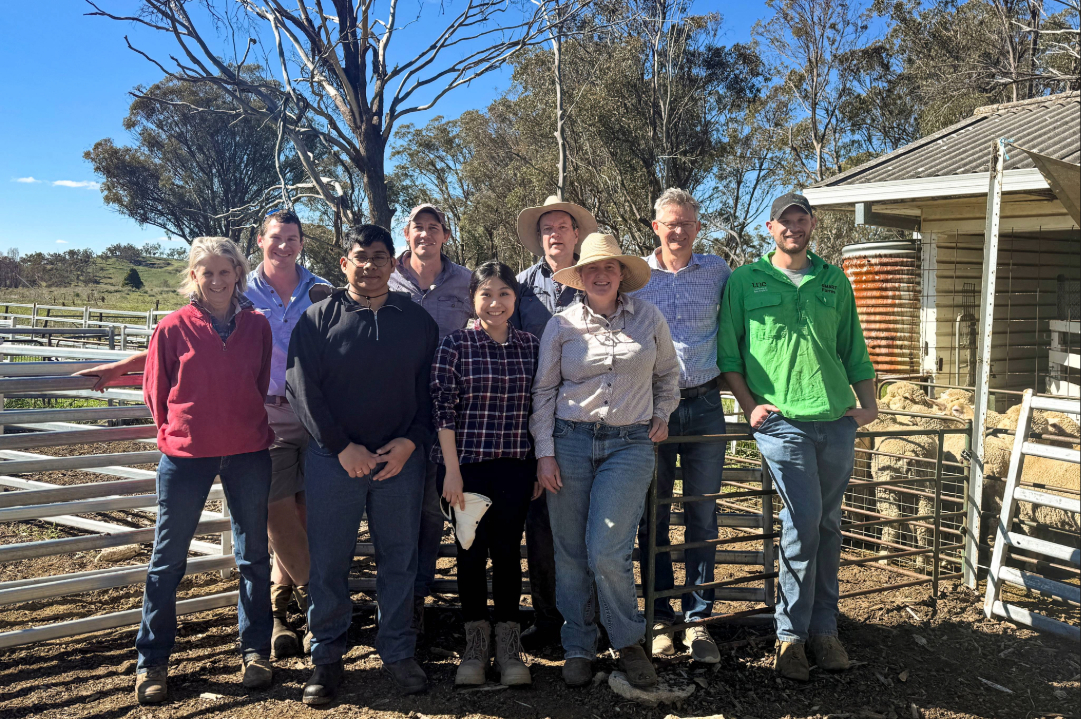
The University of New England (UNE) recently welcomed researchers from across Australia to the UNE SMART Farm to explore ways to measure the methane output of sheep in the Meat & Livestock Australia (MLA) National Resource Flock.
The industry is utilising UNE’s state-of-the-art sheep feed intake unit to provide sheep breeders with the tools they need to select and breed sheep with lower emissions and higher feed efficiency while maintaining high productivity and product quality.
"The feed intake system at UNE is probably the largest in Australia, and possibly one of the largest in the world for measuring individual animal feed intake and behaviour," says UNE Project Officer, Research, Pete Fitzgerald.
"Five research projects with a combined value of about $20M contributed to activities here at Kirby. By harnessing the brain power here at UNE and across our global networks, we are providing the industry with the tools to ensure sheep production is both sustainable and efficient for decades to come."
Alongside researchers from the University of Queensland, the South Australian Research and Development Institute, the NSW Department of Primary Industries and Regional Development, AbacusBio, and the Global Methane Hub, the team is investigating the relationship between a sheep’s methane production and its rumen microbiome and its saliva.
The more efficiently we can measure, the less intrusive it is for the animals and the better it is for the industry.
If a strong enough relationship is identified, it could revolutionise the speed of data collection.
"Currently, it takes about two hours to get a measurement for one animal, which limits us to about 105 animals in a day," says Pete.
"If we can prove that a simple mouth swab provides the necessary data, we could potentially do a thousand animals in a single day, which is a tenfold increase in throughput and significant cost savings.”
UNE Professor of Animal Breeding and Genetics, Julius van der Werf, says it could also improve animal welfare.
"The more efficiently we can measure, the less intrusive it is for the animals and the better it is for the industry."
With support from MLA, the Zero Net Emissions Agriculture CRC, and the Global Methane Hub, the UNE team is set to measure thousands more animals for methane emissions and feed efficiency over the next five years, cementing UNE's long-term commitment to livestock research and industry development.
Watch a video about the recent developments here and find out more about the MLA National Resource Flock here.


