
Three Indian scholars will soon join UNE as recipients of coveted scholarships designed to bolster Australia-India economic ties. They will further their education and advance their knowledge of areas in which UNE has strong expertise – climate-resilient cropping, agri-solar and soil carbon.
Staff in the School of Environmental and Rural Science at UNE secured three Maitri (Hindi for friendship) Scholarships for up-and-coming doctoral students Devika Thottapully Murali, Amal Jyothy and Aditya Bhukya. The scholarships will enable the trio to contribute to important UNE research projects in the fields of agribusiness, technology and clean energy – projects that promise practical and commercial solutions for both countries.
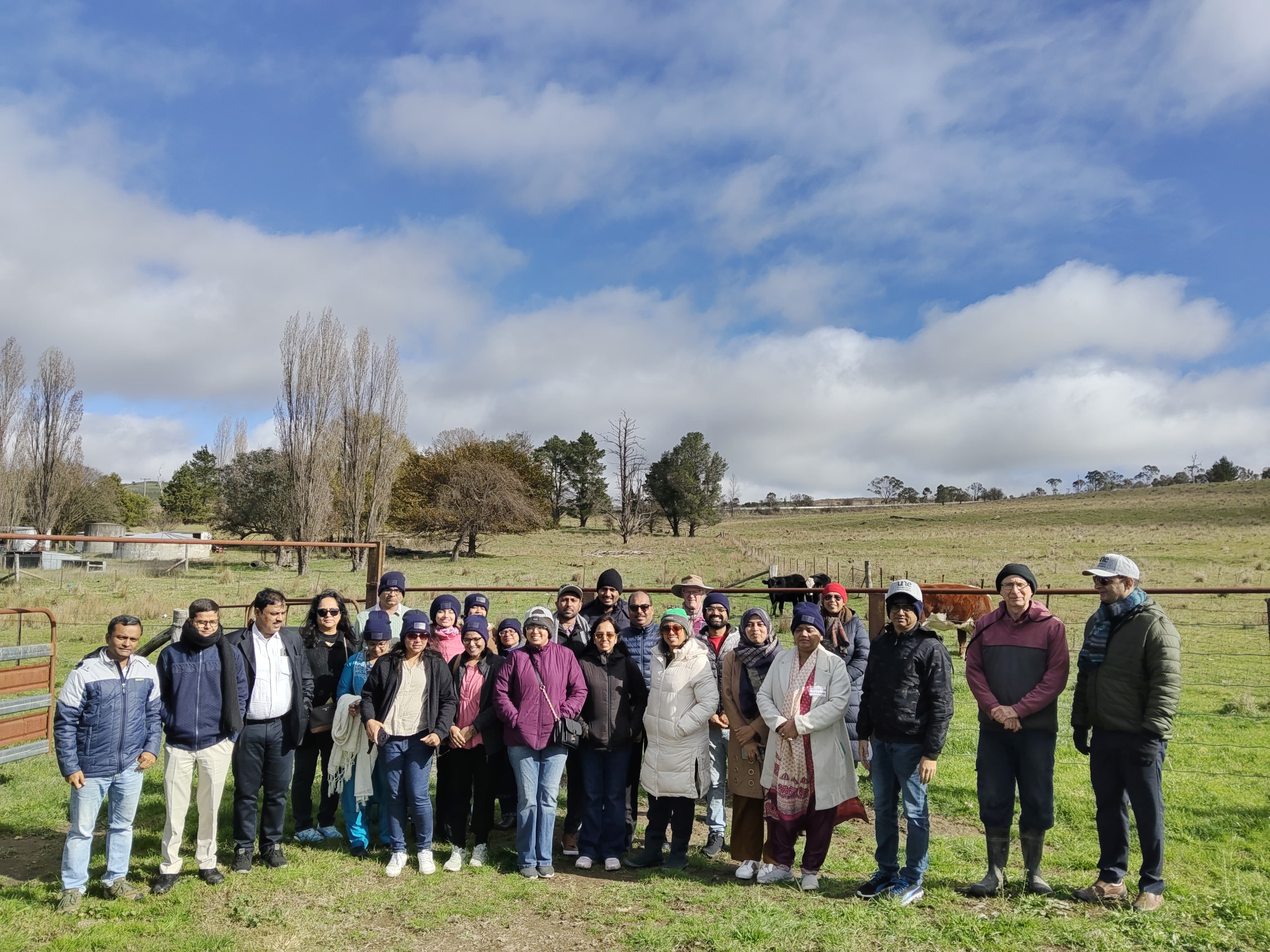
The Maitri Scholarship announcement follows UNE’s successful delivery of two-week Australia Awards Short Courses to 20 students from Indian research institutes in 2025.
UNE supervisors describe the Maitri Scholarships as a potentially life-changing opportunity for the PhD scholars to advance their research careers by engaging with world-class experts, facilities and research methods. The scholars will receive mentorship, and opportunities for industry and government engagement as they undertake their PhDs, supporting international cross-institutional cooperation goals outlined in the Australian Government’s New Roadmap for Australia’s Economic Engagement with India.
“The scholarships strengthen UNE’s global reputation as a research institution of choice, and at a time of geopolitical upheaval and energy supply challenges,” said Deputy Vice-Chancellor Research Professor Chris Armstrong. “The students will be contributing to research projects of real-world relevance and, by supporting this two-way knowledge exchange, UNE is helping to strengthen Australia-India research and industry links, which can only amplify the impact of our work.”
Amal will contribute to spatial modelling research led by Dr Priyakant Sinha and Associate Professor Paul Kristiansen, which aims to create a commercial blueprint for combining renewable energy and sustainable agricultural production on farms in Australia and India. It builds on the work of UNE’s Renewable Energy Hub and involves a direct industry partnership with the ACEN Australia Solar Farm at Uralla, International Maize and Wheat Improvement Centre (CIMMYT) and MPKV Agriculture University in India.
The students will be contributing to research projects of real-world relevance and, by supporting this two-way knowledge exchange, UNE is helping to strengthen Australia-India research and industry links, which can only amplify the impact of our work.
Under the primary supervision of UNE Lecturer in Agronomy and Soil Water Management, Dr Shamim Mia, Devika will investigate how cropping systems influence the stability of organic matter in Australian and Indian soils. This understanding is vital to climate change mitigation and agricultural productivity, and the team hopes to develop a carbon tracking model in collaboration with the NSW Department of Primary Industries and Regional Development (NSW DPIRD) and the CIMMYT.
Aditya, to be supervised by crop physiologist Associate Professor Onoriode Coast, will partner with NSW DPIRD researchers at the Australian Cotton Research Institute and the Indian Institute of Science Education and Research to examine how a better understanding of crop physiology and rotations can build the drought resilience of cotton grown in Australia and India.
The Maitri Scholarships are managed by the Centre for Australia-India Relations (CAIR) and Australian Department of Foreign Affairs and Trade (DFAT). Indian research partners will participate in each of the research projects, to share learnings and help translate the knowledge into practice.
Taking the soil research project as an example, Dr Shamim Mia envisages the delivery of mutual economic benefits and potentially even international applications.
“Understanding carbon dynamics in cotton-based farming systems will benefit both Australian and Indian farmers by improving productivity, enabling access to carbon credits and contributing to global efforts to achieve net-zero emission targets,” he said.
Indian-born Dr Sinha, a Senior Lecturer in Spatial Science, understands the personal value of the scholarships all too well. He was lecturing at a university in Ethiopia when he secured a faculty scholarship to complete his PhD at UNE 17 years ago.
“Coming from a developing country, I had always dreamt of advancing my research career in Australia,” he said. “My scholarship gave me a very strong foundation upon which to build my research career and changed the entire course of my life. I see similar opportunities for these students, including the chance to participate in events organised by CAIR and DFAT to boost their profiles and networks.
“By studying in Australia and at UNE in particular, the students will be trained according to the rigorous Australian Code for the Responsible Conduct of Research in world-class research facilities with the very best supervision.”


