
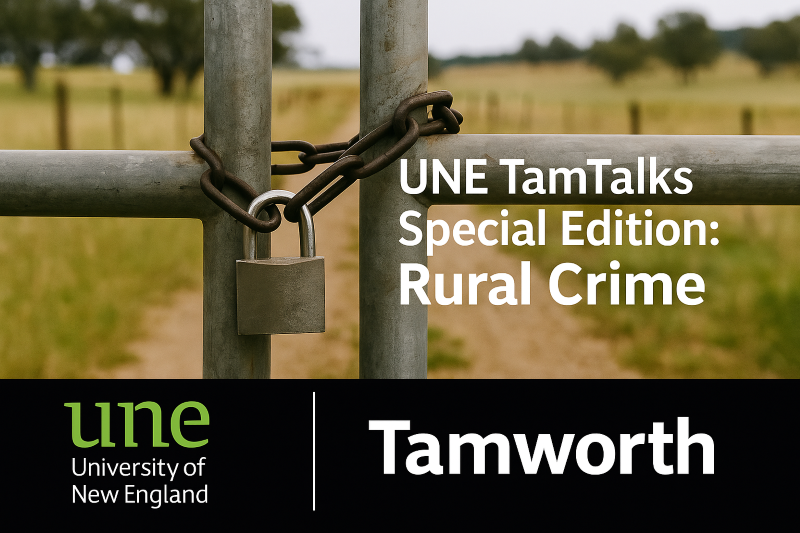
This week, the University of New England is bringing together three of Australia's leading rural criminology experts to examine this often-overlooked issue.
The free event, on Thursday September 11, will see UNE’s Professor Rob White, Associate Professor Alistair Harkness, and Dr Kyle Mulrooney come together to explore the complex nature of rural crime and its far-reaching impacts on communities and the economy.
Professor White, a world-renowned expert, will examine the concept of "rural folk crime" – activities that may technically be criminal but are deeply embedded in rural culture and tradition.
"Folk crimes are activities that may be criminal in a formal legal sense, but because they are rooted in tradition, survival and community, they may not be perceived as such by locals," Professor White said.
"Central to this is the idea that 'oh, we all do it!' and so even if the act is criminal, it is not seen as serious or worthy of much concern. We commonly see this in relation to certain kinds of farming, fishing, hunting and logging practices."
Associate Professor Alistair Harkness will challenge audiences to understand why rural crime should matter to everyone, regardless of where they live.
"If you think rural crime doesn't impact absolutely everyone, then think again!" Associate Professor Harkness warns.
"Rural crime has huge impacts on local people and local communities – but the impacts can also be felt across regions and even nationally such as with higher prices for food and fibre. These include devasting social consequences as well as economic effects as well. So, we need to sit up and take notice about crime that happens outside of the cities."
Dr Kyle Mulrooney will share insights from UNE's Centre for Rural Criminology, which has conducted extensive research into farmers' experiences of crime.
"The Centre for Rural Criminology at UNE has been at the forefront of cutting-edge research into rural crime for years now," Dr Mulrooney said.
"A central part of our work has been to find out what farmers have to say about farm crime – their experiences of being victims, their interactions with police and what they are doing about it. It's vital to know 'from the horse's mouth' what is occurring so that we can do something about it to improve livelihoods."
The panel discussion will be followed by a Q&A session, allowing community members to engage directly with the experts and share their own experiences and concerns. The University Panel will be joined by NSW Acting State Rural Crime Coordinator, Detective Acting Inspector, Andrew Maclean who will speak to the importance of timely crime reporting.
“The Rural Crime Prevention Team relies on building partnerships with Rural Communities to be kept abreast of rural crime issues. One significant barrier to the effective prevention and investigation of Rural Crime is reporting, or more specifically, the under reporting of Rural Crimes,” Detective Acting Inspector MacLean said.
“Whilst there has been an improvement in the reporting of Rural Crime since the creation of the Rural Crime Prevention Team, The Rural Crime Prevention Team are still faced with finding out about unreported crime, after the fact.
“The RCPT review every reported Rural Crime, every day and we allocate our resources based on where we see the most problems occurring. We look at crime trends, based on reports and intelligence and deploy our resources strategically where we see crime trends occurring. If we don’t know about it, we can’t address it.”
This UNE TamTalks Special Edition event is part of UNE's ongoing commitment to community engagement and addressing issues that matter to regional Australia.

