
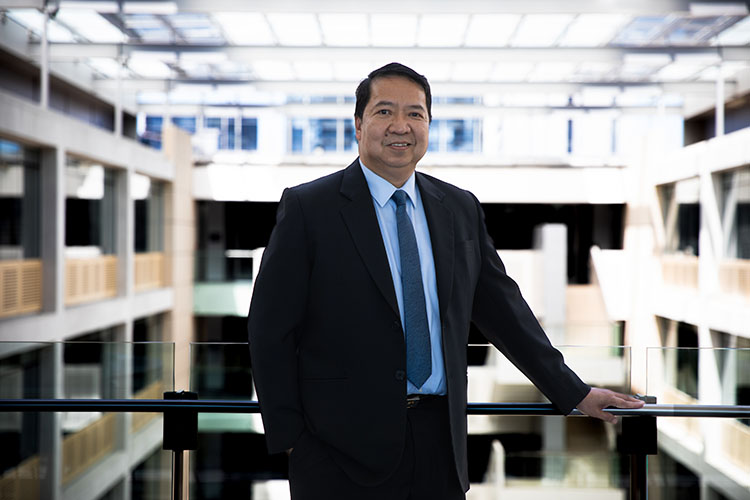
“I would always ask my parents: when will it be my turn to ride in a plane?” he says.
As it turns out, Franklin had to be patient.
His parents had limited means and four children. Scholarships would be key to them receiving a higher education.
For Franklin, that was a scholarship to complete his Bachelor of Science (Statistics) and then a Master of Statistics at the University of the Philippines, which equipped him to work for the National Statistical Coordination Board (NSCB, which became the Philippine Statistics Authority). His job was to conduct research and analysis and to compile the country’s national accounts.
Then came another scholarship – from the Australian International Development Assistance Bureau – to begin his Master of Economics at UNE in 1993, including a Graduate Diploma in Econometrics. Combining economic theory, advanced mathematics and complex statistics, econometrics is widely considered a difficult study subject, but there was some respite.
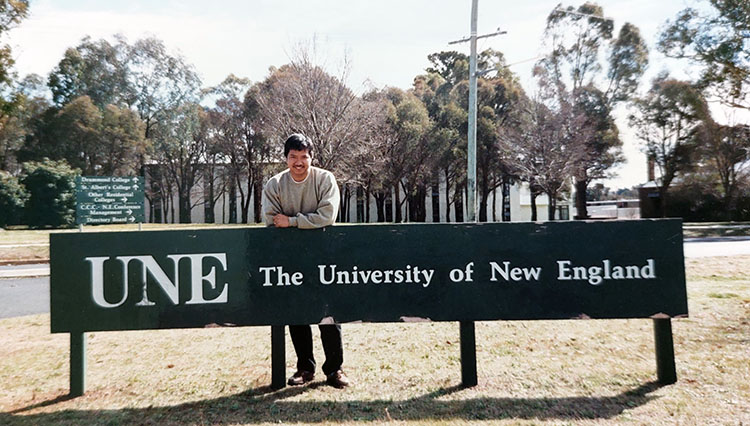 Image: Franklin behind the old University of New England sign.
“Socially, UNE became my second home, staying at the university flats (today’s Wright Village) sharing accommodation with international students from South-East Asia, Bhutan and Africa as well as domestic Australian students,” Franklin says. “I became the President of the UNE Filipino International Student Association (UNEFISA). We had international students’ nights, when we would perform our national dances, and I always participated in UNE International activities.
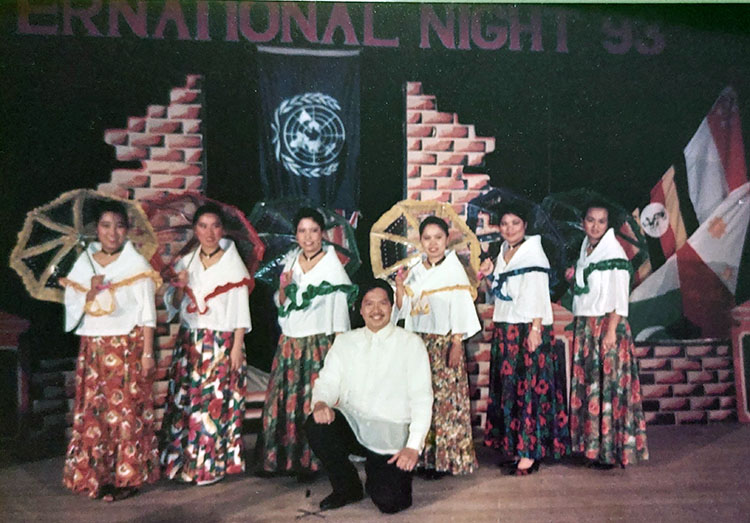 Image: Franklin Soriano front and centre at UNE's International Night in 1993.
“I made a lot of friends from around the world and remain in contact with some in Bhutan even today. Armidale and UNE will always be close to my heart.”
Returning to the Philippines in 1996, Franklin applied what he had learnt to test economic theories, measure causal relationships and forecast future trends for the Philippine Statistics Authority. It was his task to produce official economic statistics on core inflation, regional gross domestic products, mining input-output tables and to pioneer the Philippine Water Resources Accounts.
In 2000 Franklin began a new chapter in his life when he migrated to Australia and settled, once again, at UNE – this time to work at the Centre for Efficiency and Productivity Analysis (CEPA) as a postgraduate PhD scholar and associate lecturer. But the PhD he began was disrupted two years later when CEPA was relocated from the UNE Business School to the University of Queensland’s School of Economics.
Leaving academia in 2004, Franklin joined the Australian Bureau of Statistics (ABS) to begin an illustrious public service career. But just as he was nearing completion of his PhD thesis (on productivity and efficiency analysis) he encountered a final hurdle. However, all was not lost.
“UNE staff from my Masters era encouraged me to start my PhD afresh (on innovation and business performance in the food industry) in 2016, with the current Head of the UNE Business School Professor Renato Villano as my principal supervisor, and the late Emeritus Professor Euan Fleming and Adjunct Professor George Battese as co-supervisors,” Franklin said. “I studied part-time while working full-time at the ABS as an econometrician and statistician, and had my PhD conferred in 2020. It was a PhD 20 years in the making.”
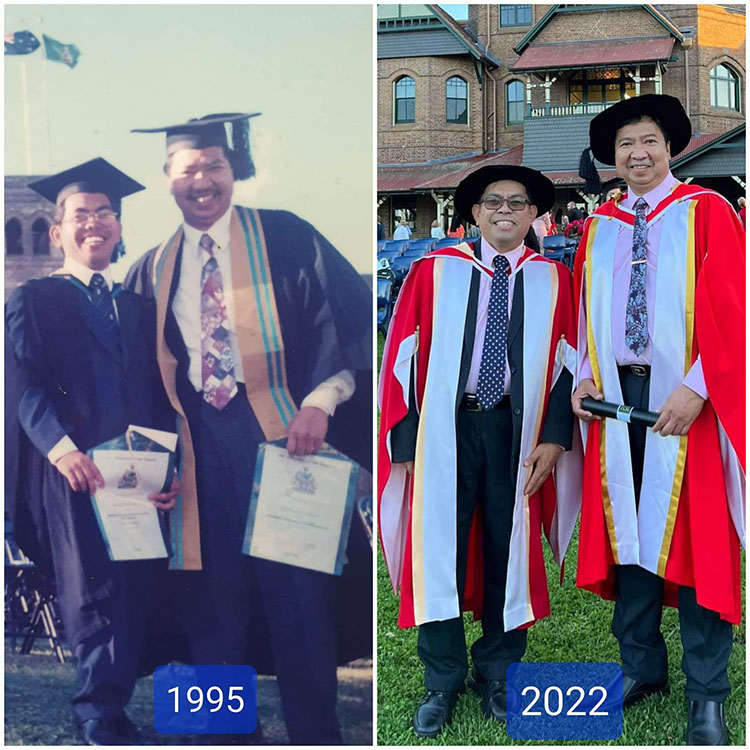 Image: Renato Villano and Franklin Soriano at their graduation in 1995 and together again in 2022.
During his extensive ABS career, Franklin led and managed the Economic Analysis and Modelling program unit. There, he developed groundbreaking methodologies for analysing things like household expenditure and productivity, modelling business microdata, measuring economic and price indexes, and quantifying imputed rent and the energy efficiency of homes.
“The ABS is Australia’s national statistical agency and an official source of independent, reliable information,” Franklin said. “The statistics tell the real story of Australia, its economy and its people by bringing life and meaning to numbers. All the statistics produced were supported by robust statistical and economic methods and went on to inform critical national policies and decisions.”
In a more public-facing role, Franklin was also a multilingual spokesperson for the ABS Census for two census years (2021 and 2026), sharing important messages with Australia’s 300,000-plus Filipino community.
“My face was all over Facebook and even on a poster. I had Filipino friends across Australia saying they had seen me.”
Retiring as Principal Data Scientist at the ABS just a month after the last Census night, Franklin leaves the analysis of that data to others, feeling content with the role he played.
“Some of the methodology that I developed is still being used to produce official statistics and some of the graduate recruits I mentored are now directors at the ABS, which is great. They are my living legacy, along with my son Franko, who lived in Mary White College while studying a Bachelor of Urban and Regional Planning at UNE, also on scholarship.
“My 91-year-old mother is very proud that all four of her children – all scholarship recipients – are now doctors and earning good incomes. But money is just money to me. Education is one of the greatest investments you can make.”


