When Olivia Tierney left the small coastal town of Woolgoolga to study nursing at the University of New England in the late 1990s, she described it as "a really big moment" in her life. She was 18, fresh out of high school, and heading over the mountain to Armidale to begin a Bachelor of Nursing at a university she already knew by reputation.
"I clearly remember that it was absolutely renowned for its quality of the nursing program and quality of the students," she says. "When I used to go on my clinical placements, people used to say, 'Oh, you're from UNE, you'll be fine, you'll be great.' There was this level of expectation."

Image: A young Olivia Tierney during her time as a nursing student at the University of New England in the late 1990s.
Nearly three decades later, Dr Tierney has been appointed as the inaugural Commonwealth Chief Midwife at the Australian Government Department of Health, Disability and Ageing, creating for the first time a dedicated national voice for midwifery.
The UNE program gave Dr Tierney broad clinical exposure across NSW, from Tamworth and Coffs Harbour to Newcastle and Sydney. It was during a placement at Tamworth Base Hospital that her path toward midwifery first took shape. Assigned time in the special care nursery, she found herself returning each day to the same family and their newborn.
"I got to see them every day over two weeks, and see the baby grow and develop, and the parents becoming more and more independent," she recalled. "I think that was the moment I got interested."
After completing her new graduate year, Dr Tierney went on to a Graduate Diploma in Midwifery. That’s when “I absolutely just knew that's where I needed to work”, she says.
In the next two decades, she built a career spanning clinical practice, education, management and strategy.
Her roles included Clinical Midwifery Specialist, Midwifery Unit Manager, educator and lecturer at the University of Newcastle, and senior positions within NSW Health.
"Every one of those roles has contributed in some way to the next role that I have been fortunate enough to be in," she says. "Having that variety and combination of experience just opens your perspective and helps me connect what happens during maternity care with decisions made at a broader level."
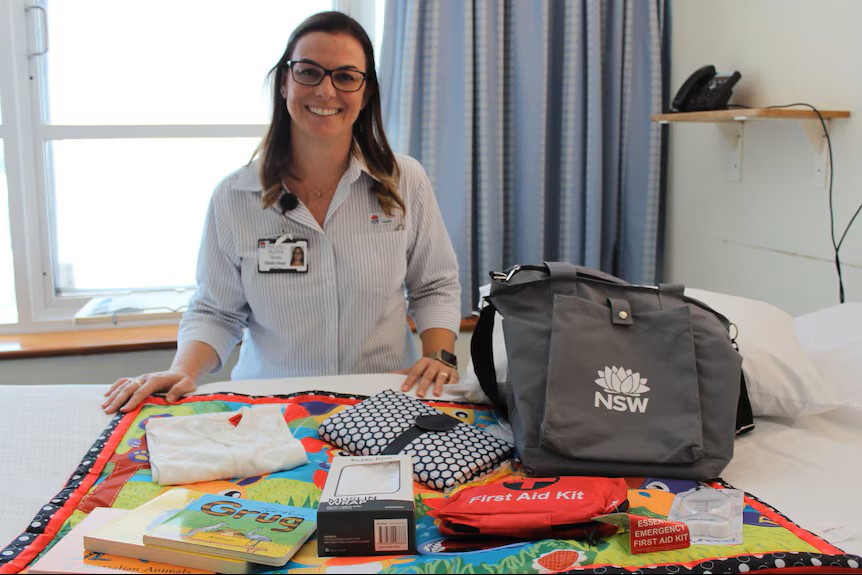
Image: Olivia Tierney during her time with NSW Health, pictured with a maternal and newborn care kit including essential resources for new families.
Her time in education left a particular mark. Dr Tierney speaks warmly about the students she taught, many of whom she remains in contact with today.
"Just when you think you're an expert, there's always something more that you need to understand, or see from a different perspective, and students are just excellent at helping you do that. If you've been part of somebody's midwifery journey and you see them thrive in their own career, I think that's just validation that you're in the right space, doing the right thing."
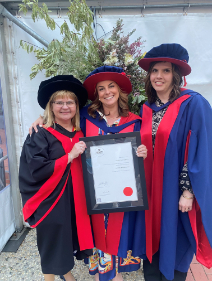
Image: Olivia Tierney (centre) celebrates the completion of her Doctor of Philosophy, at her graduation ceremony.
Dr Tierney’s research journey was a little less straightforward, however. She began doctoral research into student learning in midwifery programs but had to set it aside when the demands of a management role became her priority. .
Years later, she discovered that others were already citing her unfinished work.
"I felt this sense of, 'Oh gosh, people think I'm doing this work, I've got to finish it,'" she laughs.
She did just that, completing her PhD at Deakin University in 2024.
As a Florence Nightingale Global Scholar, and having worked in Canada earlier in her career, Dr Tierney has observed maternity care systems across the world. She believes
International experience has taught me that we should always be curious about how others are approaching the same challenges. Australia has much to contribute globally in midwifery, but we also have much to learn. I’ve been fortunate to have opportunities to connect with midwives and leaders internationally, and what has really struck me is that while our health systems can be very different, many of the issues facing midwifery are remarkably similar.
Whether we are talking about workforce sustainability, strengthening midwifery leadership, education, or enabling midwives to make their full contribution to maternity care, there is enormous value in learning from what other countries are doing.
Now, as Commonwealth Chief Midwife, Dr Tierney's focus is on elevating midwifery at the national policy level. She acknowledges Chief Nurse Alison Macmillan for the leadership that made the role possible and is clear about what the appointment represents for the profession.
"The more that you can enable more midwives to work to their full scope of practice, will mean more women and families can access their care, the impact of that will improve women's experiences, improve midwives' professional identity, and we know that it absolutely improves outcomes."
She remains based in a rural area and sees that as a deliberate and important signal. "It does demonstrate to other midwives who are looking to develop their career or go on a leadership pathway, that it is possible to do that close to home."
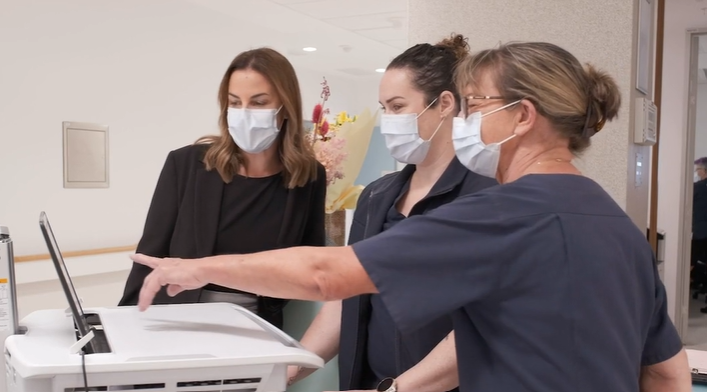
Image: Olivia Tierney (left) engaging with nursing and midwifery staff during a clinical visit, reflecting her hands-on approach to workforce engagement and leadership.
For UNE nursing and midwifery students, her message is simple and direct. "Follow your hopes. What your heart's telling you to do, where you want to be, follow that and trust it. Say yes to opportunities when they come. Be curious.
"I always hope that midwives invest in other midwives. The more that we can grow and develop our colleagues, the more engaged and powerful midwifery will be."
Olivia Tierney completed her Bachelor of Nursing at the University of New England. She is the inaugural Commonwealth Chief Midwife at the Australian Government Department of Health, Disability and Ageing.


