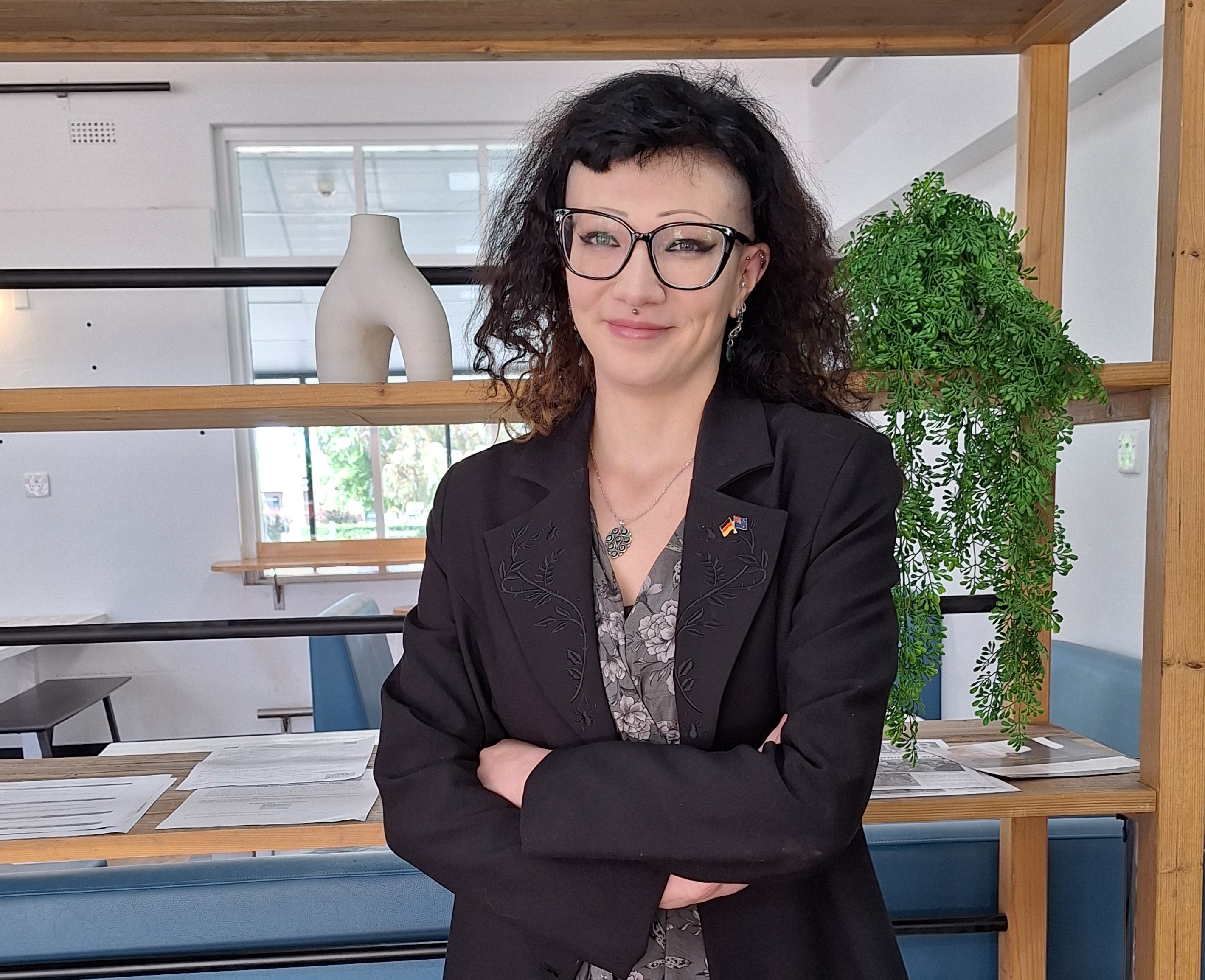
With a UNE history lecturer as a father, Teresa van der Kraan had decided at a young age it was not a path she would follow. Dropping out of high school seemed to seal the deal.
But the passion was there, deep down.
“I just didn’t have my head in the game,” Teresa says, “It took a few life changes to change my mind, and some growing up. At 23 I decided it was time to do something for me.”
That meant starting at the beginning, with UNE’s Pathways to University course (now known as the Foundations Program). The original plan was to move into an archaeology degree from there. But after undertaking her first modern history unit in the second year of her pathways program, Teresa was hooked.
“I really vibed with the humanities side of it,” she says. “I love creative writing – I have self-published a few novels – so I have a good feeling for prose. In modern history studies, I like the capacity to express myself and have an opinion – you can make an argument around an area of your own interest. For me, that ended up being political history.”
In modern history studies, I like the capacity to express myself and have an opinion – you can make an argument around an area of your own interest. For me, that ended up being political history
By this stage, her dad had retired from the department. “But he was very happy I went that way,” she says.
A year into her studies, Teresa was on the VC Scholars list for high achievement, and she had won some prestigious history prizes by the time she’d finished her undergraduate degree.
History had already taken her further than she had imagined. But for her honours research, it also took her to Germany.
“At that point, I couldn’t imagine doing anything else except modern history. I was also learning German, so German history became my research focus.
“My supervisor, Professor Richard Scully, encouraged me to undertake a research trip, which would be the first time I’d do archival research. It was intimidating at first, as each archive uses its own system, so I had to learn through trial and error, and mostly error. But I found some sources, and being in Germany just helped me make sense of little things in terms of cultural context,” she says.
Teresa won the University Medal for that thesis, and one of her markers, Professor Riccardo Bavaj, from St. Andrews University, Scotland, offered to co-supervise a PhD which she started in 2020 with Richard Scully as her UNE supervisor.
It’s hard to put yourself out there as a young academic, so it made a huge difference to have supervisors who advocated for me and believed in my work.
Plans to study for a year at St. Andrews University were dashed due to COVID lockdowns, but she managed to get into Germany instead – and found herself stuck there when Australia closed its borders during the pandemic. She stayed for four years, using her time to teach English and take German classes as well as undertaking her studies.
Despite the isolation of the times, Teresa says a highlight of the PhD was the support she received from her supervisors.
“It’s hard to put yourself out there as a young academic, so it made a huge difference to have supervisors who advocated for me and believed in my work,” she said.
“They were also understanding when unexpected life events happened along the way, including helping me get a six-month extension for my thesis when my father passed away.”
That support has not changed as Teresa has moved into the UNE history department as a casual academic, where she teaches a range of subjects, including a unit run biannually on Weimar and Nazi Germany.
“As a colleague, Richard keeps me up to date with research opportunities, including bringing a couple of history conferences to my attention where I’ve been able to present my research. These conferences have helped me connect with the most fascinating people with shared interests.”
Now, Teresa is proud to also be in the position to be that inspiring teacher. “I love receiving student feedback that I’ve inspired someone to study modern history. For me, it’s a lifelong passion and for history at UNE to remain strong, we need students that share the passion,” she says.
“It’s great to be able to do what I love – there’s nothing better than if your work is genuinely your area of interest.”
Teresa is also awaiting the release of her first book published by academic powerhouse Routledge, based on her PhD studies.


