
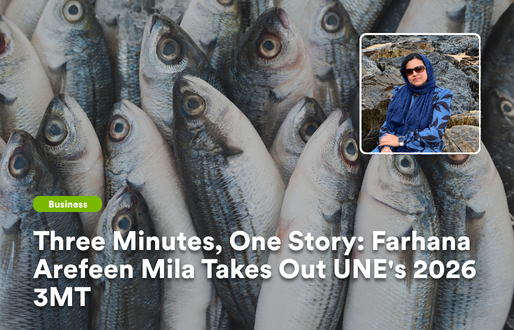
Farhana Arefeen Mila did not open her prize-winning presentation with data or an economic model. She opened it with Rukhsana, a busy working mother in Dhaka who spends her evenings navigating crowded fish markets just to get dinner on the table.
That choice has paid off. Farhana, a PhD candidate in the UNE Business School, has been named overall winner of UNE's 2026 Three-Minute Thesis (3MT®) competition and will represent the University at the UQ 3MT Semi-Final Showcase.
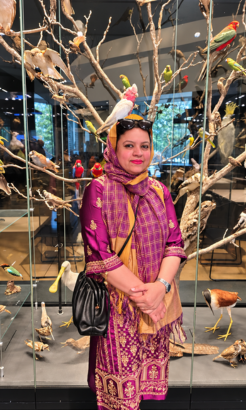
Image: Farhana Arefeen Mila visits the UNE Natural History Museum's bird collection, a quieter moment away from the research and competitions that have defined her PhD journey.
Her PhD examines consumer preferences and willingness to pay for new ready-to-eat, freshly packaged local fish products in Bangladesh, exploring what shoppers value and whether they would pay a premium for convenience.
"I wanted to enter 3MT because it challenged me to explain why this research matters to people beyond my field," Farhana said. She credits her principal supervisor, Dr Emilio Morales, for the encouragement. "He first told me about the competition and inspired me to give it a try."
Farhana grew up in Bangladesh, where agriculture, food and fisheries are closely woven into everyday life. Before coming to Australia, she spent more than a decade working as an academic in agribusiness. She came to UNE with the support of an International Postgraduate Research Award (IPRA) and a Destination Australia Program (DAP) Scholarship.
"My research brings together my academic background, my knowledge of Bangladesh's food system, and my interest in consumer behaviour," she said. "I wanted to explore how innovation could make traditional foods more convenient for modern consumers without losing their cultural importance."
A story, not a statistic
For her 3MT presentation, Farhana chose to lead with character rather than data. "I chose Rukhsana's story because I wanted the audience to see the real-life problem behind my research rather than beginning with statistics or economic models," she said. "Rukhsana represents many busy urban consumers in Dhaka who balance work, family responsibilities, long commutes and meal preparation."
Someone can still love a traditional fish dish, she explained, and simply lack time to buy, clean and prepare it. "Her story helped me turn an academic research problem into something human and relatable," she said.
Fish is closely connected to family meals and livelihoods in Bangladesh, which is why Farhana focused on familiar local species, including Hilsha, Silver Pomfret, Rohu and Catla. "I wanted to explore whether greater convenience could fit into existing food habits while preserving the qualities consumers value," she said.
What shoppers want
Farhana surveyed 400 consumers in Dhaka. Around 70 per cent said they would consider buying the proposed products. "Convenience matters, but consumers also care about freshness, taste, hygiene and price," she said. "Businesses would need to earn consumers' trust through good product quality, clear information and a price they consider reasonable."
Her advice to industry is simple. "Make the product convenient while keeping it recognisably local," she said. "Start with fish people already know and enjoy, then make freshness, safe handling and preparation instructions clear on the packaging."
Three minutes, one message
Condensing her PhD into a three-minute talk was, Farhana admitted, the hardest part. "The hardest part was deciding what to leave out," she said. "A PhD involves years of reading, data collection and analysis, but three minutes gives you room for only one clear message."
Rukhsana's story became the thread that held it together. "It allowed me to explain the problem, the purpose of my research and its potential impact without overwhelming the audience with technical details," she said.
Next stop, Queensland
Farhana says the win has already changed how she sees herself as a researcher. "The experience has given me more confidence to speak about my research with people outside academia," she said. "I hope to keep developing that skill as I complete my PhD, publish my findings and continue teaching."
Her advice to future 3MT entrants starts with a question. "Ask yourself why someone outside your discipline should care about your research," she said. "Then find a simple way to make that problem relatable. For me, it was Rukhsana's story."
And once competitors find their story, she said, they need to understand it, not memorise it. "Practise repeatedly, but don't just memorise the words," Mila said. "When you genuinely understand your message, the presentation becomes much more natural, confident and engaging."
UNE congratulates Farhana Arefeen Mila on her win and wishes her well at the UQ 3MT Semi-Final Showcase.


