
The questions being addressed by the 6th Tamworth Textile Triennial are vitally important. How do we create in ways that sustain, rather than deplete? How do we use technology in ways that shape our lives for better rather than worse?
Weaving sits at the intersection of these questions, as Blake Griffiths and Bridget Guthrie have eloquently written in the exhibition catalogue. So does the University of New England (UNE).
Universities are institutions where new technologies are imagined, examined, refined and shared. They are also places where the consequences of those technologies (for ecosystems, economies, culture) are held up to sustained and critical review. This dual responsibility – to invent and contribute to technological progress, while moderating and critiquing it – is an increasingly important role for universities.
A world in which technological progress has saturated us with information also poses questions for universities themselves. If we carry instant information in our pockets, what then is the role of an institution dedicated to creating and sharing knowledge?
A warning sounded by media theorist Neil Postman in the mid-1980s contains some of the answer. Postman – referring then to television – said that if we are continually bombarded with trivial information, we will lose the capacity to distinguish the trivial from the profound. (He could not imagine how thoroughly we would perfect the technology of trivia.)
Universities are a bulwark against this trend. Throughout their 800-year history, universities have been places where information is turned into knowledge. UNE's mission commits us to an extra step: we transform information into knowledge into human thriving – particularly the thriving of the regional communities of which we are part. Rather than being an ivory tower disseminating its lofty learning, UNE is in a reciprocal partnership with its communities. We share in their fortunes.
As we move into an increasingly technology-mediated world, UNE is working to ensure the regions harness the benefits of technology while remaining alert to technology's possible harms.
As Blake Griffiths notes in his essay in this catalogue, technology is linked to progress, yet the demographic decline of regions worldwide tells us that progress is not equally distributed.
True progress would reverse the decline of human capital in many of our regions, support the flourishing of our Indigenous people, bring robust health to our natural systems, and have our young people go out into the world equipped to exploit its opportunities and be resilient in the face of its challenges. This is the sort of progress that UNE is interested in contributing to.
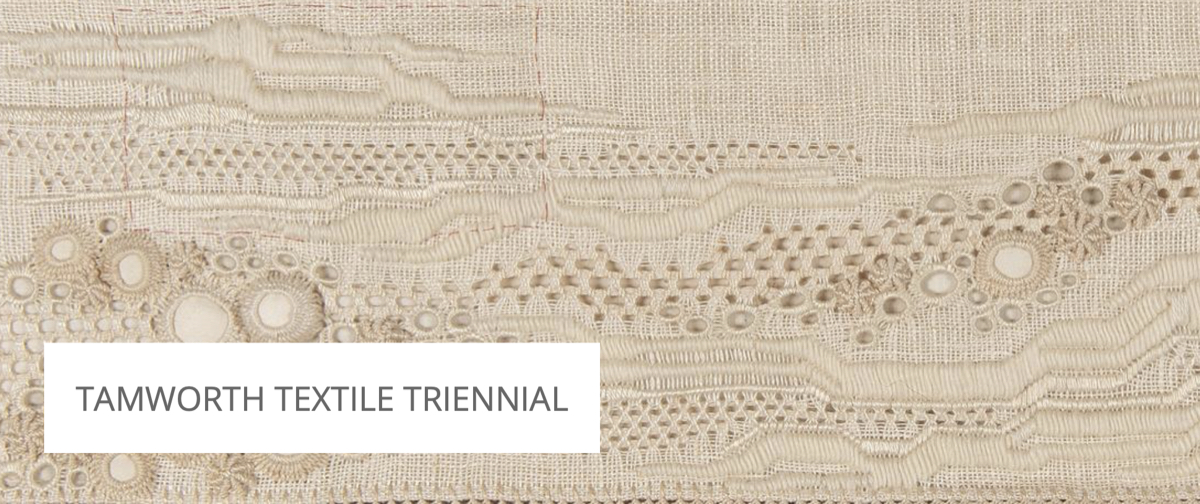
UNE’s support for *Nature Machine: The 6th Tamworth Textile Triennial* and its national tour is part of this outlook. Here we see the full spectrum of responses to technology-as-progress. Some artists have rejected technology entirely, cultivating and harvesting their own natural materials; some pick up technology’s discards and recycle and renew; others are engaged on a thorough exploration of what technology can offer a craft associated with the intimate skills of the hand.
The ideas expressed in *Nature Machine* are another expression of conversations being carried out in laboratories and classrooms, or being conducted online between lecturers and students. They reflect UNE’s long-standing belief that regional cultural institutions are essential to the intellectual and creative life of the nation – a belief manifest in UNE's long-term partnership with the Tamworth Regional Gallery.
UNE thanks Blake Griffiths for the rigour and imagination of his curatorial vision, the participating artists for the quality of their work, and Bridget Guthrie and her colleagues at the Tamworth Regional Gallery for the partnership that has brought this exhibition to audiences across Australia.
In the woven, printed, stitched and coded works that this exhibition puts on display, there is a lot to consider - about nature, about machines, and about the communities we are all working to sustain.

