
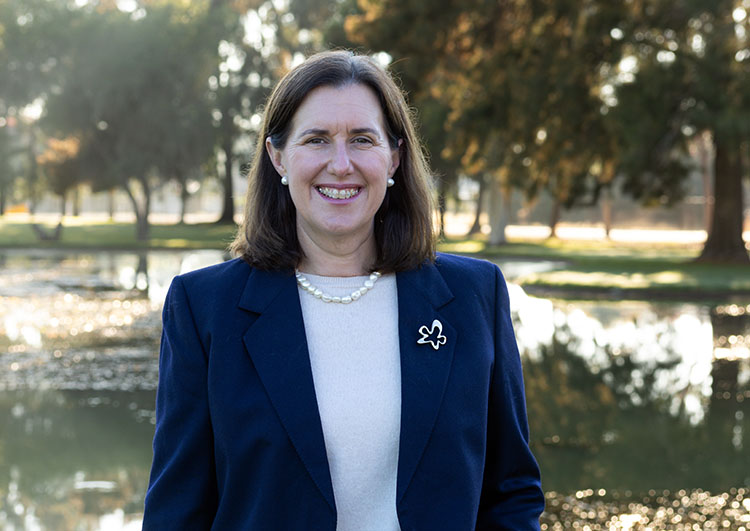
Seventh-generation farmer Georgina Pengilley has long been a fan of woollen garments, growing up on a sheep and cropping property in the cooler climes of Tasmania, attending UNE for her undergraduate and postgraduate studies, and now residing in Armidale.
But her focus is now on cotton as the newly appointed Managing Director of the Cotton Research & Development Corporation (CRDC).
For CRDC, Georgina’s appointment ushers in a new era of research, development and extension leadership. For Georgina, an agricultural leader whose experience spans livestock, grains and irrigated cropping, a commitment to helping growers never goes out of fashion.
“My career has been driven by a simple principle: agricultural innovation only matters if it reaches the paddock, performs under pressure and creates value for growers,” Georgina said.
Fresh from her role as the inaugural CEO of Rice Breeding Australia, Georgina sees synergies between the two irrigation sectors.
“All Australian agricultural sectors continue to face challenges around productivity, sustainability and profitability. Irrigated industries will continue to come under threat as we see changes in policy, expectations and climate. That’s where our research, development and extension work becomes critical to enabling industries to keep operating in environments that are changing rapidly.”
In the landmark Rice Breeding Australia position, Georgina set up a $10 million facility that accelerated the development of new, more water-efficient rice varieties. In previous roles with the NSW Department of Primary Industries and Regional Development across grains, livestock and broadacre cropping, she led investments that delivered practical, measurable, commercial impact for Australia farmers and regional communities.
“Research only matters if it is going to be adopted and create impact,” Georgina said.
“Growers and taxpayers need to know that they are getting value for money. We achieve this by striking a balance between foundational research with universities and industry R&D. Both short and longer-term contributions keep growers in business.”
Little could Georgina have known, back in the early 2000s, how useful her own Bachelor of Science (Honours) and PhD in Plant Physiology from UNE would be.
“Scientifically, UNE equipped me very well. It taught me about problem solving, how to learn, and the mentorship helped me to build connections and networks. In my first decade of professional work and when I ended up back on farm, that scientific knowledge and being able to apply it on the ground brought me full circle. UNE’s reputation has paid dividends for me throughout my career. I hope that my daughter Isobel, who is now studying agriculture and business at UNE, reaps those same benefits.”
A Robb College resident for two years, Georgina said her university studies were “a fabulous experience”.
“We had a great, close-knit cohort and it’s interesting now, nearly 30 years on, how many people I went through university with that I am still connected with. That’s really special and something that is much harder to create now.”
Those connections – and ones built since – enable Georgina to be a strong advocate for agriculture and the role of women at all levels. She participated in the National Farmers’ Federation’s Diversity in Agricultural Leadership Program in 2023. For a decade, she has also been chairperson of the Tasmanian-based Ralston Trust that financially supports university students studying zoology and organisations that assist underprivileged women and children and those with a disability.
“I am aware that not everyone has been afforded the same opportunities that I have,” she said.
“In agriculture, it’s been important for me, particularly through the mentoring programs I’ve done with the Australian Rural Leadership Foundation, to work with young men and women, to help them to access what they need to progress their careers – to build their confidence and have a voice.
“I’m proud to be contributing to efforts that ensure farmers continue to be able to thrive and contribute to the regional communities they’re part of.”
In terms of leadership, Georgina also believes an astute leader knows when to step aside.
“Transition is important in every agricultural organisation, to allow others to come through and build their skills, so they can be the best they can be and continue to ensure the industry thrives into the future. I try to be the kind of leader who enables and empowers those I work with; I see it very much as a partnership. I have no doubt that I might be reporting to one of my mentees in the future.”
The can-do attitude that pervades Australian agriculture gives her great cause for optimism.
“Irrespective of what might be thrown at us, we always find a way to solve the problems we face, whether that be individually, as regions or industries collectively,” Georgina said.
“Agriculture is important to regional communities and to Australia – it matters.”


