
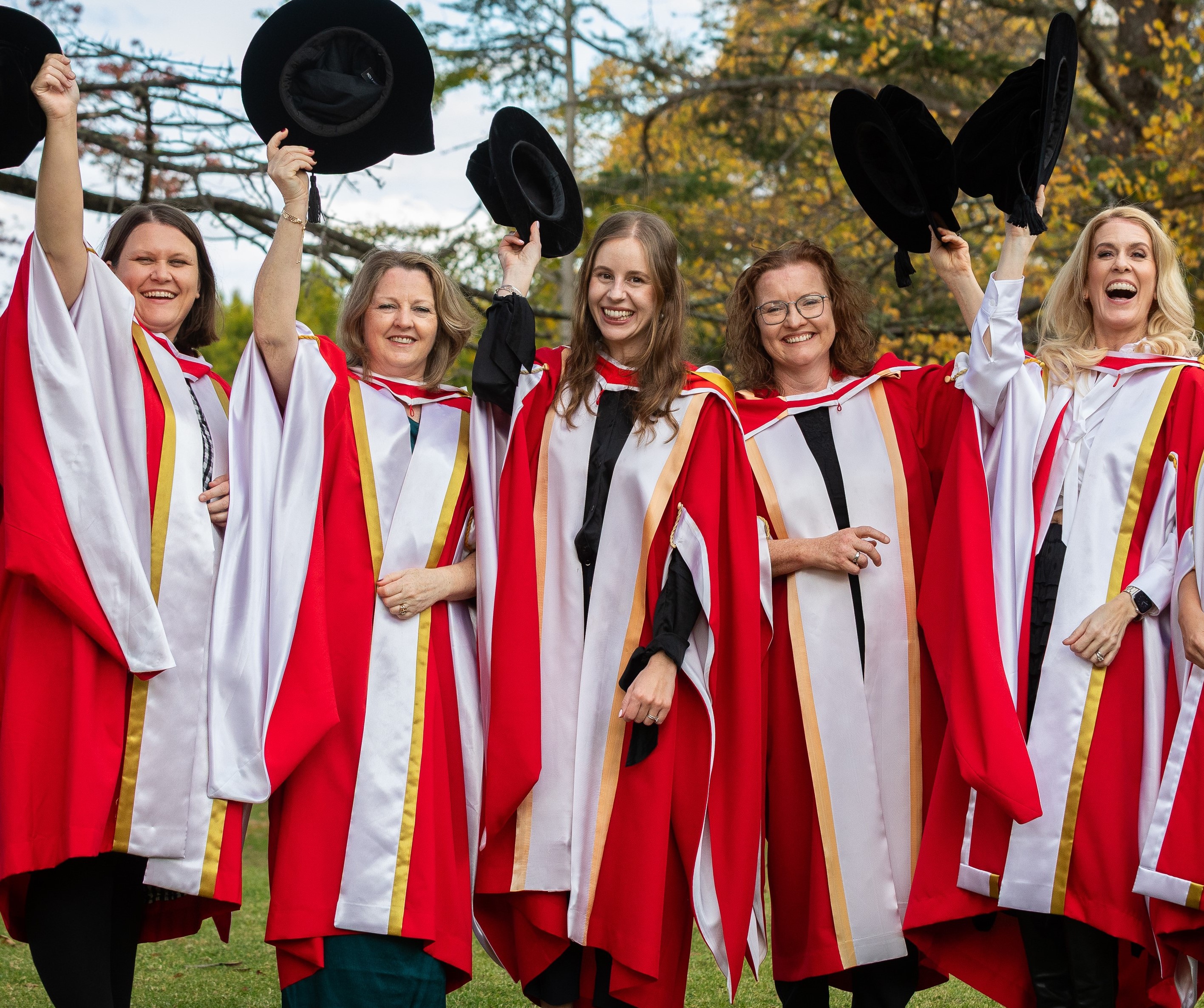
One of the strengths of studying psychology at UNE are the academically rigorous, supported pathways to postgraduate qualifications – and fulfilling careers.
Within the School of Psychology, a record number of recent doctoral students has recently grown the ranks of practising clinicians. And they say their supervisor and UNE’s encouraging approach were critical to their completion.
“Getting students connected and working alongside one another helps to ease issues associated with studying in isolation,” said their primary supervisor, Associate Professor Kylie Rice, Associate Dean Research of UNE’s Faculty of Medicine and Health. “I try to connect students to work in small groups, to provide a level of collegiality and accountability, and support to deliver their research programs.”
The four PhDs also praised the supervision they received.
“Kylie has profound curiosity and incredible expertise in research and study design, and was incredibly skilled at supporting us to structure our time to complete all the components of the PhD,” said Dr Alex McCord, who is now practicing in northern NSW. “She helped me to maintain momentum … and her clinical background shone through with her unconditional support and encouragement.”
Dr Louise Ferraz De Camargo appreciated Kylie’s “calm and reassuring approach” and ability to always see a way forward. “Her unique combination of guidance and support makes her an exceptional PhD supervisor, and I will always be very grateful for her mentorship and the relationship we built over the years.”
At times, Dr Jaeva Shelly said she felt as though Associate Professor Rice believed in her potential more than she did. “All the way through I felt that she was genuinely interested in my thesis and passionate about supporting me to get the most out of it and to progress my career. Anytime I experienced a challenge or problem she responded with encouragement and reassurance.
“It was also very helpful to go through the same demanding process with a peer in a regional area. Stephanie and I could bounce ideas off each other and share the woes and the wins.”
Completing her PhD while also becoming a mother posed additional challenges for Dr Stephanie Banner. “It’s such a journey, full of frustrations and anxiety, but we received constant motivation to keep going, to see it as a marathon. Being partnered with Jaeva in our online group provided me with an anchor. We kept reminding each other there was light at the end of the tunnel and Kylie’s support ensured it was a truly enriching experience. I can’t imagine getting through the PhD without her.”
In the past four years, Associate Professor Rice has had 12 candidates submit their PhD, and was the primary supervisor for nine of them.
“I love PhD supervision because you form an ongoing connection with the students and they do really important, meaningful work that stands to benefit communities and the profession,” she says. “I enjoy seeing them develop as researchers and practitioners, and it is such a privilege to be a part of their journey. We undertake PhDs by publication, so they publish along the way, enabling their work to inform the discipline early on.”
In 2025 and 2026 Associate Professor Rice has maintained the highest HDR student portfolio university-wide and maintains a 100% completion rate as primary supervisor. She was awarded the Executive Dean’s Award for Graduate Research supervision in 2025 and 2026, and the University Award for Excellence in HDR Supervision 2026.


