Generative Artificial intelligence (AI) is evolving fast and challenging what it means to be human.
If you feed this statement into Google’s search engine, AI’s own Overview paints a stark picture: “Generative AI challenges human identity by mimicking cognitive abilities like creativity and language, forcing a re-evaluation of what makes humans unique and valuable”.
While debate has tended to concentrate on the economic and political impacts of AI, it is also redefining that very ‘unique and valuable’ human concept – creativity. The ability to generate new text, images and even music using AI has those in the creative industries grappling with concerns about fakery and fabrication, originality and authorship.
New collaborators
Now, a ground-breaking unit at the University of New England, as part of a new major (Creative Futures) in the Master of Arts, is bringing these issues into sharp focus, to discover how humans and machines can create, together.
Developed by musician Associate Professor Donna Hewitt and writer Dr Ariella Van Luyn, Creativity and AI is giving students a chance to experiment with AI technologies in wildly creative ways.
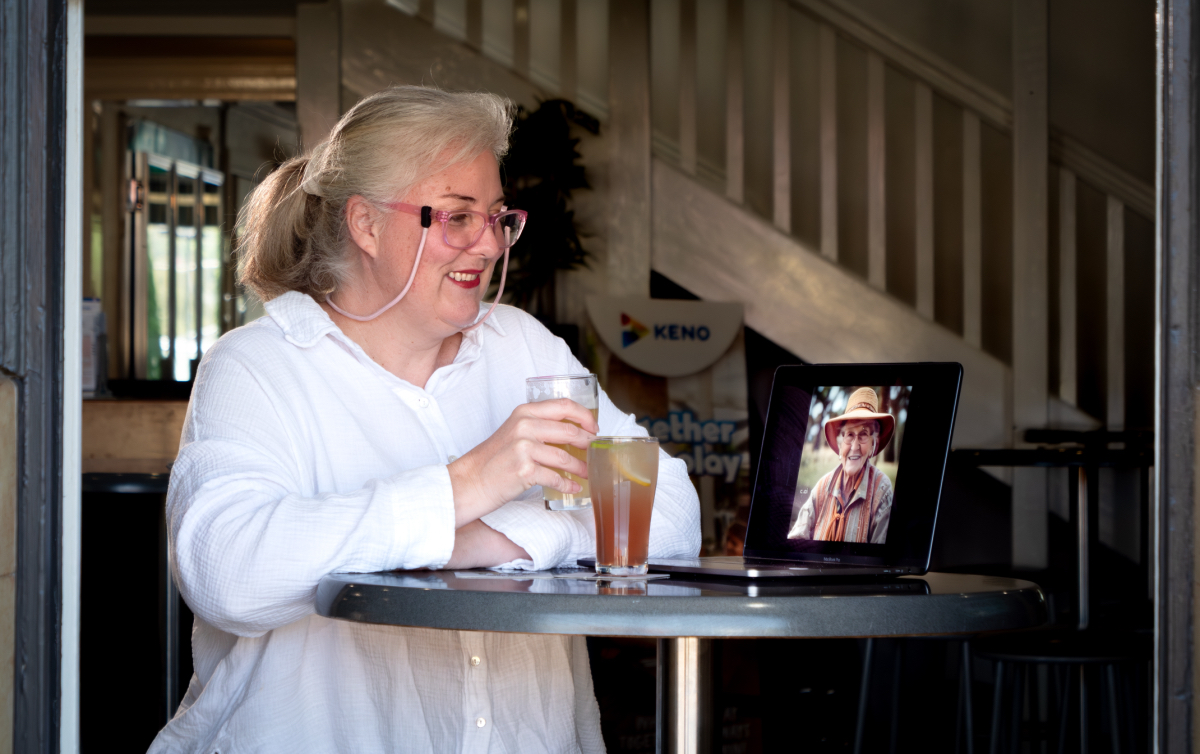
Including performance artist Irene Lemon, who has employed Character.ai to create an avatar based on the best of Country Women’s Association values, named Mrs Dorothy (Dot) Kanasata. The AI filter Justice A.I. GPT gives Dot “ethical and conscientious” character traits in line with modern Australian attitudes, and Irene plans to introduce her to audiences via her comedic country music persona Sheila Knacquers.
“Dot will help me to maintain my connection to traditional audiences and honour the heritage and histories of the values we recognise in country music but also help raise my profile in a new digital space,” Irene says. “People will be encouraged to engage with her as a chatbot, to discuss whether a humble scone can save the world. I would love to get to the stage where I can have Dot on the stage with me, co-presenting.
“Dot has all those country attributes we recognise as Australian – she is forthright, dependable, sensible and pragmatic – but she’s also aware of bias, racism and colonial practice. This all speaks to Sheila’s commitment to tackling bigger social challenges as we try to become better neighbours and Australians.”
Deep thinking
Initially, Irene was unsure where her thinking would land on AI. “I had some initial concerns about the integrity of AI. But it’s critically important to get your head around the technology if you want a portfolio career in the arts and to be part of the conversation.”
Ariella says Irene was not alone in her reservations.
“AI is powerful and deeply controversial in the creative space,” she says. “Some people celebrate it as a revolutionary tool, while others reject it entirely. We are asking students to think deeply about the kinds of ethical relationships they can have with emerging technology. For this reason, Donna and I talked for a long time about whether we should require students to use AI in this subject. Ultimately, we decided that some may wish to conscientiously opt-out, producing a work of activism art that engages with the issues raised by AI.”
Donna has long integrated technology into her own creative practice and she’s been thrilled to see the creative works students have produced.
“AI blurs the boundaries between human and machine creativity,” she says. “Machine creativity makes us rethink what it means to be creative, conscious and human. By challenging their assumptions, students are learning how they can meaningfully, responsibly and critically engage with it.”
The course, offered for the first time this year, includes subjects spanning computing and philosophy, music, theatre, writing, media and communications.
“Students are being empowered to make informed decisions on their use of AI,” says Ariella. “There is a more nuanced, middle ground in this conversation and we feel educators have an obligation to support students to understand the complexities.”
Respecting sources
To overcome concerns about AI’s exploitation of Intellectual Property, several students – including Irene – are training AI on their own artistic output. “I prefer to think of it as me and this machine collaborating to create a third character together,” Irene says. “The technology allows me to expand my practice to include digital performance, and I hope Dot will help me to build my networks and audiences.
“As an artist, it’s my responsibility to reflect what’s going on in society and to give people a way of engaging with it respectfully and safely. There is potential for AI to make a real difference in the telling of authentic, regional stories, and Dot is an experiment in figuring out how to do that.”
That tension between AI’s role in artistic innovation and fears about the potential threats it poses to creativity infuses the new UNE course, which will be offered to undergraduates for the first time in trimester 2 in 2026. “This will be an ongoing conundrum, but we need spaces like this unit to experiment with AI and derive a sense of joy from it, scaffolded by a really strong academic framework and ethical engagement,” Irene says.

