Eight UNE qualifications and counting
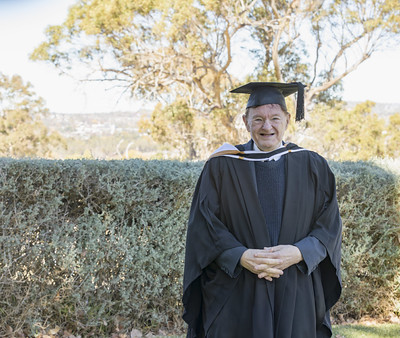 Image: Victor Pigott (Credit: Peter Torning)
28 September 2026
Among the hundreds of proud UNE graduands receiving their testamurs in May was one who knew the drill better than most. Victor Herbert Pigott, a true lifelong learner.
His Bachelor of Historical Inquiry and Practice was his eighth UNE qualification and twenty-fourth tertiary award – that’s seven bachelor’s degrees, seven postgraduate diplomas and 10 master’s degrees, which must be some kind of record.
Spanning education, social science, psychology and history, Victor’s studies with UNE across nearly five decades have not been dictated by workplace requirements or career ambitions but a pure love of learning.
“I suppose it started at school, where I was interested in history, but I have simply studied what interested me at the time,” says the scholar, now in his 70s. “My parents didn’t have one degree between them but always encouraged me to keep learning.”
Sydney-born Victor completed a Bachelor of Arts in History, English and Psychology at the University of Sydney in 1972, straight from high school. He then achieved a Graduate Diploma in Education in 1976 as a distance student while working as a teacher before completing his first UNE degree – a Bachelor of Education – in 1980 in record time with advanced standing.
In 1978, Victor resigned his teaching position to devote his full attention to two more degrees – a Bachelor of Music at the University of Melbourne [his grandmother was a concert pianist] and a Bachelor of Social Science at UNE, which he had begun in 1976.
Moving to UNE’s Armidale campus in 1979 to study full-time for a year, he lived in what were known as the UNE townhouses.
“I was enrolled in two degrees simultaneously, both part-time. Some of my UNE lecturers were aghast, but I managed. I kept mostly to myself but made a few good friends. Country folk are wonderful people – loyal, friendly, broad-minded and full of life.”
It was a juggling act Victor perfected in the years that followed, working again as a teacher before finally leaving the profession permanently in 1989 to undertake a suite of legal degrees at various Sydney institutions – first a Bachelor of Legal Studies, a Graduate Diploma of Legal Practice, a Master of Criminology and then a Master of Laws.
At UNE, Victor would go on to acquire a Graduate Diploma in Tertiary Education (1987), a Graduate Diploma in Humanities (1999), a Master of History (2011), Bachelor of Psychological Science (2017) and Graduate Diploma in Psychology (Advanced), in 2022, enjoying regular visits to Armidale for intensive schools when offered.
“Victor has been a feature of much of my career at UNE,” says Professor Richard Scully, Head of UNE’s Department of Archaeology, Classics and History, who supervised Victor’s 12,000-word Master of History research paper. “I’ve always been impressed by his work ethic and persistence, working across units of study that can be very challenging. I remember him being thrilled that Professor Thomas Fudge was still running intensive schools on campus, something he recalled from the 1980s as an external student under the old system, but not so common anymore.”
Victor’s most recent UNE qualification was one of his most expansive, enabling him to indulge his passions for medieval history, forensic criminology – “a truly fascinating journey through forensic methods used historically by police” – and Australian and European history.
Reflecting on his combined tertiary credentials – including subsequent master’s degrees in art history, forensic mental health, human rights law and international law, and health law, plus a Master of Letters in Holocaust and Genocide Studies (featuring a 28,000-word thesis) – Victor says his academic pursuits chart vast societal and technological change.
“I learnt how to research the hard way,” he says, “using library index cards and microfiche. You had to manually find articles in books and journals in those days; computers did not exist. You then had to photocopy at your own expense. Now we have AI and all sorts of other things to contend with.”
Throughout his studies, Victor says he has been essentially “interested in the human condition”. He is currently halfway through a Graduate Certificate in Neurobiology and Criminology at UNE, taking one unit per semester.
“I view what’s happening in the world today through a variety of different prisms. I came from a highly conservative family, and my studies have been an education in enlightenment and, at times, tolerance. I have an understanding of psychology, law and various historical contexts, which enable me to see patterns today that existed back in the Middle Ages.”
And, as someone who considers university handbooks essential bedtime reading, Victor is always considering what’s next and where.
“As I have limited time left on this planet, it’s time for me to enrol in a pure research degree on an issue I am concerned about. Maybe the NSW victim compensation scheme, which is severely flawed, or the schism in the worldwide Anglican Communion.”
The May conferral of the Bachelor of Historical Inquiry and Practice was Victor’s seventh UNE graduation ceremony – and, he says, even better than the first.
“I’ve been to so many different graduations and it was the best – a beautiful ceremony on the lawns of Booloominbah. I’ve kept coming back to UNE because it’s a very friendly place – the academics and the administrative staff treat you like a member of the family and the rural atmosphere is very pleasant. It’s been a wonderful journey at UNE and I have thoroughly enjoyed myself.”
And one suspects that journey is not over yet.
