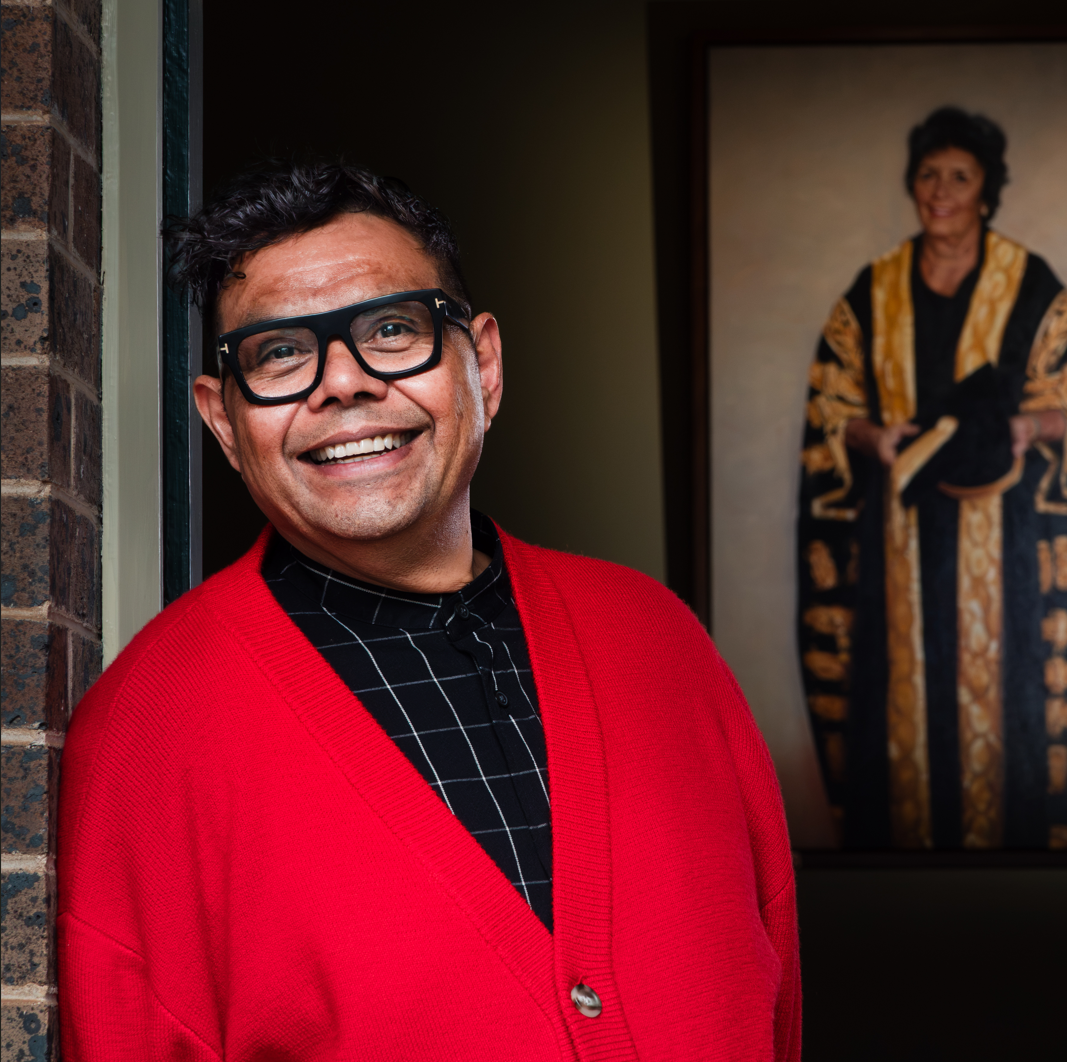
A Warlpiri and Murrinh Patha man, Professor Anderson has worked as a teacher, teacher educator and academic, and has seen what education makes possible when it is treated as a right that belongs to every child.
But by seeing education through the lens of his experience as an Indigenous person, Professor Anderson has long sensed that something is missing in the Western education system and stymieing the growth and potential of young learners from early childhood to the early primary years, which has an impact through adulthood.
Over two new edited research volumes, co-edited by Professor Anderson and published by Routledge, a range of leading scholars and practitioners from a diversity of cultural viewpoints set about exploring what it is that has been missing and how it can be centred and taught. They call it ‘wisdom’.
“Everybody has ideas on how to fix education and do it better,” Professor Anderson says. “It’s the first thing that governments like to overhaul when they come into power. That’s because there’s a prevailing underlying assumption that education is a passive process where knowledge and information is simply transferred from teacher to student and getting that information right will automatically create change.”
But there are important and grounding lessons that cannot be taught simply by knowledge transfer. These, he says, come from wisdom and relatability.
“Teachers are really undervalued in society. Even in the education system, teachers are not actually valued as people who have something unique to contribute to the classroom. They are the conduit for information transfer, rather than being listened to and learned from as people with lived experience,” Professor Anderson explains.
There’s a prevailing underlying assumption that education is a passive process where knowledge and information is simply transferred from teacher to student and getting that information right will automatically create change.
“Likewise for the learner, the curriculum may feed a sense of wonder, curiosity and inquisitiveness for children who have it, but it doesn’t cultivate it.
“Wisdom encompasses how we learn to make decisions based on knowledge of ourselves and consequences. This type of learning is not something static that you know or you don’t – it’s the collection of experiences that you put together that establishes foresight and hindsight and patterns of knowing and decision-making.”
The new books: Teaching for Wisdom in Early Childhood and Primary School Education: Educators' Practices and Pedagogies and its companion Learning for Wisdom in Early Childhood and Primary School Education: Children's Perspectives and Pathways, explore how this broader sense of learning can be incorporated by practitioners – without altering the curriculum.
The writers draw from a range of cultural and wisdom traditions from around the world, including Indigenous perspectives from Australia, Samoa and Latin America and teaching traditions from Russia, Japan and Sweden, for inspiration on how wisdom can be taught through teaching practice.
One of the commonalities across the perspectives that is evident in the books, Professor Anderson says, is the idea that learning is a communal and relational practice, encompassing ethical action, community wellbeing and obligations to others.
“Pedagogies of self-knowing are taught in schools across the world, some based on Indigenous knowledges and others on long-standing philosophical and spiritual traditions. For example, in Russia, education is strongly influenced by a range of philosophical thought. There’s a Buddhist school in Victoria, Australia that focuses on personal growth through conflict management and self-reflection.”
Professor Anderson says teaching from this perspective also centres and values the learner and their unique perspective and experience.
Early childhood and primary students are critical thinkers, they are not just empty vessels needing to be filled with information when they enter the classroom. They have experiences and stories and cultural traditions, but the curriculum doesn’t value sharing this knowledge.
“For Indigenous children, there can be a real tension between how and what they learn from their cultural practice at home, and what they are told is correct at school. This can be very confusing for a young child.”
This issue is not just academic for Professor Anderson. He reflects in his chapter, Enacting Indigenous Wisdom in Education: Beyond Rhetoric to Rights-Based Praxis, on his own schooling, where he was told he wouldn’t continue beyond Year 6 – the extent of the expectation for Indigenous children at the time. He believes the way teaching and learning is largely siloed in the classroom, and the kinds of knowledge valued in education continue to limit the potential of young learners.
“Early childhood and primary students are critical thinkers, they are not just empty vessels needing to be filled with information when they enter the classroom. They have experiences and stories and cultural traditions, but the curriculum doesn’t value sharing this knowledge,” he says.
“Teaching from a wisdom perspective asks not just ‘what do I know’ but ‘how do I know what I know’ and ‘what do I know about myself’. This kind of reflection can be seen as self-indulgent, but you have to know yourself to be part of the world,” he says.
Professor Anderson says the books offer a language and framework that can be incorporated by teachers, as well as a framework for policymakers and a springboard for further research.
“We were able to fill two volumes of content from a wide range of authors. The level of interest from scholars and educators who are working on this same issue of how we can better centre the teacher and the child in classroom learning has been really interesting to me. People are having this conversation, around the globe.”
We are not valuing the agency of children and the skill of teachers in the current structures of learning in the classroom. It takes a lot of skill to engage and read young children and understand what’s going on for them, and we aren’t valuing just how good teachers are at this.
“Imagine what the adult would look like, if we have this kind of learning happening in our classrooms right from early childhood.”
In societies increasingly facing challenges of misinformation and disinformation, teaching wisdom – including instilling a confidence in self-awareness and critical examination – is more important than ever.
“We are not valuing the agency of children and the skill of teachers in the current structures of learning in the classroom. It takes a lot of skill to engage and read young children and understand what’s going on for them, and we aren’t valuing just how good teachers are at this.
“Pedagogies of wisdom transcend academic knowledge, and I think it’s something we’ve largely lost. These volumes offer a range of valuable perspectives on how we can help bring the human back into the classroom, in a way that can help set young learners up for life.”
Teaching for Wisdom in Early Childhood and Primary School Education: Educators' Practices and Pedagogies is edited by Zane M. Diamond (Monash), Peter J. Anderson (University of New England), Kristina Turner (La Trobe) and Eri Mountbatten-O’Malley (Bath Spa University). Order it here.
Learning for Wisdom in Early Childhood and Primary School Education: Children's Perspectives and Pathways is edited by Kristina Turner (La Trobe), Eri Mountbatten-O’Malley (Bath Spa University), Zane M. Diamond (Monash) and Peter J. Anderson (University of New England). Order it here.


