
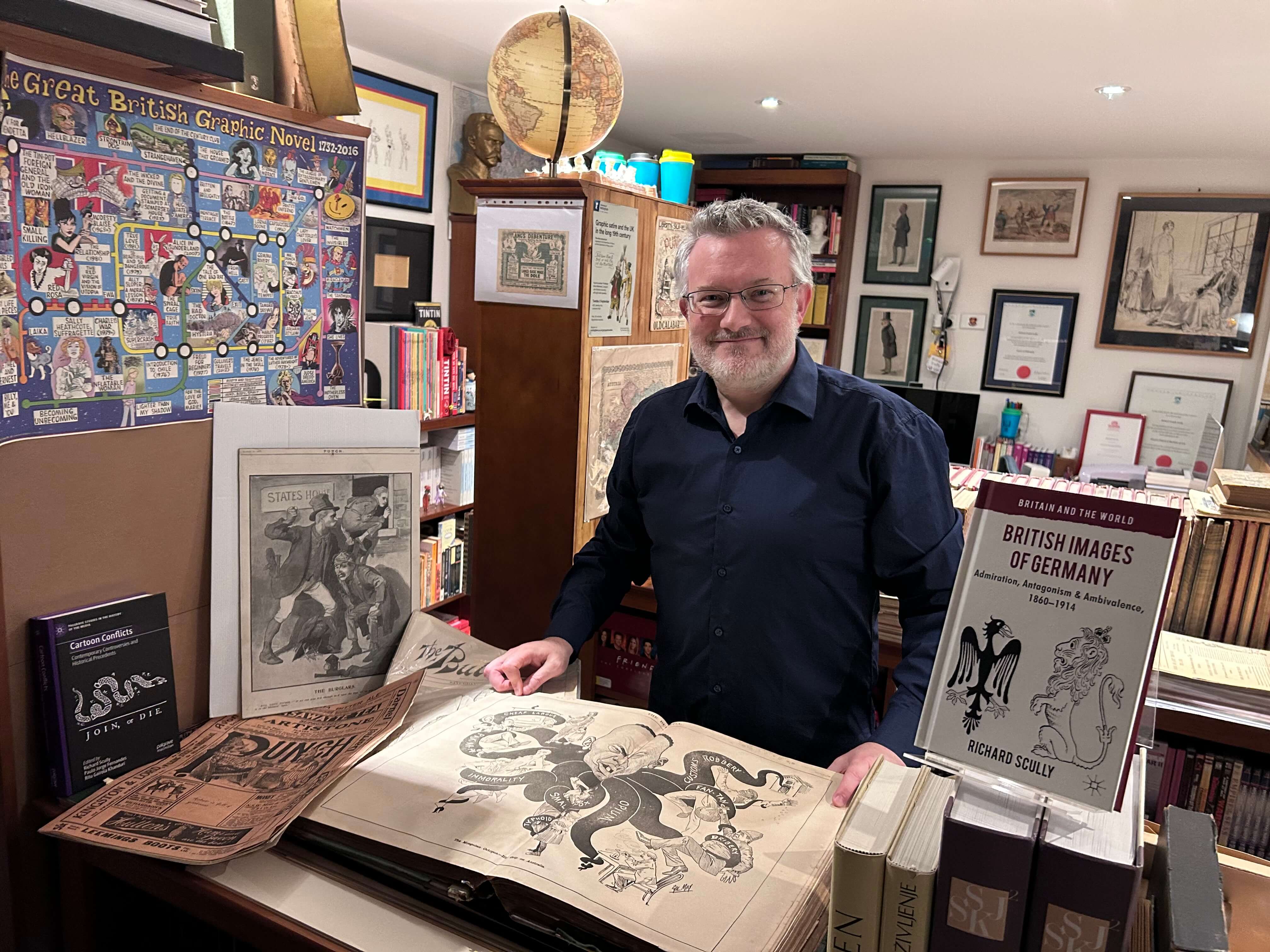
Dr Richard Scully
Professor in Modern History,
Head of Department of Archaeology, Classics and History
As a young boy, Richard Scully devoured Astérix, Tintin and Disney comics and was admonished at school for caricaturing his friends and teachers. Now, as part of his academic research in Modern History, he can freely indulge his passion for political cartoons.
Why are political cartoons important?
Cartoonists are vital commentators. In a few short strokes of a pen, they can enunciate what it would take a writer a whole column to say. Cartoons give voice and structure to what people may be thinking. The late Michael Leunig used to say they give balance – a voice to the voiceless. The imagery is so powerful and immediate.
I’m currently co-authoring a history of Australian cartooning, with Flinders University Professor of English Rob Phiddian, Monash journalism scholar Steph Brookes and Lindsay Foyle, the honorary historian of the Australian Cartoonists’ Association. We are calling it Cartoon Nation, but cartooning in Australia predates the nation. The earliest cartooning was probably Indigenous, of cows and bulls that escaped from the First Fleeters, weird sailors and colonists. Then there’s convict cartooning and colonial cartooning and, as this implies, over the course of more than two centuries there’s been huge shifts in how cartoonists have imagined this country. In fact, they have helped to create and shape our nation.
A strong cartoon challenges you; it provokes debate. It is a crucial outlet for what Rob calls the CAD emotions – contempt, anger and disgust.
Cartoonists hardly ever get called up for defamation because what they draw is usually fair comment. We can laugh or grimace about a cartoon but then reflect more deeply and later discover the true acerbic wit and intellect behind it.
So you see cartoons as legitimate historical records?
Absolutely! And they have been neglected. My entire career has been about convincing historians to take cartoons seriously, not just in Australia but in Britain, America and Europe. To understand the hate campaign against Julia Gillard, John Howard’s constant battles with the Murdoch press, or even the politics of Billy Hughes and Sir Henry Parkes, the Father of Federation, you need only turn to the cartoons featuring them. They serve as good primary sources of public opinion of the time.
Cartoons are important to history, but also important to contemporary life and democracy. In fact, people use the barometer of a flourishing free cartoon press as an indicator of democracy. In parts of Africa, if the cartoonists are starting to come under pressure, you know the place is in trouble, and a dissident Russian cartoonist was murdered earlier this year. We are so lucky in Australia.
You teach some heavy historical subjects. Do cartoons provide welcome levity in your life?
Yes. I say to my kids, you think my dad jokes are bad ... I spend my career explaining dad jokes from centuries ago! Because good cartoons stand the test of time.
Of course, not all cartoons are meant to be funny. Some can be considered vile or gut wrenchingly disgusting, especially when depicting real people. Take the Nazis’ cartoons, or Australia’s long history of anti-Chinese or anti-Irish cartooning. Not nice.
Do you regret not becoming a cartoonist?
Not really. I mean, a professor’s position is pretty well paid and relatively secure. My cartoons were rubbish compared to the brilliance of those who produce cartoons every week or every day. And, sadly, their jobs are becoming more and more precarious.
Why is teaching history so important to you?
History is my passion. It’s my real obsession. Every day I wake up and I think, thank God that our VC, Chris Moran, is still paying me to do my hobby! And when history and cartooning came together, it’s just the best thing.
The first proper history book I read was my aunt’s copy of Modern Times, a textbook about modern history that I’ve still got. In it are all these cartoons from Punch and other 19th and 20th century magazines. And there’s one that was done in 1890 of the German Emperor, Wilhelm II, dismissing Chancellor Otto von Bismarck. If I had to put down a moment in my life when I thought I wanted to study history, it would be when I saw that cartoon and figured out what it meant. I remember asking my grandmother later that day whose job it was to write these books. (She said I could be a historian, for sure, but wouldn’t earn enough money, so should be a lawyer!)
As a historian, you are always trying to find something new and to push the boundaries. I can’t wait to sit down and start reading and writing each day. Don’t tell the Vice-Chancellor, but I would do it even if no one paid me.
Most of my students are not straight from school or studying for work; they are studying history for the love of it. It speaks to them as human beings, as Australians, as global citizens. Sometimes my biggest privilege is helping ignite that passion.


