
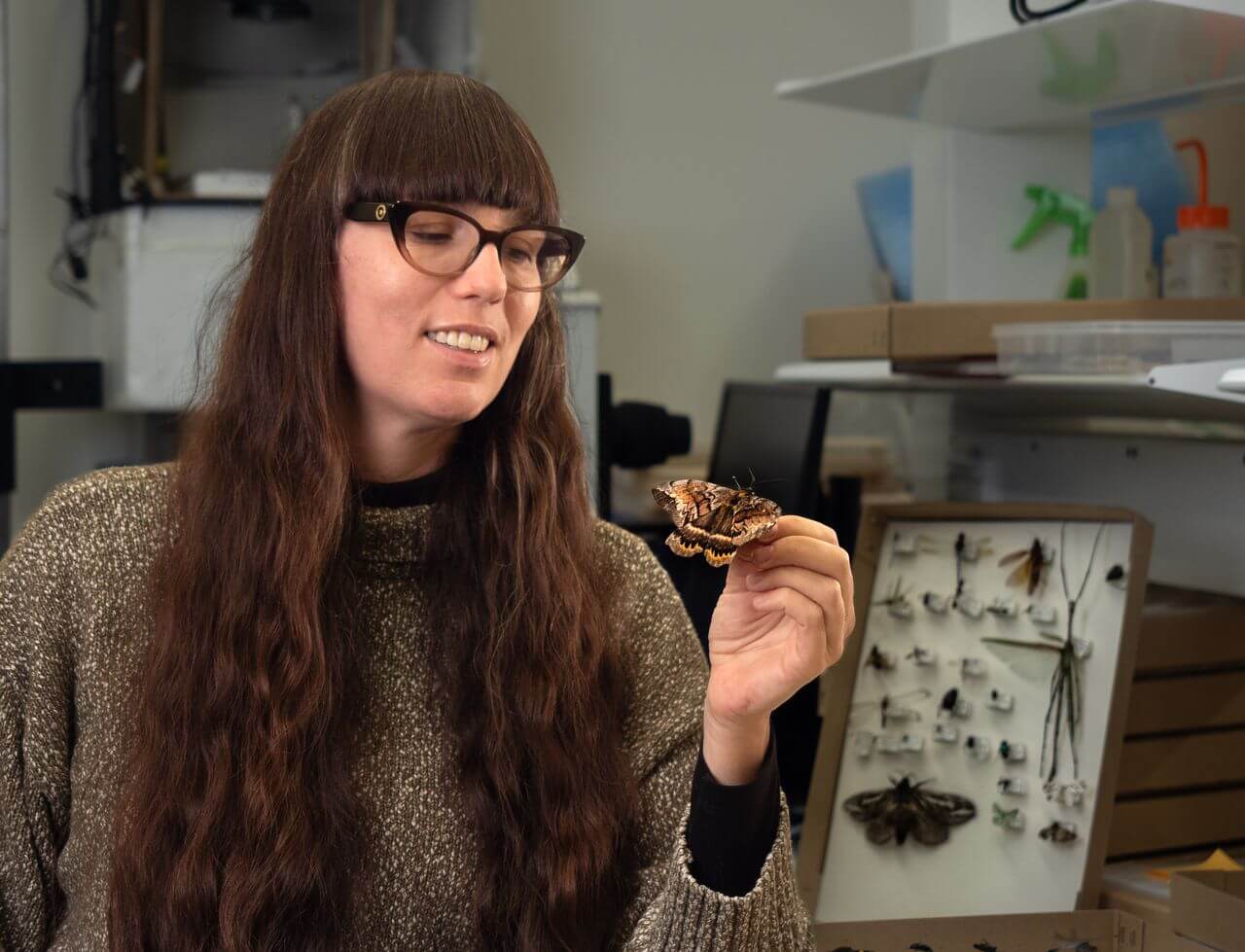
Dr Anna Probert
Entomologist, Lecturer in Entomology and Pest Management
School of Environmental and Rural Science
Why do you find insects so fascinating?
There is so much to learn from insects. There can be indicator species and great models for asking ecological questions that have wide-ranging implications for society. Insects tend to be everywhere and there’s such great diversity, especially here in Australia. They play important roles – like improving soil health and dispersing seeds – so learning about them is critical to protecting what is so special about our country.
I focus on the order Hymenoptera – ants, bees, wasps and sawflies – which are key predators, parasites and pollinators found on every continent except Antarctica.
This group contains many social insects, that work together for the good of the colony. That strength in numbers is one of the reasons why non-native social insect species have been such successful invaders.
So the smallest animals can tell us big stories.
They’re often very underappreciated because they are so small and people can regard them as a nuisance but they play an important role in all ecosystems.
But you don’t just look at the good guys but also non-native species.
Yes, pest insects can impact biodiversity and have harmful ecological, social and economic impacts, even changing the way humans behave and practice cultural activities. I’m part of an international collaboration that’s looking at the cost of non-native species and a member of the EICAT Authority that assesses their environmental impacts under the International Union for Conservation of Nature (IUCN).
Have you had any bad bites or stings?
Oddly, the worst sting I’ve had – from a Macao paper wasp on the Cocos (Keeling) Islands – happened when I was enjoying a leisurely walk on the beach. I wasn’t even conducting field work at the time. The sting on the back of my neck was so painful that I rushed into the ocean and submerged my head.
You’ve recently been teaching UNE students how to gather and curate a collection of 25 insects from their own environment. Why are these collections important?
Learning how to sample, photograph and record data – that attention to detail and precision – is vitally important to science. We get all kinds of cool specimens, from students as far afield as Western Australia, the Northern Territory and Tasmania, so it’s a little treasure trove each year. The collections serve as an important record, a data point for perpetuity. Scientists still refer to collections made by Charles Darwin on the Beagle.
Some students are happy to donate their collections to the UNE Natural History Museum, which enables us to keep assembling a great record of fauna. Every collection, every stick insect or butterfly is important in this era of huge anthropogenic change. Across different spatial and temporal scales, we’re seeing changes to insect populations, and how species look and sound. It all helps us to understand our world and how it’s changing. Their true value may not be fully realised for decades or centuries to come.
Your work has taken you to some interesting places.
Yes, I’ve worked down in the South Australian mallee, looking at how insects respond to fire and environmental disturbances like exclusion zones. On the Cocos (Keeling) Islands in the Indian Ocean, I’ve worked on the Macao paper wasp that can travel on freight ships, and recently went back to Christmas Island, where the insect flora on the island is poorly documented and the yellow crazy ant started causing problems in the 1970s. This species can form supercolonies that threaten iconic island species like the Christmas Island red crab. It’s a really interesting system that is highly vulnerable to invasive species – like the Macao paper wasp that poses a high biosecurity risk.
Why should we all be more interested in insects?
Big stresses caused mainly by human activities are changing our landscapes and climates. It’s going to trigger different responses from different insects within ecosystems and we’re going to have to learn a lot more about insects to be able to manage and safeguard what we have.
I grew up in New Zealand and spent a lot of time outside. I remember keeping Monarch butterfly caterpillars as a child. Insects are a really great way to engage young people with the natural world. It still boggles my mind that some undergo holometabolic development, whereby they go from an egg to a larval, pupal and then adult stage. It’s magical.
I think that’s probably one of the best things about my job – opening the eyes of students to the insect world and inspiring the next generation. I often get emails from students who say they never used to notice insects and now can’t walk down a path without pointing them out. You learn that everything has its place. Encouraging people to develop a good understanding of what’s in their local environment also helps support biosecurity surveillance. It helps ensure a rapid response to something that’s potentially new or foreign.


