Damien Andrew
Senior Technical Officer
School of Environmental and Rural Science
Damien has been described as “the kind of person a university quietly depends on”. We caught up with him just after he was highly commended in the Unsung Hero category of the 2026 UNE Staff Awards.
How did you come to be in this role?
I suppose I watched too many David Attenborough documentaries as a kid! No, I studied a Bachelor of Environmental Science at UNE from 2016 to 2020 and always thought I would love the job of my predecessor, but he’d never leave. Then, after I finished my degree, I got a part-time technical officer role, and he recommended me as his replacement. So it was a little bit of serendipity, I suppose. That was six years ago.
You provide technical support to academics teaching and students studying ecosystem management, zoology and botany. What does that involve?
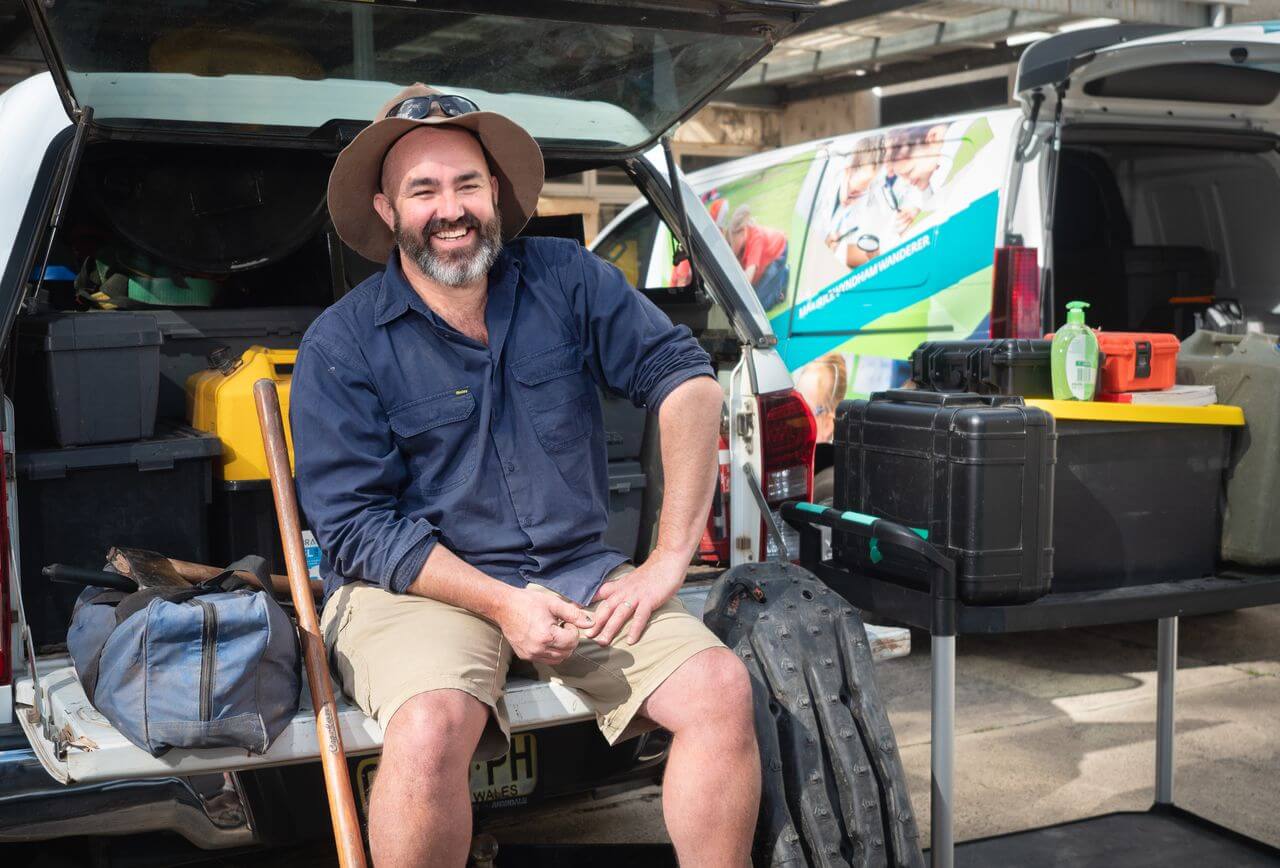
I provide unit support with pracs and tutorials and help prepare for field-based units and research. That involves logistical planning for about 20 local and long-distance trips, intensive schools and on-campus pracs a year. Last year I spent close to 50 nights in the field, 30 of them sleeping in my swag.
It takes weeks to get all the field gear together, handle vehicle bookings, organise the catering and accommodation, prepare field guides, and look after the risk assessments. It’s basically ensuring that the students have everything they need.
I usually drive a vehicle and sometimes cook. We are lucky on the New England Tablelands to have so many different biomes within half a day’s drive. You can be in an arid shrubland or a sub-tropical rainforest in a day. The biggest trip we’ll make this year is to Boodjamulla National Park in the Queensland Gulf Country, which will be a 6,000-kilometres round trip
What happens during the field trips?
These trips are brilliant and not a lot of other universities do what we do at UNE. We get to visit some cool places. Most are only two or three nights, but they can be five nights or longer.
They can be long days in the field, surveying animals or plants from sunrise to sunset, and then processing the samples after that. I help students with their plant identification, but also with camera trapping and animal trapping, like catching turtles and bats. They learn how to both handle and identify the animals and what measurements they need to take as part of the research.
It’s not a relaxing holiday, but you experience different landscapes, different flora and fauna. Even if you are coming back to a place, you always find something different. There’s a real sense of discovery. A massive part of it for me is seeing what the students get out of it. I feel lucky to get to enjoy that and try to be a person they can turn to and trust.
What makes for a successful field trip?
You become experienced at foreseeing the unexpected and need to be prepared for anything, especially when going to remote locations with no power. The number one thing is that everyone is happy and healthy and that they all come home better than they left.
Botany is your special interest. Why?
The sheer diversity hooked me. Plant blindness is a big thing and once you can get past that it’s a whole new world. The myriad ways that plants seek to combat a problem really intrigues me. I’ve lived on a bush block for 10 years and still find new things, depending on the season.
Have you discovered any plant species?
One, I suppose, but I’m sure Indigenous people knew about it for years. A plant in the genus Nicotiana, which is not usually seen on the tablelands. Samples that I collected with [former UNE N.C.W. Beadle Herbarium Director] Professor Jeremy Bruhl were sent to Kew Gardens in London, where botanists working on that group described a new species. It’s quite a unique little plant that only turns up after disturbance, every 10 or 20 years. I just happened to be in the right place at the right time. It shows you that things are out there; you just need to look closely.
Why do you consider your work important?
No one in my family had been to uni before me. When I was growing up, it was never really on the table. I spend quite a bit of time away from my family, but I hope that I show my kids that university is achievable.
There is still so much to learn and discover about our world, and I love being able to share that. This is by far the best job I’ve ever had. Sometimes I’m out in the field, once everything’s running, and I’ll think, ‘Wow. I can’t believe I’m getting paid to do this’.”


