
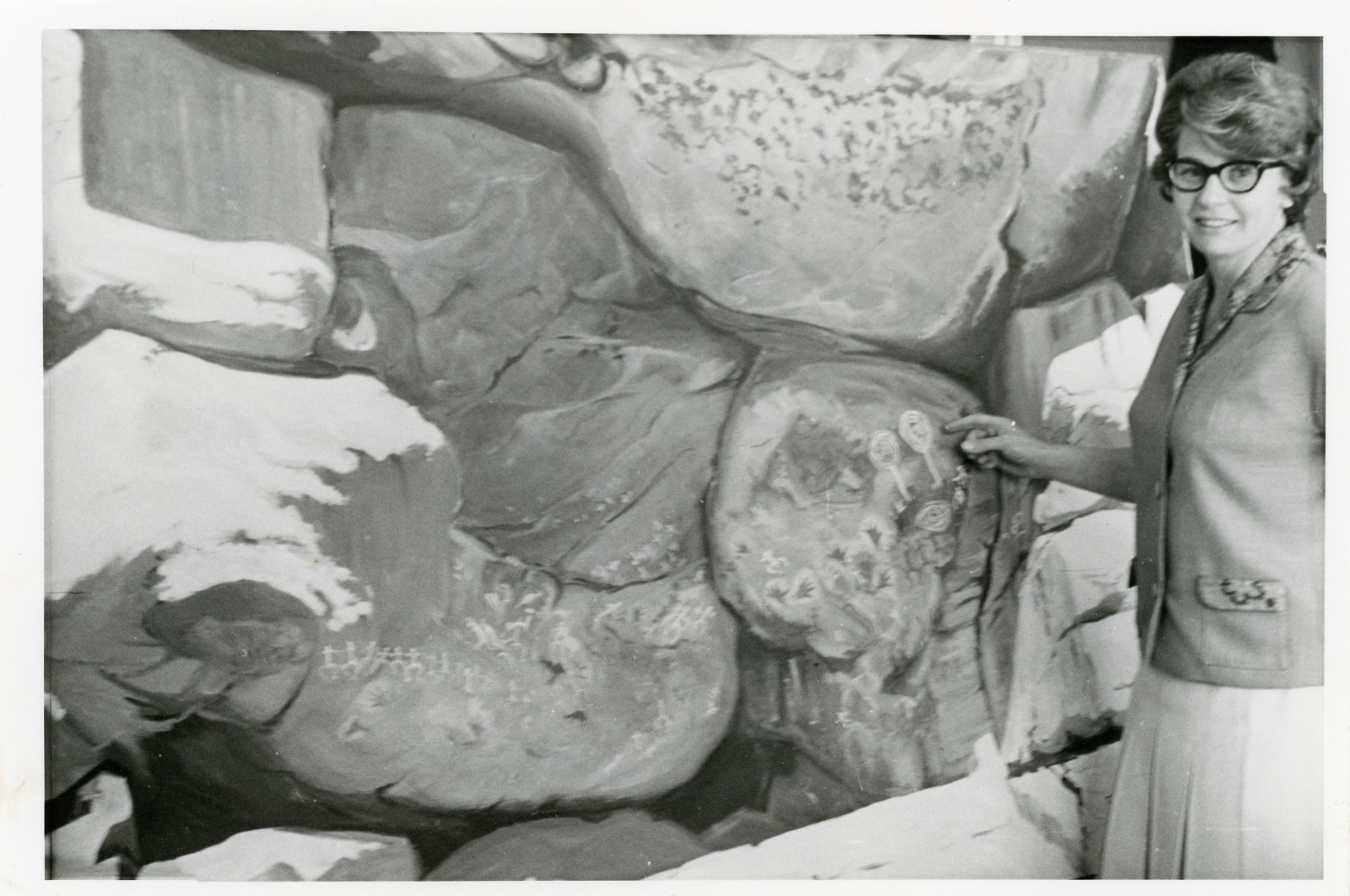
A pioneer of Australian archaeology and first lecturer in prehistory and ancient history at an Australian university (UNE) has died. Dr Isabel McBryde AO was 92.
Widely respected for “altering the course of the discipline” and championing the rights of Indigenous communities to their heritage, Dr McBryde is being remembered as an inspiring mentor, thorough investigator, unconventional thinker and prolific author.
Her modest “twinset and pearls” demeanour contrasted with a fierce commitment to radical thinking about Australia’s past and how it should be documented and conserved. As well as valuable field discoveries – including tracing Aboriginal stone axe trade routes – Dr McBryde was a strong advocate of cultural heritage protection, the joint Indigenous management of Uluru and the return of Indigenous remains to Lake Mungo, in western NSW.
“Isabel was very active in the field of historic archaeology and historic heritage conservation. She did the first field study of Aboriginal occupation in Australia, in the New England and down to the coast,” says one of her early UNE students and field assistants Sharon Sullivan AO, who went on to develop some of Australia’s earliest protocols for cultural heritage management. “She was pivotal in changing the way that archaeology was done, at a time when most archaeologists were only interested in Australia’s ancient past and didn’t see any connection between that and modern Aboriginal people.
“Isabel had a more holistic, integrated view of what she saw as cultural landscapes and all the history imprinted on them. She consulted and engaged Aboriginal people, which was a radical practice in the 1960s, and one of the projects she helped lead was a statewide effort by the NSW National Parks and Wildlife Service and the Institute of Aboriginal Studies to record Sites of Significance to ensure their protection.”
Back in 1960, Dr McBryde arrived at UNE fresh from completing an archaeological qualification at Cambridge University and postgraduate studies in ancient history at Melbourne University. She was charged with establishing UNE’s archaeological teaching and research, despite not having a PhD. The doctorate she subsequently completed at UNE in 1966 became the first on Australian archaeological fieldwork to be awarded and her courses the first formal training to be offered in archaeology in Australia.
Fostering a new archaeological field largely concerned with our Indigenous heritage – at a time when many considered Aboriginal society “primitive” – meant testing and challenging long-held assumptions.
In Dr McBryde’s own words, she sought to involve local communities in the study of “their own regional history from archaeological evidence” and was “grateful for their willingness to share local knowledge with an outsider”. She built close relationships with Aboriginal Elders and became a vital link between their communities and formal institutions, contributing to national conversations about connection to Country and the ethics, ownership and protection of cultural material.
The more complete geographical and ecological picture that Dr McBryde composed – captured in her book Aboriginal prehistory in New England – showed that archaeological evidence could reveal the complexities of Aboriginal knowledge and society, including relationships with land and resources. “Unless our archaeology … addresses social questions, unless it is ‘peopled’ archaeology, its representations will lack dimensions of meaning as pasts, as history,” she wrote in 1996.
Early Masters student Michael Quinnell – a retired senior curator with the Queensland Museum who recalls one particular white-knuckle ride in her white Alpha Romeo – says his supervisor was at the vanguard of a major shift that created an archaeological record as well as the narrative that accompanied it. “Dr McBryde showed that culture was about people and not about things,” he says.
After moving to the Australian National University in 1974, Dr McBryde became the Chair of Prehistory in 1986 and worked at ANU until her retirement in 1994. Stepping into the breach as a lecturer in what was then known as UNE’s Department of Prehistory and Archaeology was Emeritus Professor Iain Davidson.
“I soon realised they were very big shoes to fill,” he says.
Isabel represented the last of that pioneering generation (which also included Jack Golson, Peter White and John Mulvaney) who set up the discipline of archaeology in Australia. She had established goodwill for Aboriginal archaeology at UNE and across the New England, which was quite an achievement in the 1960s, and went on to train three generations of Australian archaeologists.
“Dr McBryde was a much loved and revered member of the cultural heritage community who gave Aboriginal people an important voice.”
Former UNE zoology and arts student David Horton, who went on to create the Encyclopaedia of Aboriginal Australia and the Aboriginal Australia map at the Australian Institute of Aboriginal and Torres Strait Islander Studies, says Isabel was “quite a woman” who explored new territory in a formerly male-dominated and competitive field.
“As one of the first major women archaeologists in Australia, Isabel inspired many of the women that followed. She was a very warm and thoughtful person, who actively supported my career and celebrated my successes for 30 years.”
As her own career progressed, Dr McBryde became heavily involved in heritage advisory committees, notably for the Australian Heritage Commission, the World Heritage Commission and UNESCO.
In 1979, she was elected as a Fellow of the Australian Academy of Humanities and, a year later, was made an Officer of the Order of Australia for “her service to education, particularly in the field of Australian Prehistory”. Dr McBryde received a Centenary Medal in 2001 and was awarded the Australian Archaeological Association’s highest honour – the Rhys Jones Medal for Outstanding Contribution to Australian Archaeology – in 2003. The medal citation read: “Few people have created such an enduring legacy for Australian archaeology. She has touched the minds, hearts and actions of virtually the entire Australian archaeological community. She is celebrated by students, Indigenous communities, colleagues and friends.”
While many recall her sharp intellect, it is for her warm friendship and mentorship, as well as her humility and integrity, that Sharon Sullivan will remember Dr McBryde best.
“Isabel never saw her research as any more important that her contribution to Aboriginal welfare in terms of giving Aboriginal people recognition of their own past. She carried this into all her research and social practice in the community.”
UNE awarded Dr McBryde an honorary doctorate in 1992. And while the mobile field laboratory she set up in an old horse float is long gone, the Archaeology Department’s laboratory will soon be officially named in her honour.


