
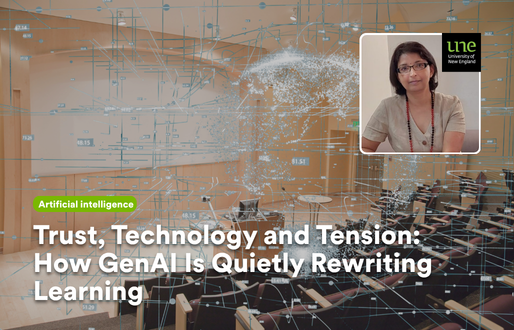
When UNE Business School academic Nina Bhardwaj began interviewing students and lecturers about generative AI, she expected to hear mostly about cheating and detection. Instead, she is uncovering a quieter, more complicated story: AI is reshaping what learning feels like from the inside.
With UNE ethics approval, Bhardwaj is midway through a qualitative study, interviewing students and faculty across Australian universities about how they actually use tools like ChatGPT in real courses. Rather than analysing policies, she is listening to lived experience.
“Currently, AI’s use in education is framed as a question of academic integrity,” she said. “But based on my ongoing research with students and teachers, that’s not the real story.”
Students describe AI as everyday infrastructure. They use it to brainstorm ideas, structure assignments, refine drafts and check fluency. It has become a workflow companion rather than a one‑off shortcut.
“Students are prioritising efficiency over depth of engagement,” Bhardwaj explained. “They use AI to structure their thinking, not just generate answers.”
They use AI to structure their thinking, not just generate answers.
This shift brings a new kind of tension. Universities warn about AI and academic integrity, yet employers expect AI‑fluent graduates. Policies differ by unit and lecturer, leaving students to define their own ethical boundaries, often based on risk and social norms rather than clear, shared rules.
On the other side, lecturers are trying to keep assessments meaningful. Many are redesigning tasks, experimenting with oral defences, in‑class work and process portfolios, while wrestling with a nagging doubt: if AI can help any student produce polished, citation‑rich writing, does a strong assignment still prove real understanding?
Bhardwaj’s early findings suggest a growing decoupling of learning and performance. High‑quality work no longer guarantees deep comprehension, and detection tools are too unreliable to carry the load.
Yet she resists the language of collapse.
“What’s emerging is a system in transition, not a breakdown but a recalibration,” she said. “AI is not replacing learning. It is reshaping what learning looks like.”
AI is not replacing learning. It is reshaping what learning looks like.
Her developing AI Trust–Authenticity Co‑adaptation Model argues that students’ trust in AI and their sense of academic authenticity are evolving together, while institutions struggle to keep pace.
For Bhardwaj, this leads to a simple but demanding challenge for higher education:
“The question for universities needs to move away from ‘Should students use AI?’ to ‘What do we actually want students to learn in an AI‑enabled world?’”
Her ongoing research aims to help universities answer that question with the nuance and urgency it now requires.


