
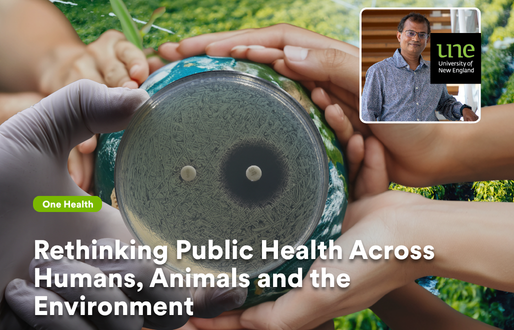
Antimicrobial resistance (AMR) is often described in numbers: millions of deaths, rising resistance rates, and shrinking treatment options. But Associate Professor Md Shahidul (Shahid) Islam’s recent work reminds us that AMR is really a systems problem – and that systems problems need systems solutions.
In his scoping review on artificial intelligence and AMR within a One Health framework, Islam and colleagues argue that AMR cannot be solved by focusing on hospitals alone. They write that the One Health approach “integrates human, animal, and environmental health to address AMR’s complex and interconnected drivers across ecosystems.” In practice, this means recognising that resistant bacteria move between hospital wards, farms, wastewater, wildlife, food chains and communities.
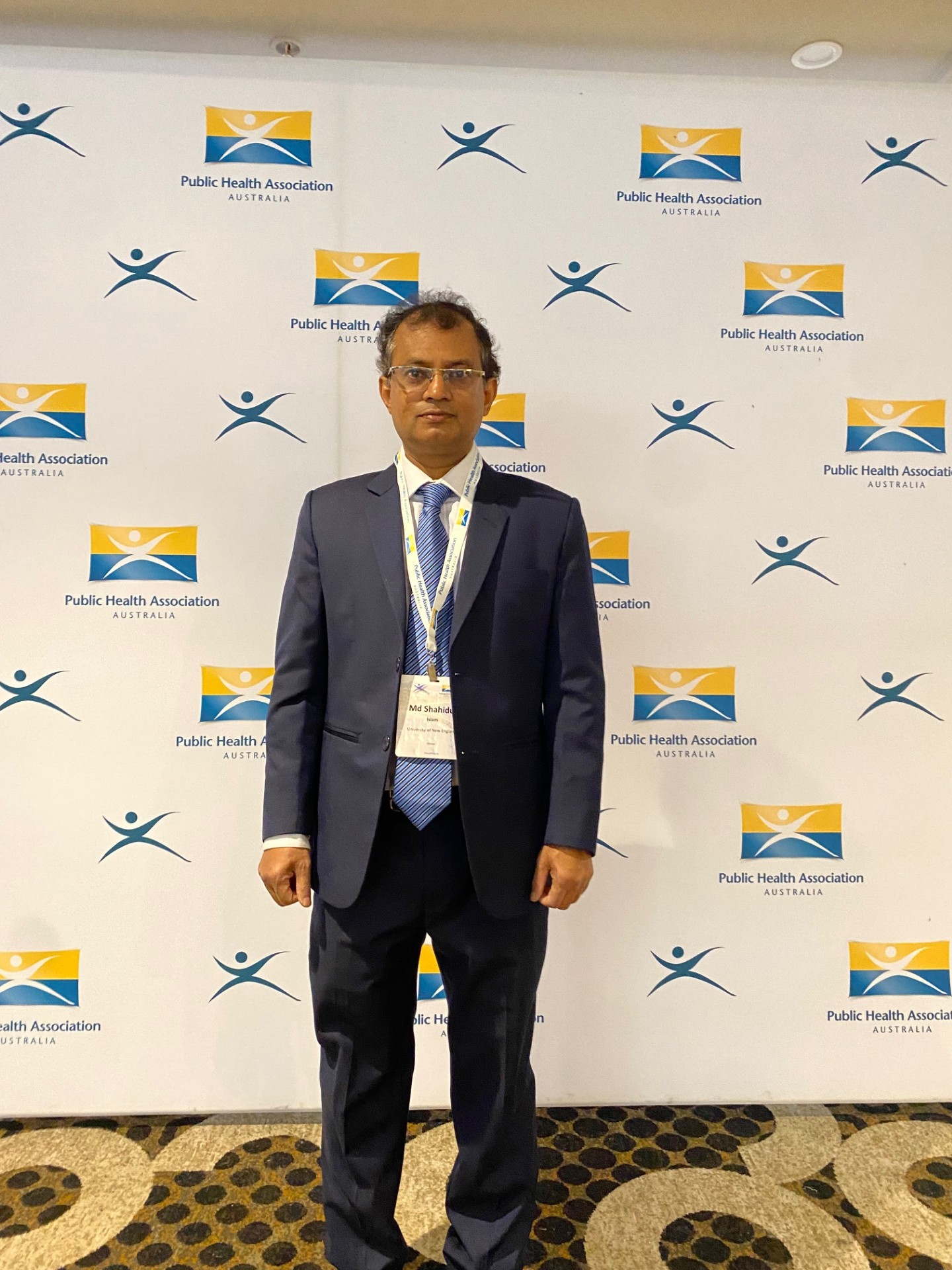
Image: Associate Professor Md Shahidul (Shahid) Islam representing the University of New England at the 2025 Australian Public Health Conference.
His comparative meta-analysis of AMR in food-related sources makes that interconnection tangible. Reviewing 40 studies, the team found a pooled prevalence of resistant bacterial pathogens of 45% across food sources, with “38.2% of isolated bacterial pathogens… resistant to three or more antimicrobials.” High resistance was seen in Salmonella from ready‑to‑eat foods and fish, E. coli and Staphylococcus in meat, dairy and slaughterhouse environments, and Campylobacter and Enterococcus in poultry systems.
From a One Health lens, these are not separate problems. As Islam’s food‑systems paper puts it, AMR is “a systemic outcome of interconnected human, animal and environmental food systems,” exacerbated by “the transmission of resistant pathogens through various food sources.” Antimicrobials used to promote growth in animals, untreated effluent entering rivers, and informal food handling practices all feed back into human health.
At the same time, his AI-focused review is cautiously optimistic. It highlights “AI-driven biosurveillance platforms [that] aggregate and analyse data from human, animal, and environmental sources, delivering real-time alerts and outbreak predictions.” These tools can help identify resistance hotspots, guide targeted interventions, and support better antibiotic stewardship across sectors. But the authors are clear that this promise will only be realised with “investment in explainable AI, better data infrastructure, stronger cross-sector collaboration, and clear regulatory frameworks.”
Taken together, Islam’s work frames One Health as both a scientific and governance shift:
- Scientifically, it asks us to combine clinical microbiology, veterinary science, ecology, data science and social science.
- In governance terms, it calls for “multisectoral collaboration, emphasising the control of foodborne transmission” and new forms of data sharing and joint decision‑making.
For professionals who want to work at this intersection, the University of New England’s Master of Public Health (One Health) provides a structured way to build that expertise.
Delivered fully online, UNE’s program focuses on exactly the kinds of challenges Islam describes: understanding how infections move “where humans, animals, and the environment interact,” assessing impacts on health and economies, and developing One Health approaches to surveillance, diagnosis, prevention and control. Students can tailor their studies with minors in Environmental, Organisational or Global Health, and complete a real‑world action research project that applies One Health thinking to a concrete problem.
Entry is open to graduates from a wide range of disciplines – including public health, veterinary, animal, biological, environmental and social sciences – and the course is available online for international students, with multiple intakes each year.


