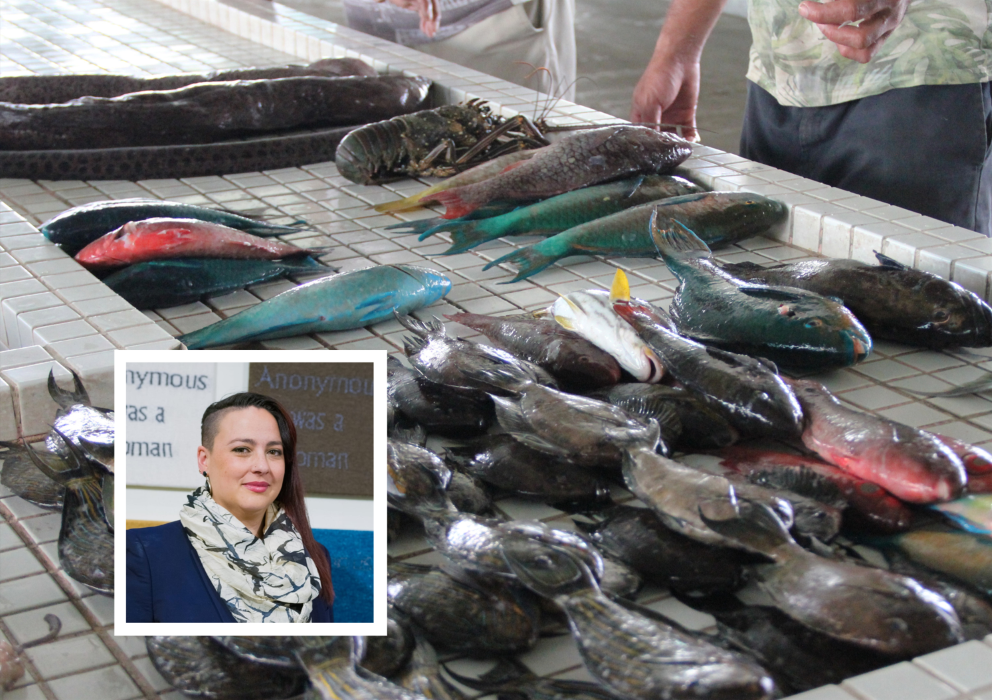
For Samoa, like many developing nations, fishing and agriculture are the backbone of society: they generate income, drive everyday activity and shape family life and culture.
These are skills learnt from generation to generation: Boys learn how to fish or farm from their fathers. Women learn how to collect shellfish or manage crops from their mothers, and other life skills along the way.
But, in recent times, gender research has been uncovering biases, inequality and discrimination in these processes and attitudes, particularly experienced by women. And, more recently, UNE research has been uncovering stories and challenges faced by people in Samoa who identify as non-binary, or people of diverse sexual orientation, gender identity and/or expression (SOGIE), whose lives are shaped by fishing culture, practices and industry.
A culturally-safe approach
Recently published in the Springer Nature Journal Agriculture and Human Values, this research into gender diverse experiences in the Samoan fishing industry, led by UNE gender researchers Dr Christina Kenny and Dr Erika Valeria alongside Samoa’s Dr Fetaomi Tapu-Qiliho, and funded by the Agricultural Centre for International Agricultural Research (ACIAR), was a pilot study in 2020 using an Indigenous Knowledges framework – with interviews led by in-country researcher Dr Tapu-Qiliho, who shared firsthand cultural experience and the ability to converse in Samoan, where preferred.
“This approach is unusual in fisheries research, but Fetaomi’s personal experience and knowledge of the Samoan culture and language was critical for people to feel culturally safe,” Dr Kenny explains.
“We also used a bespoke queer methodology to listen to and interpret the participants’ narrative in interviews – that is, listening carefully for non-normative perspectives and information on how gender diverse people experience the world. This approach helps surface sensitive, context‑driven narratives that structured interviews would likely miss, highlighting the importance of relational trust, flexibility, and local validation in research with marginalised groups.”
Dr Kenny says a particular challenge in uncovering stories from SOGIE people is the cultural taboo around breaking gender norms, and in some areas, the fact gender non-conformity is not just marginalised, but also criminalised.
“So a challenge with this work is to ensure we can keep SOGIE communities safe while advocating for increased support and investment for them,” she says.
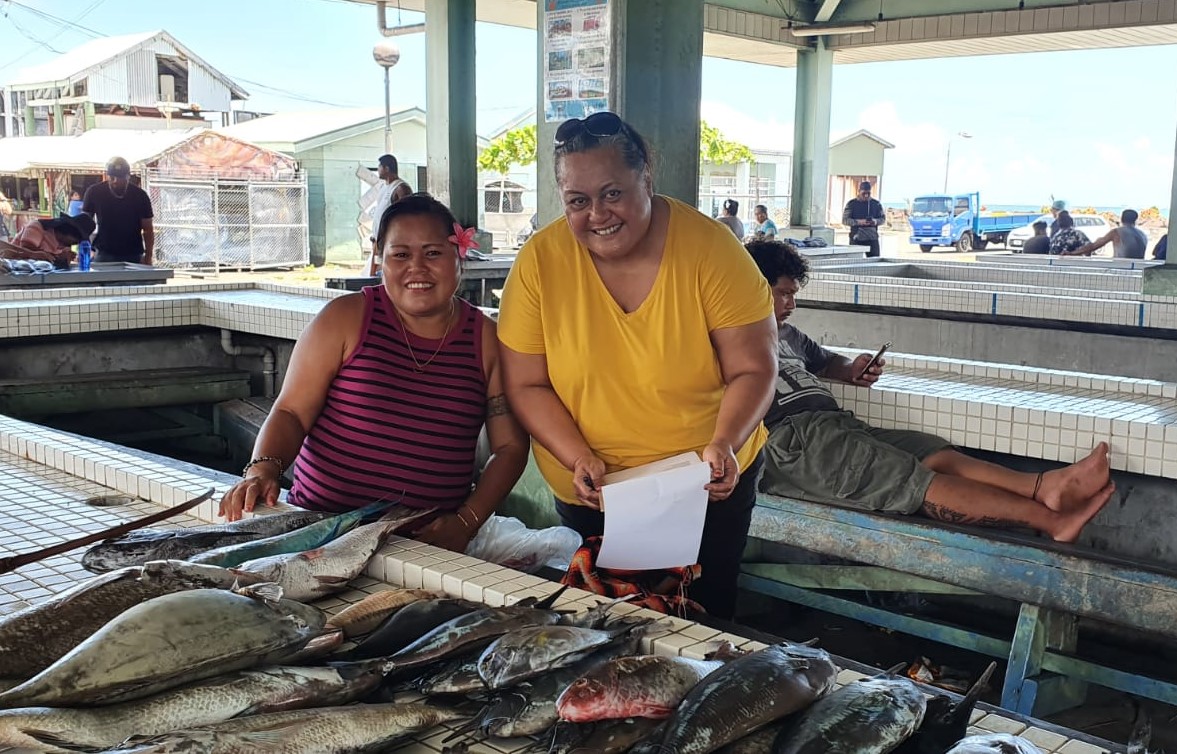
Image: Dr Fetaomi Tapu-Qiliho interviews a market seller in Samoa
Uncovering gender bias
Typically, Dr Kenny says, research around fishing and farming has the aim of supporting businesses to be more productive.
“That’s not a bad thing,” she says, “but it also often inadvertently reinforces patriarchal systems, for example men tend to win grants, because you often don’t get grants if you don’t own land – and men own the land, which is passed down from father to son down the generations. So there’s a bias in support, for people like women who often can’t meet these barrier conditions,” she says.
“Feminist researchers have been uncovering these issues, but this pilot project in Samoa demonstrated people who sit outside the gender binary have skills and contribute to subsistence fishing and fishing value chains too, but likewise, their contributions are often invisible and so their opportunities are limited.”
Through the interviews, the researchers found that although the experiences varied, for many the skills and knowledge of SOGIE individuals were accepted and valued within these very narrow, prescribed areas of life. But even then, their roles were limited and defined according to gender norms.
“Fa’afafine – or male bodied people who take on diverse combinations of traditionally feminine dress, affect and roles,often inherit roles framed as ‘feminine,’ such as cooking and market sales, yet are typically barred from deep‑sea fishing, which is a culturally understood as a more masculine role.
“Conversely, fa’atama – female bodied people who adopt culturally masculine dress, gender expression and roles – can be involved in culturally masculine activities like deep-sea fishing, but often lack recognition in village or policy circles.
“Lesbian and bisexual women sustain gleaning and retail niches that are indispensable to household food security, yet are unacknowledged in development agendas, and, with fa’atama, can face serious and endemic discrimination, violence and exclusion."
The team found non-binary people in the industry may have their own business sidelines, but typically draw on family networks for income, capital and equipment, and remain largely excluded from formal training, credit schemes, and policymaking processes that continue to operate through a narrow binary lens.
Recommendations for change
Dr Kenny says for meaningful change to occur, SOGIE people need to be formally recognised in the industry.
“Our practical recommendations are that policy frameworks must, where safe and possible, explicitly include SOGIE individuals in training, microfinance and governance,” she says. “Ideally, village-level governance bodies should enable people of any gender identity to access fisheries workshops and credit schemes, and SOGIE organisations need to have genuine partnerships in the industry where they are able to inform safe, appropriate and fair interventions to protect and encourage the vocations of SOGIE individuals.”
Dr Kenny would also like to see follow-up research in future to track such changes, such as whether targeted microfinance or training schemes are successful in unlocking new opportunities for SOGIE individuals, and corresponding research in other Pacific nations.
As a direct outcome of the work, Dr Kenny and her colleagues are also now holding a series of Queer Ruralities International Workshops, to hear the experiences of non-binary people who engage in paid or unpaid farming, fishing, or agriculture work, and who live in regional, rural or coastal areas. They will be held at UNE Sydney and in Germany later in the year, to build an international evidence base of lived experience in a sensitive and supportive way.
“In an international climate of increasing hostility and violence toward LGBTQA+ people this work supporting people of diverse sexual orientation, gender identity and/or expression and their communities to thrive is only more urgent,” Dr Kenny says.
Gender scholarship
Dr Kenny says more scholars are engaging internationally with experiences in the lives of queer people, and UNE is helping to prepare researchers for effective and sensitive research with non-binary communities through targeted gender studies units.
“Our gender studies units at UNE are about challenging the assumptions we all walk around with, and probably haven’t thought about or questioned before,” Dr Kenny says.
“We look at gender from different perspectives, including through the lenses of philosophy, politics and English literature. We encourage students to bring their own disciplinary training and perspectives, and we help them to look at how knowledge is made in that discipline, and how that is gendered.
“We provide the analytical tools for students to be able to ask questions and look at the underlying gendered assumptions in what we do every day and in how we think.”
She says far from being simply theoretical, this knowledge has real and important implications for the lives of others.
“With greater awareness of the assumptions and gender biases we hold, we can begin to minimalise marginalisation, rather than replicating it,” she says.
More


