Students across agricultural and animal science degrees at UNE are developing confidence handling livestock via virtual reality and koala researchers are breathing new life into much-needed conservation.
The two teams behind these projects have been recognised with the 2025 UNE 3Rs Award for advancing ethical animal research. It applauds efforts to either replace, reduce or refine (3Rs) the use of animals, in accordance with the Australian code for employing animals for scientific purposes.
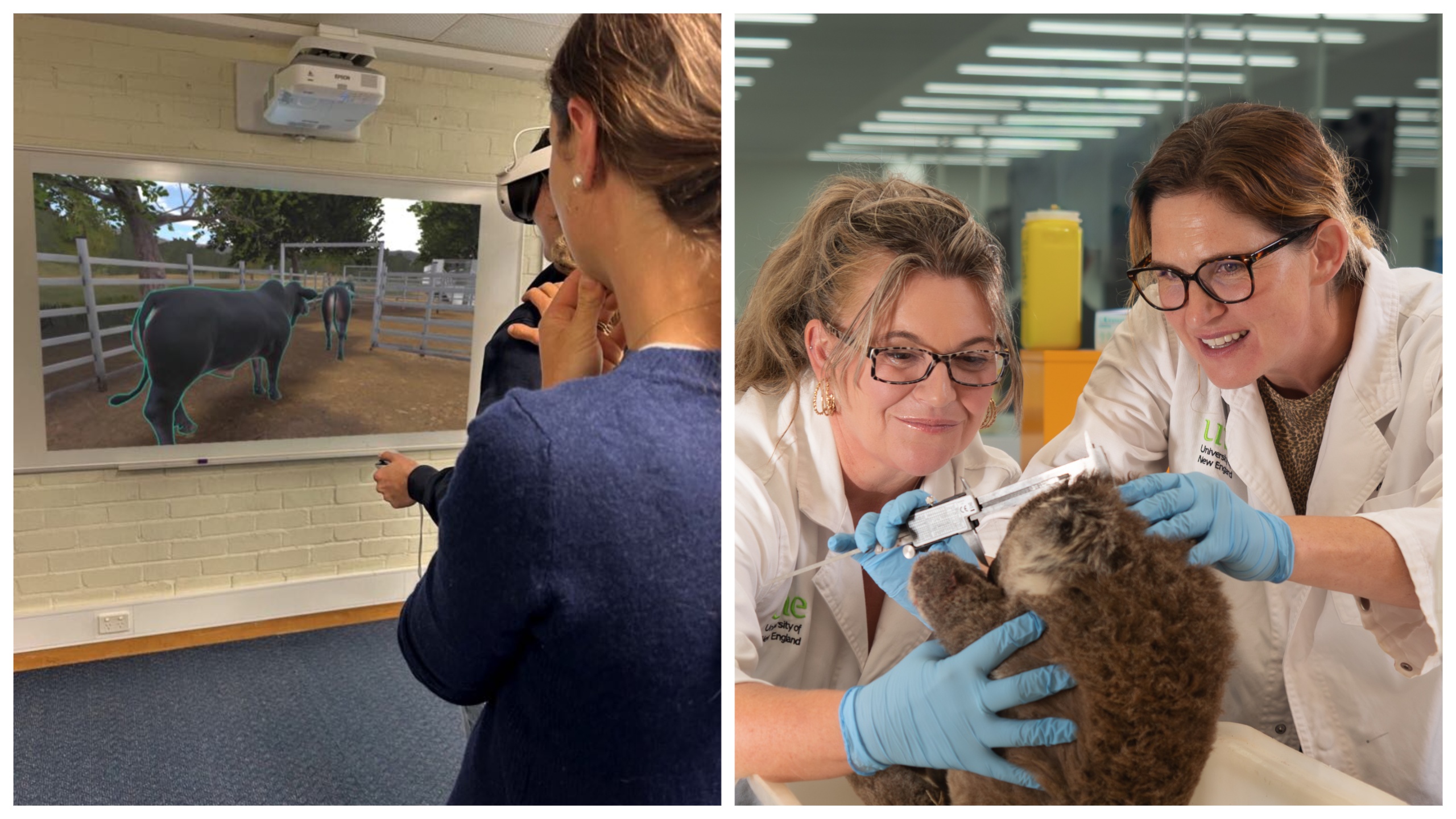
In UNE’s agricultural department, students are learning low-stress livestock handling methods – without the stock – thanks to the team of Dr Jessica Monk, Dr Emma Lynch, Dr Tellisa Kearton and Dr Amy Tait. In the comfort of their classroom, students don a virtual reality headset to practice managing a computer-generated herd of 1-15 Droughtmasters, courtesy of a program developed by Think Digital and Adelaide University.
“This is not a replacement, but a valuable and safe tool for preparing students for the real thing,” said Dr Monk. “They enter a virtual environment and learn about the best handling positions, blind spots and flight zones, and the immersive experience is shared with the entire class on the big screen.”
While the chance to handle live animals is a major drawcard of studying at a regional university like UNE, this can be a scary experience for the uninitiated. CattleVR simulates the behaviour students might expect, without the inherent risks.
“I can also see VR’s potential applications for learning in pig and chicken sheds, where there may be biosecurity concerns,” Dr Monk said.
Over in UNE’s School of Environmental and Rural Sciences, koala researchers Dr Heidi Kolkert and Dr Amy Tait are bringing critical koala conservation to life, and educating a new generation of veterinarians, using dead koalas. These donated cadavers – generally the victims of road accidents – are yielding data that could prove vital to protecting their species. Data that would be impossible to gather from live animals, and from across a vast geographic area.
“Collecting samples from live koalas is time-consuming and expensive,” said Dr Kolkert, Senior Lecturer and Collections Manager with the UNE Natural History Museum. “We are making the most of a terrible situation by using the dead animals to support a large program of research in collaboration with Koala Conservation Australia, Southern New England Landcare and Local Land Services.”
Samples collected support this new regional research into the prevalence of chlamydia, chronic stress, internal parasites, gastrointestinal microflora and the impact of microplastics. They also contribute to the Australian Museum’s world-first efforts to sequence the koala’s 20,000-odd genes.
As a bonus, vets from across the New England and North West have the chance to learn about koala anatomy from the specimens, to improve their future koala care.
“The koala vet course we have integrated into the research program gives vets the chance to improve their basic knowledge, perform external health assessments and learn about the nuanced anatomy of koalas in-situ,” said Dr Amy Tait, a researcher and Senior Lecturer in Animal Science. “By merging this clinical training with our research into koala health and genetics, we ensure that every specimen advances both scientific understanding and the skills of our regional clinicians. Ultimately, this work ensures that, even in death, these koalas are contributing to the survival of their species.”
All this research and learning is possible because, unlike many other universities, UNE has a natural history museum that can receive specimens and manage 3R principles across the research spectrum. In an ultimate closing of this loop, koala skulls and skins remaining from the research are added to UNE’s collection and then available for subsequent research.
Both award-winning projects demonstrate UNE’s ongoing commitment to ethical animal research standards.
“Animal welfare is foundational across UNE teaching and learning,” said Dr Monk. “We are looking more and more at how we can use models and other alternatives to enable students to learn valuable skills while minimising negative impacts on animals.”

