Jillian Huntley - 2025 Alumni Rising Star Award
In recognition of her pioneering contributions to rock art conservation and ochre provenance research while fostering inclusive partnerships with Indigenous communities.
There are some who see archaeology as a purely scientific endeavour – concerned as it is with the painstaking collection, analysis and interpretation of gathered evidence.
However, any investigation of past human activity is, by its very nature, also a study of behaviour and rituals, societies and cultures; all viewed through the prism of the archaeologist’s personal experience.
For 2025 UNE Rising Star Associate Professor Jillian Huntley, a (by her own admission) “privileged settler-descended archaeologist”, that creates a degree of tension, particularly when collaborating with Australia’s traditional custodians.
“It’s not my heritage, and I believe the people whose heritage it is should be making decisions about what happens to it,” Jillian says. “There’s still a huge power imbalance in Indigenous archaeology in Australia, where project resources are generally held by academics and proponents (such as housing developers, miners and utility companies), and there is a lot of evidence that governments at all levels prioritise commercial outcomes ahead of preserving cultural heritage.”
But that hasn’t stopped Jillian, even as a relatively new member of the academy, from forging a different path, founded on genuine, respectful engagement. An “inclusive, innovative and accountable” approach that has earned praise from colleagues and the enduring friendship of her First Nations research partners.
“The ways in which Jillian takes every opportunity to centre and elevate contemporary Aboriginal voices has demonstrated true leadership in a field that has long ignored the descendant communities whose ancestry it studies,” says colleague Research Professor Brandi MacDonald, from the University of Missouri. “We archaeologists must continue to reconcile our harmful colonial past and repair the severed relationships with First Peoples. The consideration and care that Jillian takes in her approach to collaborative research is an exemplar of the future of our discipline.”
Soon after completing her PhD at UNE in 2015, Jillian was recruited by Griffith University to work on projects of international importance, including evidence for the initial human occupation of Australia and the world’s earliest rock art. Her specialty – the analysis of materials used to make pigments (including ochre) – enables us to reach back tens of thousands of years to discover how people lived and expressed themselves.
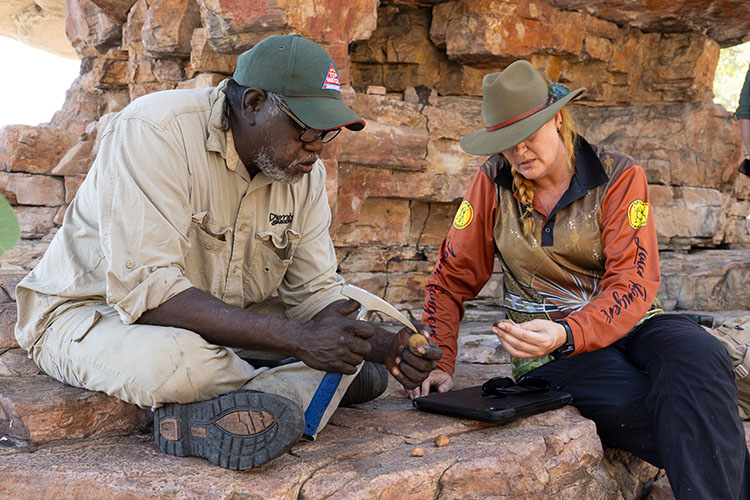
“Ochre is like stone tools; it’s one of the few archaeological materials that survives deep time,” Jillian says. “Ochres help us to understand how people were moving through the landscape, how they were interacting with their land and one another, and how that may or may not have changed as the environment transformed around them. My team and I present evidence to Indigenous Australians that they can then contextualise and interpret, and we can work together to share.”
Today, Jillian is an Associate Professor and Convenor of Indigenous Studies in the School of Humanities, Languages and Social Sciences, as well as director of the Safeguarding Heritage Program within the Griffith Centre for Social and Cultural Research. Her current research – part of team of Bama (Traditional Owners) and academics recording previously undocumented rock art styles in southern Cape York Peninsula – promises to generate new knowledge about the human occupation of Australia, and cultural and social responses to climatic and environmental change. Most important of all, it will produce information for the region’s custodians, to help them care for their sites into an uncertain future under climate change impacts.
“Co-designing projects helps to put communities back in the driver’s seat,” Jillian says. “It’s still imperfect, but my collaborators and I are committed to securing free, prior, informed and ongoing consent; then being accountable and responsive. I try not to centre myself as a colonial practitioner and am mindful to credit Traditional Owners’ cultural knowledge.
“I’ve had the privilege of working with First Nations communities across our region from Island Southeast Asia to the Torres Strait, northern and central Queensland, the Northern Territory and Western Australia. I’m very happy when Indigenous peoples say ‘no’ because it means they are exercising their choice and agency. We need to get used to being in that tension – being aware of it and feeling it – because that’s how we will get somewhere.”
Jillian traces the beginnings of this approach back to UNE. “There, I was exposed to a lot of work with First Nations people, and it confirmed what I fundamentally believe – that archaeology is a humanity. It became really important to me to push for ethical arrangements that gave more power back to Indigenous communities to make decisions aligned with their needs.”
That has since seen Jillian advocate strongly for Indigenous groups to be recognised as research partners and co-authors and, when invited, deliver training to build capacity in their communities. She considers senior Djurrubu Ranger Clarry Nadjamerrek among her most influential teachers.
“I think settler and migrant Australians sometimes feel uncomfortable about celebrating Indigenous cultures, or they are unsure how to do that respectfully,” Jillian says. “I’m keen to repay the efforts in cross-cultural education that Aboriginal and Torres Strait Islanders peoples have invested in me to take some of that colonial load where I can, but I never to speak for people.”
In Mirarr Country, inside the infamous Jabiluka mine lease area, Jillian is part of a team supporting the Traditional Owners’ aspirations “to tell their own stories in their own ways” about some of the longest archaeological records yet found anywhere in Australia, revealing cultural connections spanning 65,000 years. Current projects will also see Jillian contributing to research on Māori rock art, as well as that found on remote volcanic islands of eastern Torres Strait and within limestone caves in Southeast Asia. Using her skills in material scientific analysis and rock art conservation, she is helping to highlight that everywhere, but especially in the tropics, the cumulative impacts of climate change underscore an urgent need for rock art documentation and management research.
“All over Australia and our broader region, we have something very special and its preservation is hugely important. We are still grappling with how to do that in the true spirit of reconciliation with First Peoples.
“Archaeologists are obsessed with two things: where something happened and when it happened. As an archaeologist, I want to know those things, too, but I have come to feel, not just understand, how significant these things are for the cultural custodians of our region. I can’t tell you how joyful it is to witness people out on Country, doing what they have always done to care for their Country.
“The archaeological information we gather is useful to provide evidence for Indigenous Native Title cases or to help them advocate for cultural heritage protection, but it is also important to explain to the rest of settler-migrant Australia why that heritage is important. Australia still has its cultural custodians, who are deeply connected to their Country and heritage, and that's a beautiful thing. We have a lot to celebrate.”
UNE Alumni Awards
The 2026 Alumni Awards are now open for nominations. Find out more here.


