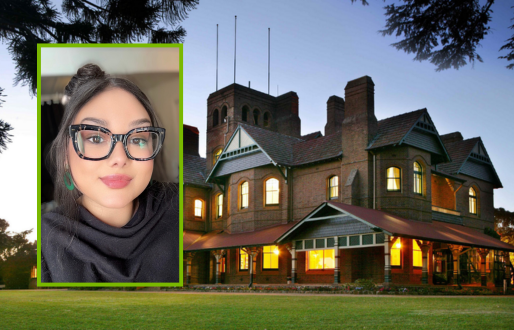
UNE Law and Criminology student Siobhan Sutherland has been named the 2026 recipient of the Brittany Abraham Memorial Scholarship, recognising her academic excellence, community leadership and commitment to justice.
A proud Kamilaroi woman and proud member of the queer community, Siobhan is studying a double degree in Law and Criminology at UNE while working full-time in the NSW Public Service. She says the scholarship is both practical support and a powerful endorsement of the values that drive her.
“Receiving the Brittany Abraham Memorial Scholarship means a lot to me. I am over the moon to have been named the 2026 recipient,” she said. “It’s recognition not just for academic excellence, but of the broader effort and intent behind it. It also gives me the space to focus more on my studies and keep building on community initiatives I am currently involved in.”
 The scholarship honours the memory of Brittany Abraham, whose life was defined by kindness, dedication and a passion for helping others. It supports Indigenous continuing students who demonstrate strong academic achievement, leadership and ongoing contribution to their communities. For Siobhan, that legacy is a reminder that “doing the work in community is just as important as receiving good grades. I really hope I do the award justice.”
Siobhan grew up in a small Indigenous community near Armidale with her Nan, Pop, Aunty, siblings and cousins, who instilled in her a strong sense of justice, self-determination and responsibility to community. She began university study earlier in life but did not complete it at the time. Returning now, she says, feels like stepping deliberately into something that was waiting for her: “Coming back now feels intentional, sort of like I’ve stepped into something I was always meant to do, just at the right time – think, tabula rasa.” She credits UNE’s Oorala Aboriginal Centre, and in particular staff member Kate Carter and the tutoring program, with helping her regain her footing and confidence as a student.
Coming back now feels intentional, sort of like I’ve stepped into something I was always meant to do.
Siobhan says she has “always wanted to be a lawyer,” a path reinforced by her work in community services where she sees, daily, how important – and how difficult – the law can be for people to navigate. A formative moment came from watching the film A Few Good Men, where a cross-examination scene showed her “the way law can be used to interrogate power,” even if real courtrooms are less theatrical. What keeps her engaged now is the nuance and impact of the law: “It requires you to think carefully, pay attention to detail, and build something that makes sense. At the same time, it’s not just intellectual. The law has real impact, and with the right skills, you can contribute to meaningful change.”
The law has real impact, and with the right skills, you can contribute to meaningful change.
Her understanding of law is shaped by country, culture and lived experience. Raised to see justice as relational and expressed in how people treat and care for one another, she is also acutely aware that the law “hasn’t always worked equally for everyone. The over-incarceration of Indigenous peoples is a clear example of that.” Her experiences within the queer community have further highlighted how easily people can be overlooked when systems are not designed with them in mind. “When I study law, I try to hold both,” she said. “I try to understand how it works but also think about how it could work better.”
The community work at the heart of the scholarship is woven through Siobhan’s professional and personal life. In her full-time role, she supports people navigating complex systems, often after significant trauma. She has been involved in early discussions about a community-led alternative justice model for young people in Armidale alongside local Elder Uncle Steve Widders, UNE Senior Law Lecturer Andrew Lawson and former NSW Chief Magistrate Peter Johnstone. She serves on the organising committee for the Myall Creek Memorial and has recently contributed to the development of culturally safe online resources for Indigenous victims of crime in NSW. “For me, I feel as though community work isn’t something separate, it’s something I carry across everything I do,” she said.
Balancing full-time work with full-time study, she admits, “takes discipline” and is something she manages day by day. Returning to university also meant “backing myself, even when I wasn’t completely sure or confident.” Personal challenges have required resilience and rebuilding, shaping how she approaches both work and study “with empathy, focus, and a clearer sense of perspective.” The $15,000 scholarship eases that load and allows her to dedicate more time to both her degree and the community projects she is committed to.
The values that underpin the scholarship – kindness, dedication and helping others – are ones Siobhan consciously tries to live out. “Dedication shows up in the consistency of doing the work properly and staying committed. Helping others is something I carry into my day-to-day, whether that’s supporting people directly or contributing to community. Kindness sits underneath both in my opinion – it shows up in how you listen, respond, and treat people.” In the spirit of giving back, she is already in discussions with UNE about establishing a future annual prize for Indigenous students who demonstrate academic excellence in Law and Criminology.
Helping others is something I carry into my day-to-day, whether that’s supporting people directly or contributing to community.
To other Indigenous students who may be considering Law or thinking about applying for scholarships but feel unsure, her message is clear: “Start before you feel ready. You don’t need to have everything figured out, you just need to begin.” She emphasises that support is available through UNE and Oorala and that students are not alone in the journey. “There may be moments where you question whether you belong, but you do, more than you may realise,” she said. “Back yourself, stay deadly and carpe diem.”
You don’t need to have everything figured out, you just need to begin.


