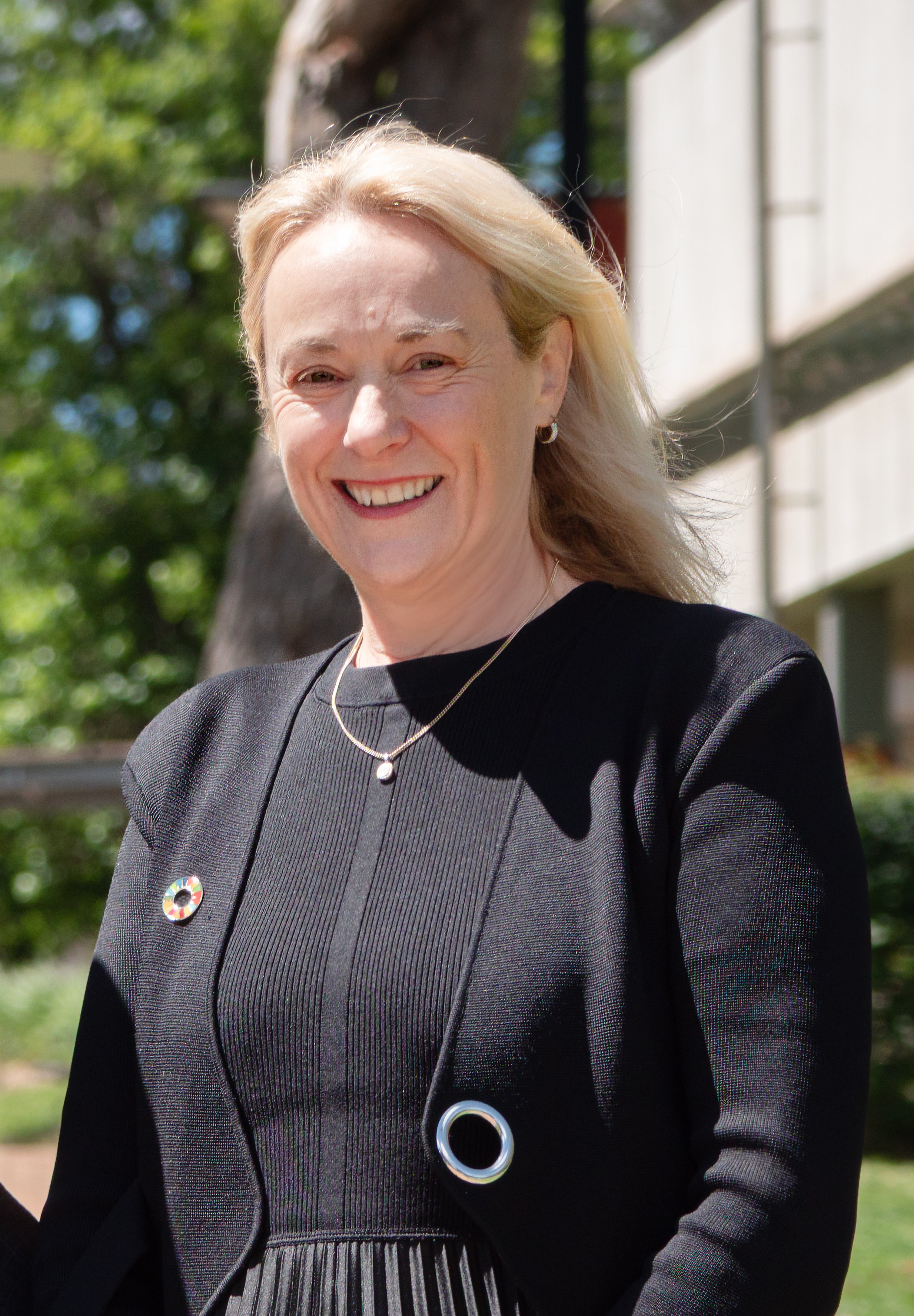
This article is adapted from remarks delivered by UNE Chancellor Dr Sarah Pearson at International Women’s Day functions.
When we talk about Balancing the Scales for women, of United Nations goals of fairness and inclusion and justice, there are many facets of the challenge to consider. Many solutions, opportunities and a complex system of injustice and imbalance. Centuries of ingrained bias that pervade the thinking of both men and women. But there is one important ingredient we cannot overlook – education.
For there can be no gender equity, no challenging of conventions or holding truth to power, without education.
It restores the legitimacy that is so often stolen from women; it gives us choices. Education affords us a voice.
We see this daily at UNE through the eyes of our learners. Our UNE alumna, women boosted by a tertiary education, are unstoppable. They bounce back from adversity and discover new strengths. They develop confidence, big ideas, and much-needed solutions. They attain an education that gives them both a voice and agency. And knowledge propels them into positions of influence, enabling them to question prevailing systems and to work to improve them.
Our UNE alumna, women boosted by a tertiary education, are unstoppable.
I am proud to be the Chancellor of a university that has always believed in universal access and has championed opportunities for women. A place where I, myself, became the first full-time tenured woman physics academic and where I now get to applaud record numbers of women graduates.
Universities like ours play a unique and pivotal role in supporting the aspirations of women. The majority of UNE’s staff and some 68% of our students today are women. Of the 84% of students learning online, many are mothers with families who appreciate the chance to learn new skills from the comfort of their own home, in their own time – while juggling all of life’s other responsibilities. Some of them push through the most crippling of circumstances to show their family you can be whatever you put your mind to. That opportunities are there for all.
I’ve seen how education empowers women – and entire communities – here and around the world. And I remain committed to helping women achieve equality in whatever ways I can.
As the Chief Innovation Officer and Chief Scientist with the Department of Foreign Affairs and Trade, I led work to support the growth of a culture of innovation and entrepreneurship in the Indo-Pacific. This was multi-faceted and fascinating work, with a gender lens across all that we did. We had the privilege of supporting women entrepreneurs who were changing their countries, empowering other women and helping those who could not help themselves. And occasionally we had the opportunity to visit startup spaces and education programs that were designed just for women – in Vietnam, Tel Aviv and India.
Walking into such thriving spaces, filled with capable women, brought me to tears and filled me with inspiration. As someone who has long worked to help women, it should not have surprised me to see all those amazing women succeeding. But this was a valuable lesson. It demonstrated how much bias had infiltrated me, too. How even my perceptions of our systems and cultures, who we are and what we expect are male-centred! Still, it was phenomenal to see how these extraordinary women had identified what we call pain points in the startup world – and opportunities to help others. They were not only addressing vexing issues but capitalising on them.
Necessity, as they say, is the mother of invention. And we know that while women are disproportionately impacted by conflict, poverty, natural disasters and climate change globally, they are also disproportionately capable of building solutions. I’ve seen this in my role as chair of the Orange Movement, which operates at the intersection of gender equality and climate action. Our mission is to mobilise $US10 billion by 2030 to empower 100 million women, girls and gender minorities to drive climate initiatives, sustainable peace and economic prosperity. We are a supporter of “orange bonds” – a new gender-based investment asset class that gives them access to the capital they need to build businesses and lead full and meaningful lives. And we are doing this by driving change in male-dominated financial systems.
Such initiatives are not the ‘nice’ thing to do. They are the ‘smart’ thing to do. Inclusion means embracing those who understand the challenges and opportunities intimately, and empowering them to make a difference and discover the best solutions. The World Economic Forum estimates that advancing women’s employment could add $12 trillion to global GDP and boost some countries’ economic output by as much as 35%.
We’ve witnessed the power of such targeted approaches through a UNE partnership with the Australian Centre for International Agricultural Research. Since 2019, we have been teaching management and leadership skills to scientists – many of them women – in developing countries from Thailand to Tanzania. They now possess the technical skills and expertise to coordinate entire research teams and assume leadership roles, often challenging social and cultural norms. These inspiring Meryl Williams Fellows are busy staging their own private revolutions. They are motivating women to develop businesses, which generate the funds to feed and educate their children. And the investment in individuals is reaping community-wide financial and social rewards.
Closer to home, we have UNE making another important investment, in the implementation of our new 10-year Strategic Plan, which reminds us again of the enduring power of education. Our blueprint is founded on the belief that education is the cornerstone of human capital and critical to a society of informed, productive citizens - indeed, of a working democracy. It is the key driver of prosperity. And if institutions like ours are to rise to the challenge of the global innovation revolution, then we need to be dynamic and fully engaged with the regions we serve, which means being representative and respectful of all genders.
We are positioning our university to deliver shared, regional responses to the major global challenges we face. We imagine ourselves at the heart of sustainable landscapes and economies that are adapting to climate change, and full of vibrant and healthy people. And as we seek to ease pressures associated with aged care, health care and childcare, we hope many of the beneficiaries of our novel research will be women.
Whether they are scientists, students, alumni or partners, women will be fundamental to UNE achieving its ambitions for community collaboration and regional renewal. That’s because women are the lynchpins, the powerhouses of every community: the businesswomen, the entrepreneurs, the carers and connectors and agitators who understand what their communities need and won’t rest until they deliver it.
That’s because women are the lynchpins, the powerhouses of every community: the businesswomen, the entrepreneurs, the carers and connectors and agitators who understand what their communities need and won’t rest until they deliver it.
International Women’s Day reminds us that women deserve to be “safe, heard and free to shape” their own futures, as UN Women Australia CEO Simone Clarke has said. Not just because it is the right thing to do, but that it is the smart thing to do. Because encouraging diversity and inclusion encourages the new thinking and original solutions and sheer determination that women are capable of. And the future economic and social health of today’s disrupted society depends on that and more that women bring to the table.
But we are yet to be truly smart. The World Economic Forum 2025 Gender Gap Report – which provides a global benchmark across economic participation and opportunities, political empowerment, educational attainment, and health and survival – makes for sobering reading. It found that the gap between men and women across these measures was as much as 30%. In some cases, the gap that exists for women seeking both economic and political opportunities had widened. That means fewer women leading business teams and fewer women in positions of power and capable of making change. The report also predicted that, at this rate, gender parity would not be reached for another 123 years.
And all this against a backdrop of soaring global rates of sexual and physical violence against women, growing insecurity associated with natural disasters and climate change, and geopolitical conflict and economic uncertainty the likes of which we have never seen before - when we know that the impacts on women will last longer and be harder to reverse, exacerbating existing earnings, assets or wealth disparities.
But far from being discouraged, I am optimistic about the future, fresh from interviewing candidates for the Chancellor’s Scholarship for Women of Impact at UNE. Although I can’t yet announce the impressive woman I will soon be mentoring, I can tell you that the calibre of applicants gives me great hope. Each embodied UNE’s values – to be bold, kind, connected and accountable. And I am pleased to be part of an institution that is empowering women – and men – to rediscover their agency through education. Because our men allies are equally vital to this discussion.
We must act today.
Too many women like the brave Virginia Guiffre continue to be the victims of violence. Too many women continue to experience discrimination in the workplace or fail to achieve the justice they deserve in court. Too many women are living in their cars or facing uncertain futures.
So as our university moves to turn talk into action, to employ education in the most powerful and practical ways, I implore you to do the same. I encourage you to be bold, kind, connected and accountable in pursuit of a more just and fair society for women. To do what you can to improve women’s representation in the workforce and leadership, and to advocate for equal pay. To break down the barriers to women feeling safe and heard.
I encourage you to be bold, kind, connected and accountable in pursuit of a more just and fair society for women
With the right tools, capital and support – including education – women can change the world. I’m a firm believer in that. And the talent and richness and heart they bring to every setting supports creativity and innovation, as well as kindness. It builds more resilient, prosperous and happy families, communities and economies. And that’s transformative.
Some believe we are standing at the precipice of massive societal change. That’s a whole other conversation. The rise of AI is hockey-sticking, and geopolitics and greed are racing for dominance. Never before have women, our voices and our agency, been more important. It’s not ‘nice to have’. It’s crucial for humanity.
So what are you going to do today, to uplift the women in your life?

