Read more and download the Strategic Plan documents here.
The University of New England’s newly released 2026–2035 strategic plan rethinks the university’s operating model, how the institution funds itself, and how it relates to the communities it serves.
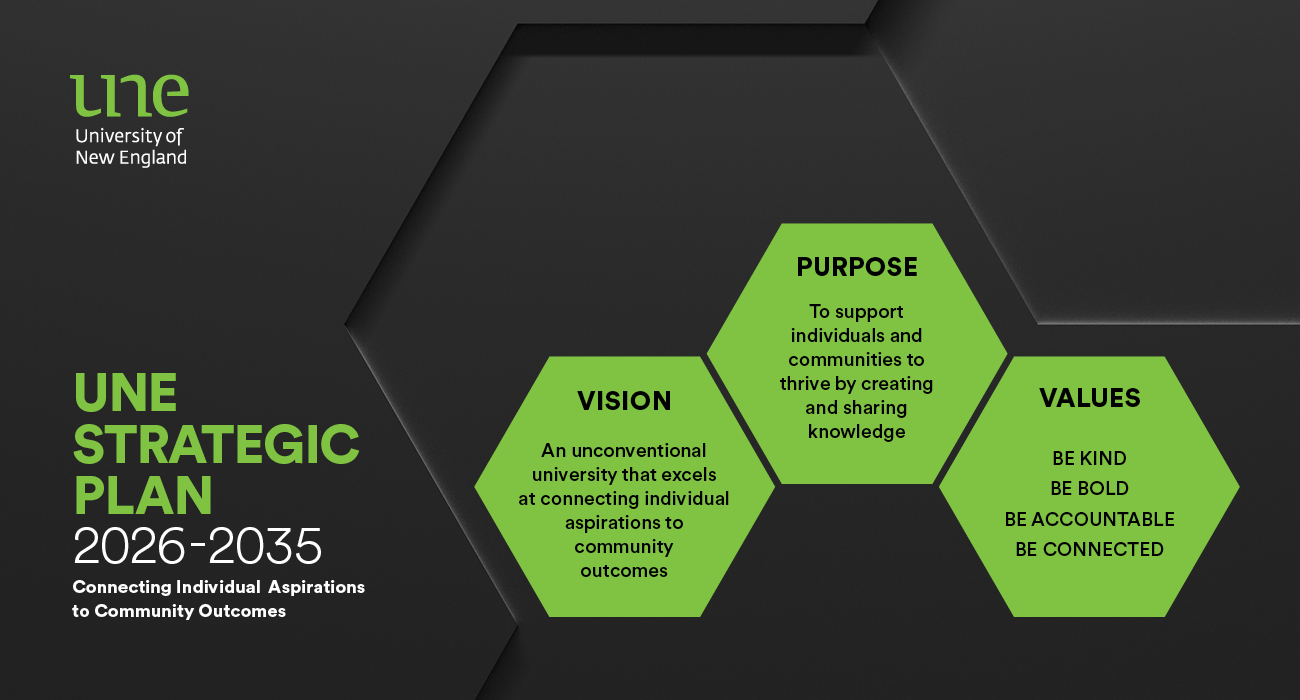
The plan was developed around UNE’s revitalised vision to “connect individual aspirations to community outcomes”.
UNE’s Vice-Chancellor, Professor Chris Moran, observes that the University’s founding policy of putting students’ needs first remains central to UNE’s work, but change is necessary.
“Traditional assumptions about universities and their role in society are being challenged by the evolution of technology, changes to university funding, and a general decline in trust in the value of a university education,” Prof. Moran says.
“Global trends, and our own monitoring, tells us that business-as-usual is not an option. UNE needs to become the architect of its own destiny so that it can sustain and grow excellence in everything that we do.
“Our commitment to independence and breaking with convention was the foundation of our origins nearly 90 years ago.
“Today, we’re embracing that heritage to chart a newly unconventional future – one that ensures we remain a highly-regarded, financially sustainable university that proudly serves our students, and regional areas everywhere.”
The Strategic Plan 2026–2035, Connecting Individual Aspirations to Community Outcomes, was built on an extensive year-long consultation with UNE staff, alumni and partners.
“It reflects a view shared across stakeholders that Australia’s first regional university should recalibrate its role in the regions, build capacity to invest in its own future, and support our staff to excel in the creation and sharing of knowledge,” says Prof. Moran.
“We can’t address these imperatives on public funding alone. If UNE is to shape its own future, we need to work differently and develop more effective forms of financial stewardship to support decision-making and re-investment in the University’s core capacity.”
The practical objectives of the strategic plan are underpinned by specific principles.
Foundational Excellence
University stakeholders are seeking significant changes to what UNE represents and delivers, Prof. Moran says. “Achieving foundational excellence requires a new operating model - radically simpler, leveraging AI and new learning technologies, resulting in more enjoyable and productive work”
The strategy lists seven areas that will be targeted for improvement: learner experience, course quality, student retention, research impact, staff satisfaction, governance standards and ‘operational fitness’.
Community Collaborations
UNE’s future engagement with its communities will be based on relationships in which the University carries shared responsibility for achieving outcomes. The strategy uses the language of cooperation – “co-creation”, “collaboration” and “partnership” – to describe its future terms of engagement.
In this spirit, the strategy outlines five “Community Collaborations” as conduits for UNE’s regional engagement:
Resilient Regional Relationships recognises that UNE is uniquely placed to support the development of regional partnerships focused on sustainable economies, climate adaptation, mental wellness and disaster management.
Upholding Aboriginal and Torres Strait Islander educational rights proposes that UNE works with Elders and communities to remove barriers to education, creating culturally safe pathways that support learners from early childhood through university to employment.
Live and Work to Learn Partnerships asks that UNE shoulders some responsibility for easing pressures in rural communities around aged care, health care, and childcare. The University will develop a program to place domestic students in regional work and accommodation arrangements, addressing critical workforce shortages in aged care, healthcare, childcare and sport.
Regions of Tomorrow commits UNE to a role in establishing the New England Northwest as a regional AI education and innovation centre, supporting businesses to uplift productivity.
Renewable Energy Zone Alliances acknowledges that as the only university at the heart of a designated Renewable Energy Zone, UNE can play a role in workforce development, research and community support.
“Our communities clearly told us what they need from UNE, and we’ve listened,” Prof. Moran says. “This is about sharing responsibility for the outcomes the regions need. We’re moving from the role of observer to partner; from education provider to co-creator.”
The UNE strategy recognises that regional areas worldwide are subject to multiple stresses as working-age people migrate in growing numbers to urban centres.
The new strategy widens UNE’s scope to become part of the global search for solutions to regional decline. This does not imply that UNE will alone find answers to the ‘wicked’ problems of the world’s regions, Prof. Moran says.
“It is rather an invitation for our people to expand thinking about the nature of regionality, relationships between regions, potential sources of students and research funding, and the University’s sphere of influence.”
Download the Strategic Plan here.

