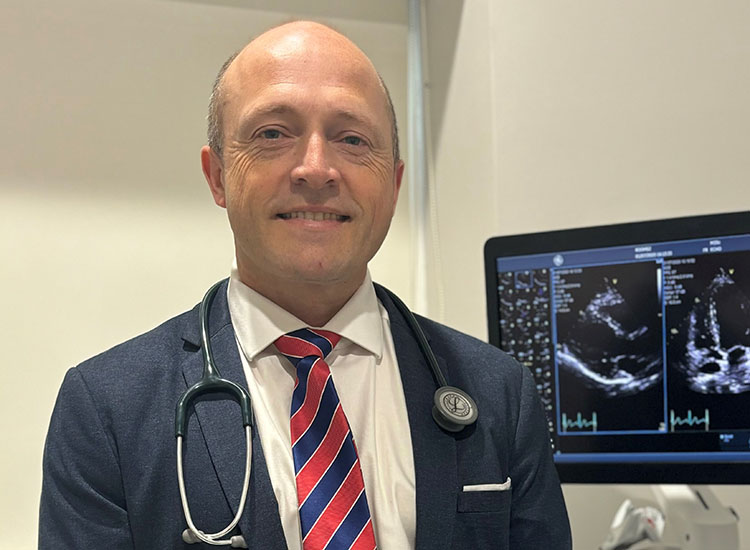
Associate Professor Joseph Suttie - 2025 Distinguished Alumni Award
In recognition of his pioneering leadership in rural health research and medical education, establishing Australia's largest inland cardiac screening program.
Dedicated Riverina consultant cardiologist, general physician and educator Associate Professor Joe Suttie has been up since dawn moving cattle. Over the next three days, his family’s property in Collingullie will host First Nations teenagers undergoing life skills and careers training.
But by lunchtime, Joe will be at Wagga Wagga Base Hospital, doing his rounds. Then there’s a few hours set aside for diagnostic work, as the region’s lead clinician for Cardiac Medical Imaging (MRI and CT), before teaching commitments round out the afternoon.
Most weeks Joe takes up to eight classes – at the University of Notre Dame, where he is head of the Riverina Rural Clinical School; and at the University of NSW, where he lectures in clinical medicine, imaging, genetics and medical law. A champion of education, especially in STEM, Joe has inspired many of his students to become rural community doctors themselves, among them five NSW Doctors of the Year and several General Sir John Monash and Fulbright scholars.
“One of my wonderful trainees is a professor in Sydney who I now refer patients to,” says Joe, a 2025 Distinguished Alumni Award winner. “I’m very proud that she knows much more about some sub-speciality cardiology than me.”
It’s his humble commitment to education and capacity-building, as well as his research and advocacy for marginalised populations that has seen Joe become a medical and community trailblazer.
Among his current roles is as Director of Medical Education and Training for the Murrumbidgee Local Health District, which has established Wagga Wagga as a centre of training excellence. Joe also represents regional communities as advisor to the Agency for Clinical Innovation NSW Rural, and for the past decade has convened two programs – Bushtracks and the Australian Regional Training and Innovation Enterprise – that aim to help students from remote and regional communities realise their full potential and, hopefully, pursue healthcare careers.
How on earth the father of six, who consults widely to the healthcare, agricultural, legal and education sectors, also manages to keep up with his own studies – a third doctorate, on educating the neurodivergent – is beyond most people. But then Joe’s passion for lifelong learning and steadfast efforts to improve healthcare in the regions is truly unique.
“I love rural Australia, the sense of affinity and cooperation … these good, small, loving communities comprising diverse people doing extraordinary things,” he says. “We’ll do anything for these communities if we can … it’s our life, our duty, our community, our families. It’s all part of the whole.”
So, when evidence began to emerge showing that cardiovascular disease was the leading cause of death in rural communities, especially among First Nations peoples, Joe felt a compulsion to act. Drawing on his doctorate in neuromuscular disorders and cardiac imaging from Oxford University, he established Australia’s largest inland rural cardiac screening program, equipped with cutting-edge CT and MRI technology. Since then, his research – which spans the diagnosis and treatment of heart conditions, as well as workforce and ethical issues – has pioneered the clinical use of artificial intelligence to assess heart health.
“It’s an issue of healthcare access; about rural people having access to screening early enough to prevent them falling through the cracks,” Joe says. “We challenged the conventional wisdom that leading technology, surgery and procedures could only be delivered through a centralised wheel-and-spoke model. And we showed what could be done.”
Professional colleague Dr Mark Schembri describes Joe as visionary; someone who can “engage collaboratively across multiple communities”.
“Joe has built serious clinical and research capacity in rural Australia,” he says. “He has led the sector in investment in clinical equity and research … to deliver highly complex healthcare systems to some of the most deprived and isolated communities.”
A curious man, with a scholarly interest in classical Greek and Latin, Joe has both a law degree and a Master of Business Administration from UNE.
To his patients, he is warm and personable; to his professional partners he is a “practical idealist” with a holistic mindset. Installing high-tech equipment, for instance, is not enough. For any health intervention to be successful and sustainable, Joe contends it must be underpinned by the latest research, sound governance and a pipeline of supported, happy healthcare practitioners.
“By introducing the best technology, the best service and the best research, we enable young scientists and doctors to see futures and careers within their rural communities,” Joe says. “That has all kinds of indirect effects, because they will truly invest in those communities and benefit themselves from helping patients. And the patients feel more involved and are more likely to respond positively to health messages.
“If we look after medical students [Joe established a support program for healthcare trainees at risk of burnout in regional areas, called Rural Minds], we build community resilience and that becomes this wonderful virtuous cycle of reinvestment and mutual success and wellbeing.”
Having such a broad notion of rural health – “beyond the caricatured version of snake bites and farm injuries” – has also prompted Joe to tackle one of its largest threats, road safety. He recently supervised research into regional crashes involving semi-autonomous and fully autonomous vehicles in collaboration with NSW Police and Roads NSW, investigating risk factors associated with variable connectivity and road infrastructure.
“This may not seem like something a doctor can help fix, but road accidents are much more likely to be fatalities in the regions. It’s exactly the sort of integrated rural and public health that we need, recognising that multifactorial problems need a multifactorial solution.”
And when it comes to solving the persistent rural health workforce crisis, Joe’s solution is disarmingly simple. “Health professionals need to be shown the opportunities for them to flourish in the bush, we need to value their enthusiasm and expertise, and then mentor them throughout their journey,” he says. “A lot of rural areas don’t need thousands of doctors. They just need a couple who love living and working in the community and love serving it. That’s how you solve the issue of health inequity – one community, one doctor, one patient at a time.”


