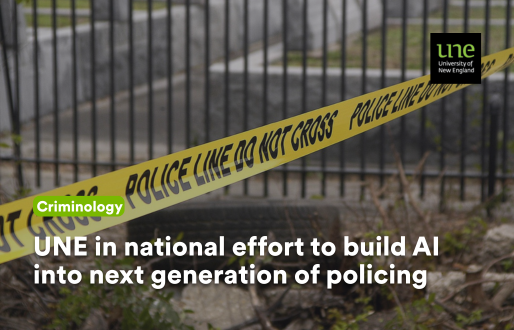
The University of New England is a key partner in a new national effort to help Australia’s future law enforcement professionals apply artificial intelligence effectively and ethically.
The Next Generation Policing Program unites academia, government and industry - including NSW and WA Police, CSIRO and universities - to explore how AI technology and data science can transform policing while maintaining community trust.
At UNE, several students will be funded to design and conduct research projects alongside police specialists and leading academics, including from UNE’s applied AI innovation lab, Lab Next 70, and the UNE Centre for Rural Criminology.
Centre co-director, Dr Kyle Mulrooney, said the program aimed to “tackle the technological challenges that are coming at a very rapid pace and prepare the next generation of policing in Australia”.
“Students will get to actually co-create projects with industry leaders at the coalface, the purpose being that the research has some tangible application and output.”
Students will get to actually co-create projects with industry leaders at the coalface.
UNE will offer generous scholarships for two PhD students, three Master’s students and four Honours students to participate in the program, which will also include an industry placement with the NSW or WA Police Force.
They will also take part in the broader CSIRO Next Generation Graduates Program. A national initiative to build Australia’s workforce capability in AI and emerging technologies, it covers sectors including agriculture and defence, and the Next Generation Policing Program is just one stream.
Students may pursue projects in a range of areas, from forensic and investigative applications to ethical and legal considerations of AI in policing. Examples include:
- AI-powered video and image analysis for digital forensics
- Fingerprint quality assessment tools
- Deepfake detection in child protection and domestic violence contexts
- The validation and court admissibility of AI-enhanced digital media; or
- The development of AI models to improve police workload and staffing analysis
“These students will graduate with not only their typical PhD or Master’s or Honours project, but also relationships in the field, an understanding of applied research and practice, and a complete upskill in terms of that next-generation workforce by being able to learn from experts at CSIRO,” Dr Mulrooney said.
“It’s an absolutely fascinating opportunity - I wish this was available when I was looking for PhD programs; I could not think of anything better.”
The Next Generation Policing Masters Scholarship runs for 2 years and is offered online or on campus with a full-time study load. Applications are open until the 3 available places are filled.
The Next Generation Policing PhD Scholarship will run for 3.5 years and is offered online or on campus with a full-time study load. Applications close 14 November 2025.


