
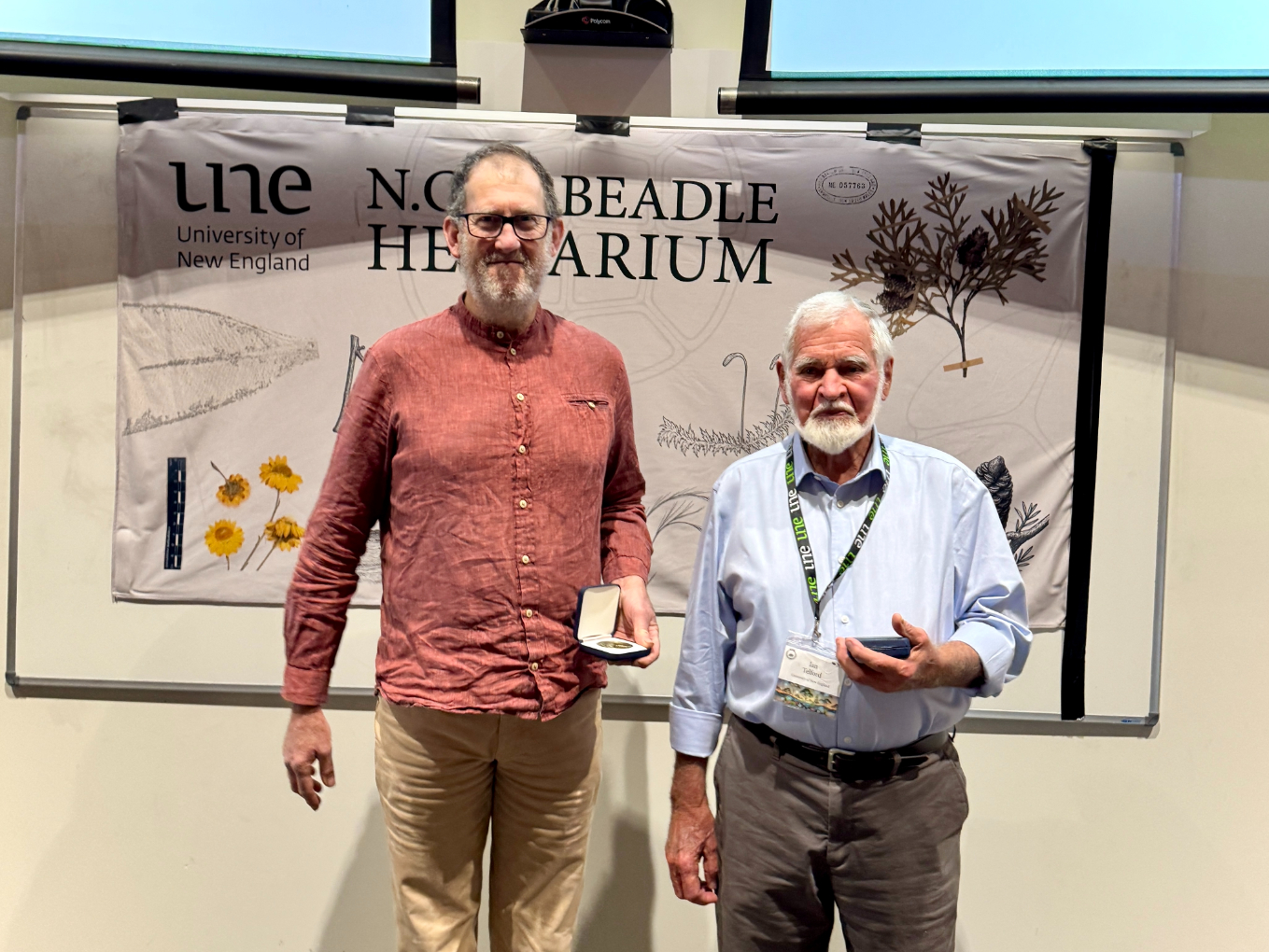
Two University of New England scientists have been awarded the highest honour in systematic botany in Australasia, recognising their exemplary contributions to the discipline.
Emeritus Professor Jeremy Bruhl and Dr Ian Telford accepted their 2025 Nancy T. Burbidge Medals at the Australasian Systematic Botany Society (ASBS) Conference held at UNE this week.
"It's lovely, slightly surreal, and a great honour to be recognised alongside many of the people that we hold in high regard," said Professor Bruhl.
"It came as quite a surprise to me," said Dr Telford. "I mean, the people who received the medal before us have been quite remarkable researchers."
During his 30-year tenure as Director of the UNE N.C.W. Beadle Herbarium, Professor Bruhl transformed the facility into an internationally recognised collection of 121,000 specimens, while mentoring countless students into successful careers. He has also garnered a global reputation for his work on various plant families, especially the sedge family, describing new species, estimating evolutionary relationships and understanding variation in photosynthetic pathways. as He has also contributed to a better understanding and conservation of the flora of Australia, including the New England region.
"One of the highlights of my career so far has been all the collaborations I've had – across campus, across the country and across the world – as well as the support the university has given me,” said Professor Bruhl.
"I was the only university-based botanist to actually spend a year based at the Royal Botanic Gardens Kew as the Australian Botanical Liaison Officer, an Australian Government appointment. That was a wonderful experience, and I think I contribute a lot back for Australia, but it was only able to happen because I was able to have a year's study leave to do that."
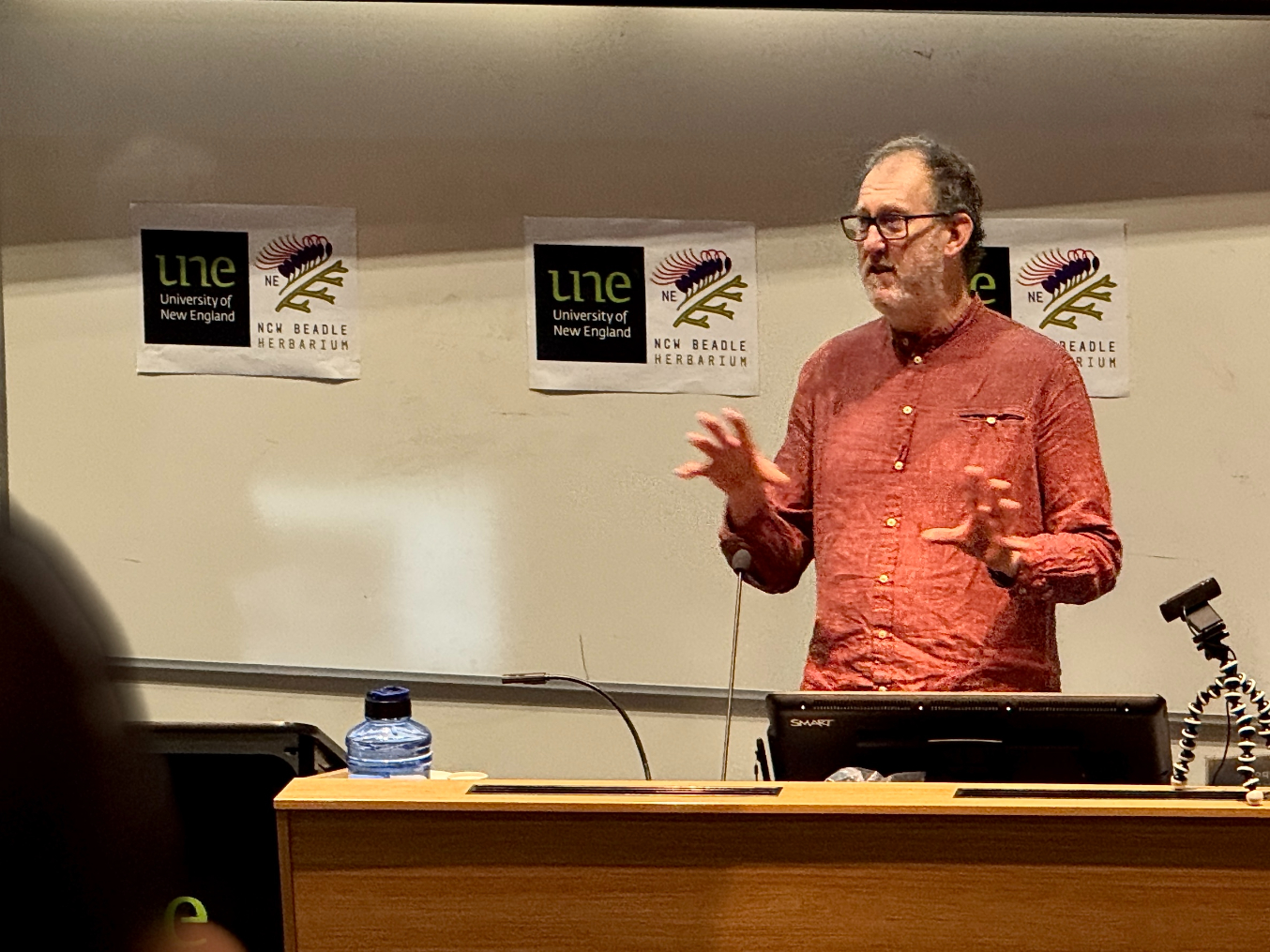
Image: Emeritus Professor Jeremy Bruhl
Dr Telford is the Honorary Curator at the N.C.W. Beadle Herbarium and has previously held positions with the Australian National Botanic Gardens and at the Australian National Herbarium. He has a particular interest in the biology, systematics and biogeography of Cucurbitaceae and Phyllanthaceae, as well as the flora of north-eastern New South Wales.
While he's carved an impressive, globally recognised career, Dr Telford said it was not his original direction of study.
"I really changed my career path because I realised that I should have done a pure science course with a major in botany rather than starting a fixed course like forestry where botany was a minor part of it," he said.
"My advice? Study what you want your career to be. I think that's very important."
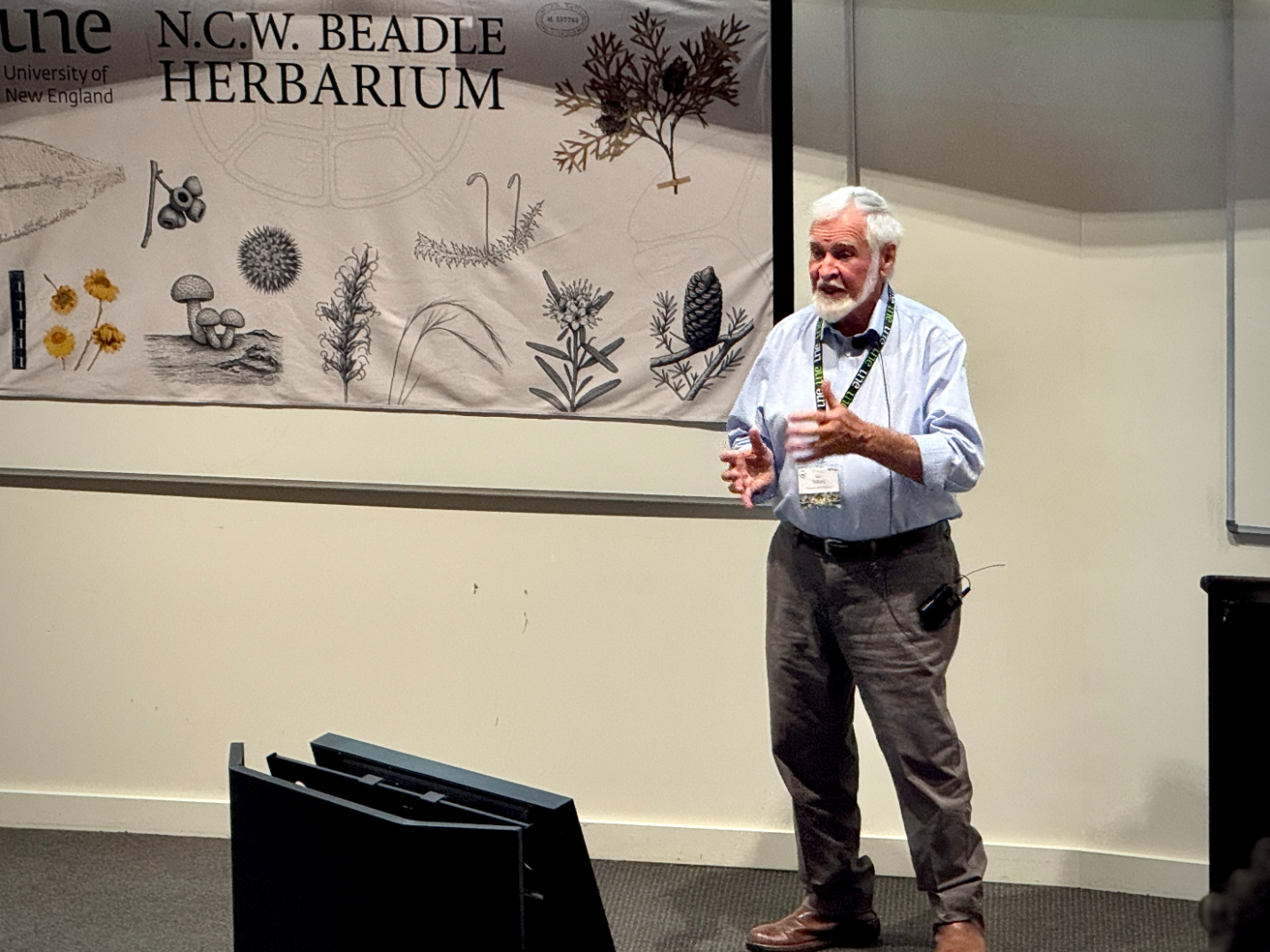
Image: Dr Ian Telford
The 2025 ASBS Conference focused on the theme 'Next Generation Botany', which aims to bring attention to the new techniques and discoveries covering aspects of Australasian plant taxonomy, systematics, phylogenetics, genomics, biogeography, palaeobotany, and conservation.
The conference also celebrated the next wave of botanical talent, featuring early career researchers as keynote speakers, including UNE alumna, Dr Helen Kennedy, who works as a botanist at the Australian National Herbarium in Canberra.
"It's such an amazing and rarely given opportunity," she said.
"I chose to speak about stewardship, because I have a great love for our field, and I really value what we do and I see how much work has happened in the past to bring us to where we are today. I think a major theme for me is how we can look after that, protect it and build on it in the future."
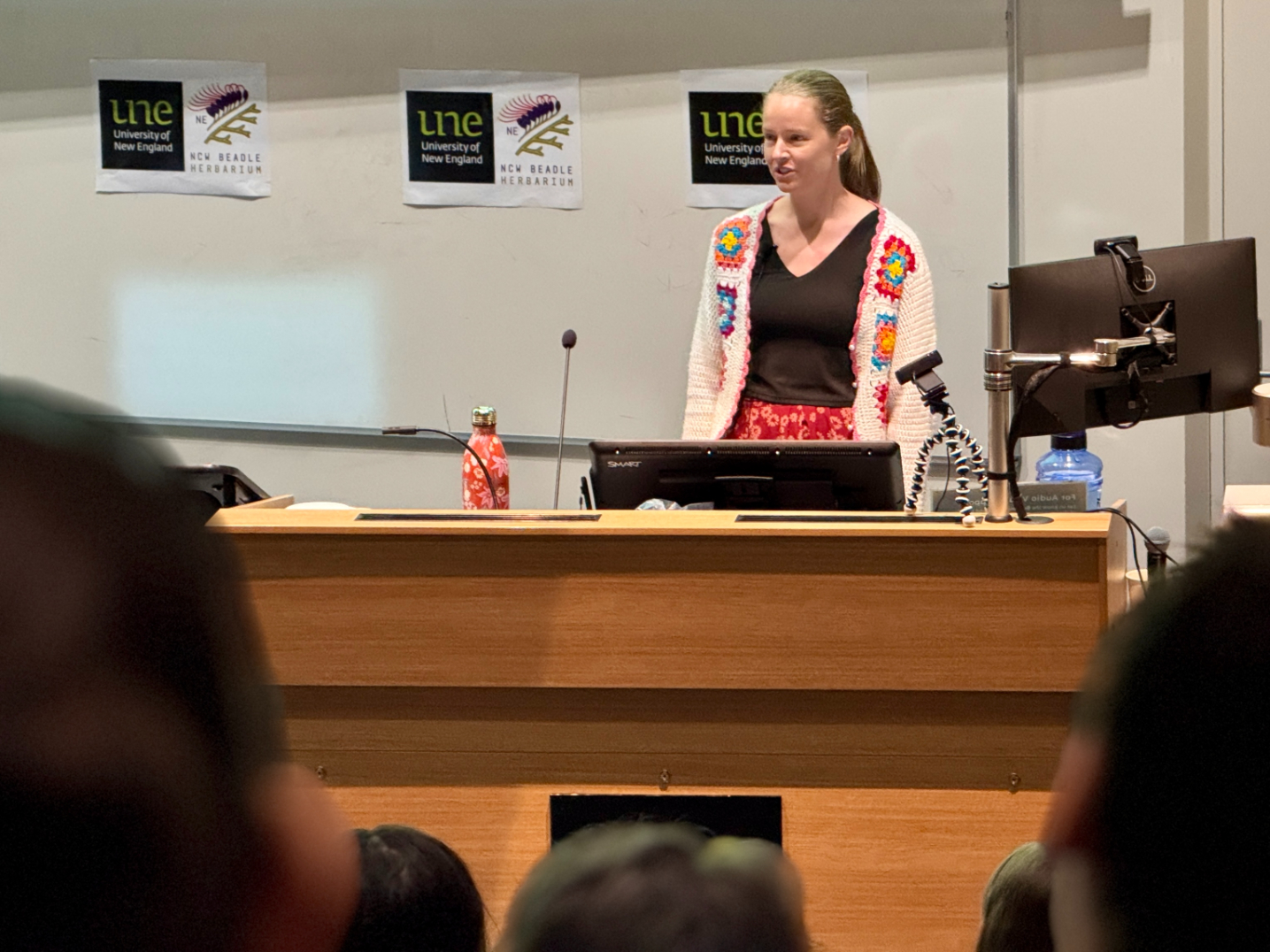
Image: Dr Helen Kennedy presenting her keynote address
When asked about her advice for other 'next generation' botanists, she had one message.
"The only wrong turns I've ever taken were when I doubted that I should follow my passion and do what I love," she said. "It's a bit of a cliché, but it's definitely always been the right choice for me."


