Here he reflects on his own education and experiences.
Tell us about your upbringing. What were your ambitions leaving school?
I was born in Darwin but spent most of my childhood in Cairns, North Queensland. My father is a Torres Strait Islander and my mother is from Victoria. I was into sport and was intent on making a go of rugby or becoming a pilot, like my grandfather. But in my last year of high school I was diagnosed with Chronic Inflammatory Demyelinating Polyneuropathy (CIDP), which effectively ended both options, so I had to pivot. I eventually went to James Cook University to study journalism. After writing for local and regional publications, I enrolled in a Graduate Diploma of Education – first-year teachers earned twice as much as cadet journalists. I then moved to Albury/Wodonga and began teaching in the Victorian education system. I got married, had a son, and that was when I enrolled to do my Master of Leadership at UNE.
What prompted this decision? How was the UNE study experience?
I had been teaching for three or so years and especially as a teacher in a middle school it was never easy to see the full impact of what I did. I thought the Master of Leadership would provide a way into consulting or something like that. I started the course right before the teaching role in the United Arab Emirates (UAE) came up and continued my study from there. It was challenging to work full-time and study, but my lecturers and the university were always helpful and supportive. The coursework was practical and applicable to what I was doing in education, and I learned a lot about good leadership and change management. I use what I’ve learned, even now, in my work every day.
Describe your role of Australian Indigenous Cultural Advisor to the Australian Business Council in Dubai.
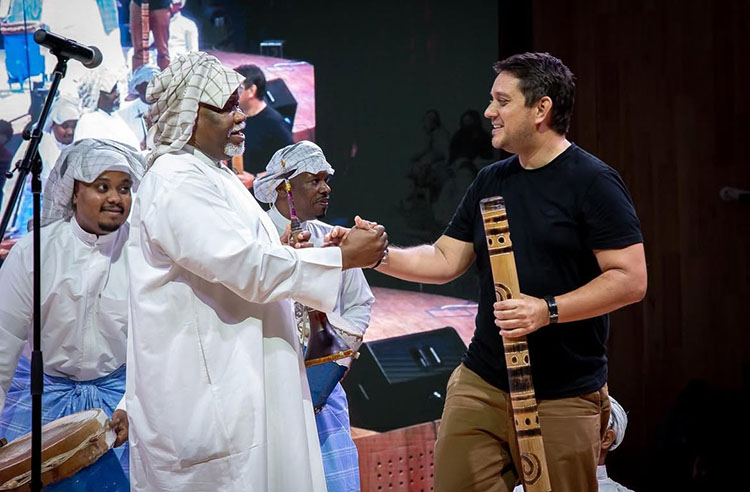
Growing up in Darwin and North Queensland, Aboriginal people and Torres Strait Islanders are part of one big community. We celebrated together and as children we learned Torres Strait Island dancing, but also how to shake a leg and play the yidaki. As the only Indigenous person at my school in the Emirates I would often play the yidaki – at my school and others. It gave me an opportunity to share both Aboriginal and Torres Strait Islander culture with people from around the world.
I was approached to share what I was doing with schools at the Australian Pavilion at Dubai EXPO 2020, which was an amazing experience. This led the Australian Business Council to approach me to consult on their events, to include an Indigenous Australian perspective and ensure they were culturally sensitive.
How would you describe the approach to education within your school?
Education in the UAE is an interesting beast. It is big business, and many schools are run just like that. They haven’t always considered the wellbeing of students, and some don’t value the wellbeing of staff, traditionally only valuing academic results, but we are working to change that. Being an Australian school and a non-profit, our educational philosophy has always been holistic but there’s a need to find a balance between family expectations and what we as educators value for our students.
What is the purpose of the CAS (Creativity, Activity, Service) program?
The program is part of the International Baccalaureate Diploma Program (IBDP) and is designed to help students learn and grow in ways they would not in a traditional classroom. They develop self-awareness and self-reflection, leadership skills, global mindedness and ethical awareness by planning, doing and then reflecting. We help them draw connections with what they do in their classes and what they see in the real world. It can be very powerful, and I think should form part of what every student does at school.
In a social media post you quoted Aristotle: “Educating the mind without educating the heart is no education at all”. In another, you stated that “When students’ academic pursuits intertwine with meaningful engagement, education transcends rote instruction, becoming a force that shapes not just minds but societies”. What do you believe is the purpose of education today? And the qualities of an effective educator?
For over 10 years now I have worked in wellbeing and wellbeing leadership in schools and I believe an effective educator has to consider the mental health and wellbeing of the students in front of them. Psychology has leant its expertise to education now for decades and so it should. How can you be a facilitator of learning if you don’t fully understand how kids learn, and what affects that learning? Teachers and educators today are expected to be experts in their subjects as well as experts in adolescent development, psychology and counselling. It’s a side of teaching that I really enjoy.
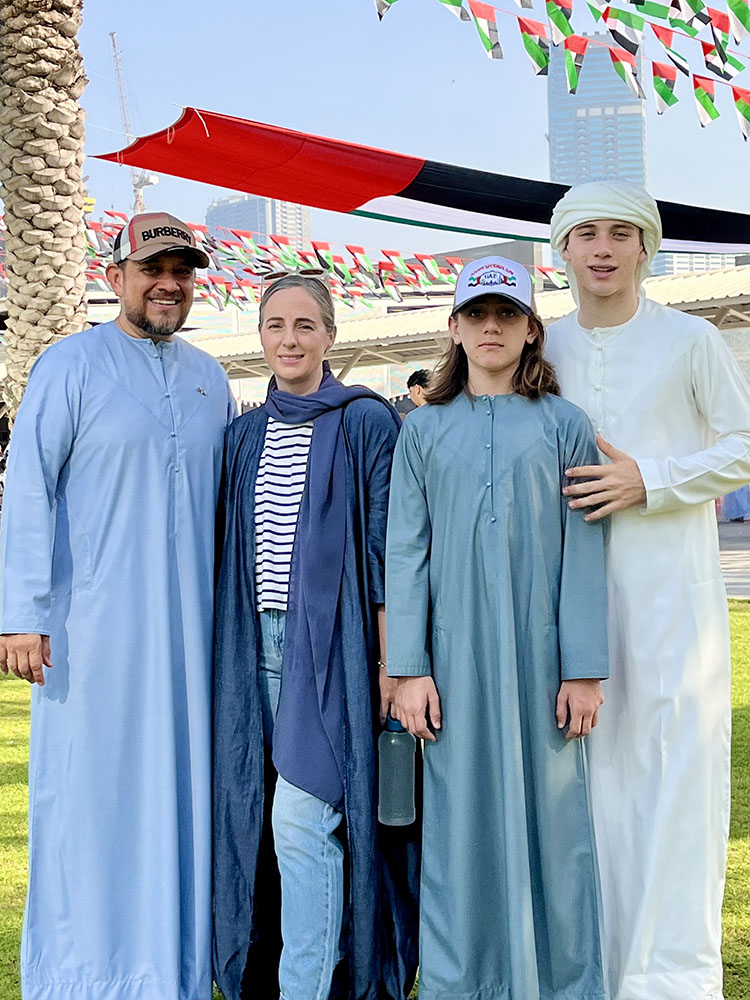 Joe with his family at UAE National Day celebrations in 2024.
What is it like living and working in the UAE?
It’s been an amazing experience. I’ve seen and learned so much and I’ve been able to give my boys an education and experience that they could never get back home. The Emirates is a 90% expat population so the multicultural aspect of life here is very unique. We’ve been able to see the world and gain great insights into other countries and cultures.
What do you miss about Australia?
I miss family and friends. I miss my connection to the Torres Strait Islands and its community, and my boys have missed out on that, too. But they know who they are, and I’ve tried to foster a sense of belonging for them. Australia is a beautiful country, with so much going for it. It will always be home.
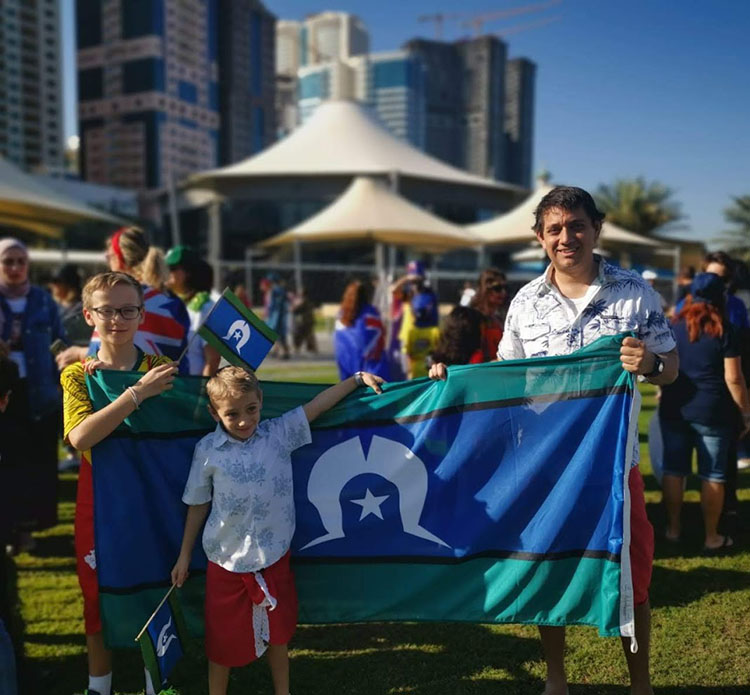 Joe with his sons Reef and Jacob at an international day celebration in Sharjah.


