

Thousands – and possibly even hundreds of thousands – of Australians can trace their ancestry back to the first British settlement on Norfolk Island, colonised on 6 March 1788, only 5 weeks after the landing at Botany Bay. However, despite the site being critical to our understanding of the early social and economic development of Australia, there has never been a major historical or archaeological study of the 1788-1814 settlement.
“When people now go to the island to see where their ancestors lived, what they see are the massive stone buildings of the later prison period (1825-1856), while the sites of the timber huts and cottages of the early settlement remain invisible and largely uninterpreted,” said Professor Martin Gibbs, lead researcher on the project.
This study is the latest in a series of UNE-led research on the history and archaeology of early Australia and builds upon over a decade of UNE work on Norfolk Island. The study is a collaboration between UNE researchers Professor Martin Gibbs, Professor David Roberts, and Dr Richard Tuffin, researchers from the University of Queensland and University of Southern Queensland, and industry partner Kingston and Arthur Vale Historic Site Authority.
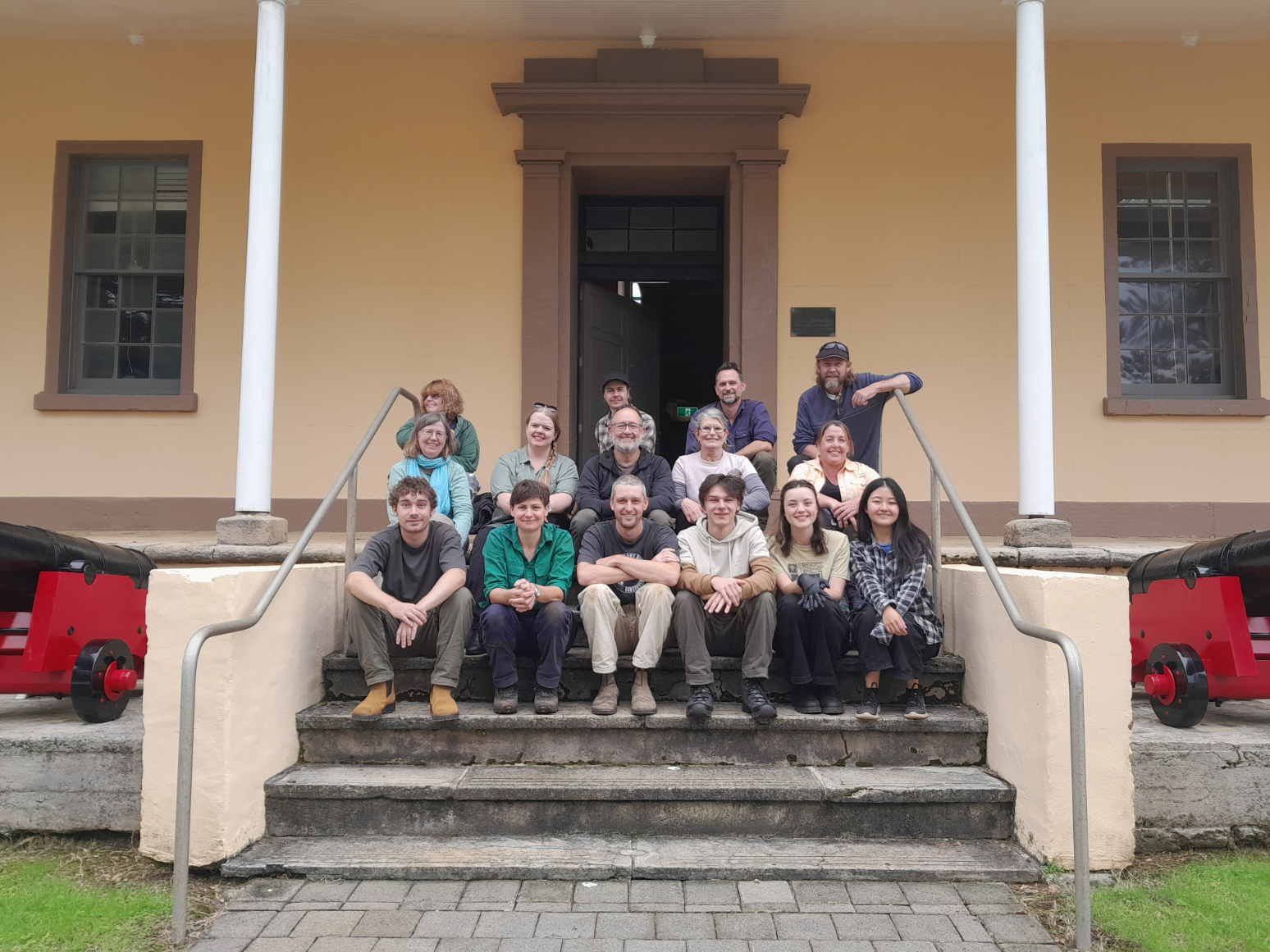 UNE and UQ students at Norfolk Island for the 2025 pilot study.
Earlier this year, the project team self-funded a pilot project to do archaeological remote sensing across some of the key early settlement areas, assisted by student volunteers from UNE and UQ.
This project leverages the interdisciplinary nature of the research team to gain new insights into early colony life. They plan on using cutting-edge tools like AI transcription and data-extraction as well as using Graph databases to connect, test and validate data drawn from multiple historical sources. These methods have already proven successful during the pilot study.
“We transcribed nearly 70 sources of population information, resulting in an additional 800 people associated with the first settlement, an approximate18% increase on what many assumed was a well-known population,” Prof Gibbs said.
There will be many opportunities for students to get involved with the project, from historical transcriptions - perfect for UNE’s off-campus students, to joining the archaeological excavation work – open to senior students.
This project will help identify first-settlement sites and develop stronger conservation strategies, allowing for Norfolk Island’s 40,000 annual visitors to gain a richer experience of life on the island. This will also include developing digital models of sites and artefacts, drawing on the expertise of Emma Watt, UNE Archaeology's technical officer and specialist in 3D imaging
“It is getting more difficult to win ARC [Australian Research Council] grants, especially as a regional university competing with the big, metropolitan and ‘Group of 8’ applications,” Prof Gibbs said.
“We are very grateful for this opportunity to promote UNE research and researchers.”
You can view initial artefacts from Norfolk Island on UNE’s Pedestal program here.


