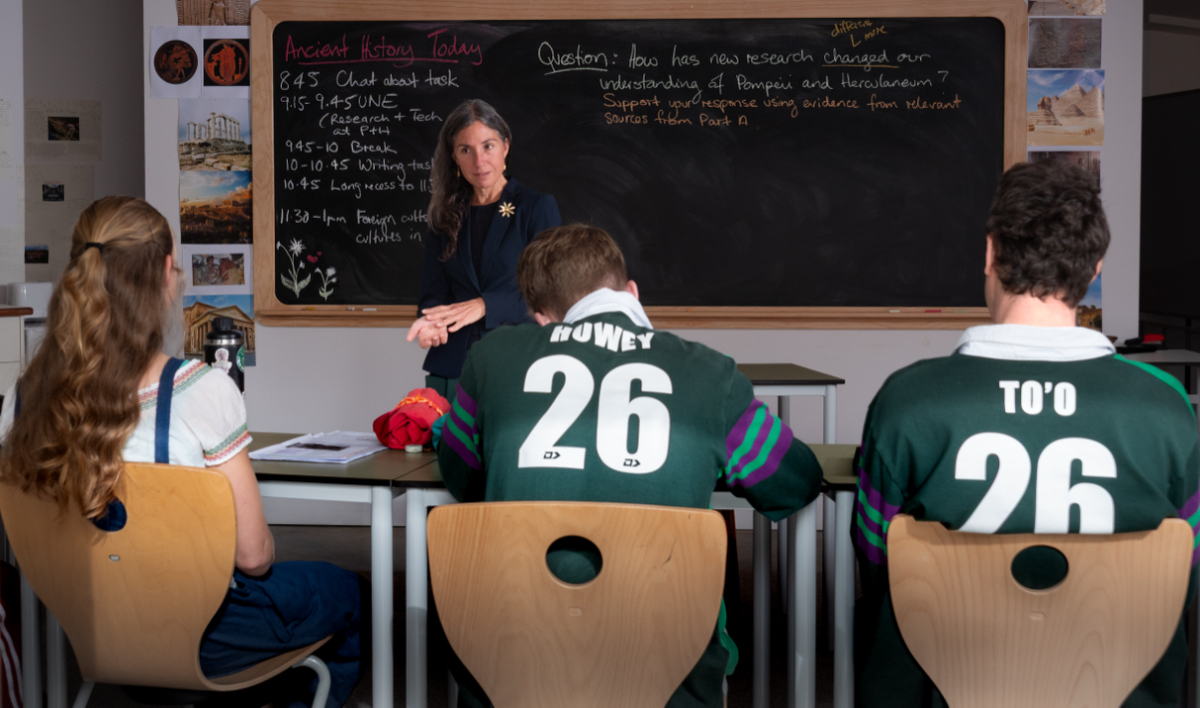
Armidale's newest high school is drawing on the lived experience of UNE researchers and academics to help give final year students an appreciation of the breadth of the possibilities before them.
The Visiting Academics Program at The Armidale Waldorf School (TAWS) is partly informal, in that academics are invited to the senior classroom to talk about the aspects of their work that inspire them, rather than the job itself, with the aim of enriching students’ ongoing studies.
But the encounter has formal objectives: the school wants to provoke specific educational outcomes in students.
"In a small country town, students might be limited in who they meet and the careers they are exposed to, and that can limit a student's thinking about the career options available to them," says Camilla DuBois, Senior Years Coordinator at The Armidale Waldorf School (TAWS).
"By meeting academics from various disciplines — historians, paleontologists, experts in Latin or turtles – students see pathways into the world that they might never have otherwise considered."
The program was conceived in discussions between Camilla and Associate Professor Melanie Fillios, UNE's Director, Place Based Education and Research.
The TAWS-UNE partnership provides UNE academics with a fresh opportunity to contribute to the future of the local community, Melanie says.
“We hope this partnership will provide school students with connections to experts who may be able to inspire the next generation of innovators. We have some truly amazing educators at UNE. Partnerships like this enable them to take their knowledge beyond the University and put it to work in the rising generations of the regional communities we serve.”
This year TAWS, which uses the Steiner approach to education, made the biggest expansion in its 40-year history and added a senior school for Year 11 and 12 students – largely at the request of students themselves.
In planning the Waldorf senior years program, Camilla and her colleagues sought to build something "that the students actually wanted".
"And the students told us that their greatest fear about going to another school for their final years was the deadening effect of those exam cram years – they wanted to stay as excited about learning as they had been in their earlier years here."
Part of the Steiner approach of making every lesson as interesting as possible, while adhering to the NSW Education Standards Authority (NESA) curriculum. To support that aim, the TAWS senior school is adopting what Camilla calls "a layered posture towards engaging with the community".
The first layer involves giving students face-to-face contact with people who have become specialists in their fields.
"The important thing to impart to students is that this knowledge that they're encountering is a lived experience. People make their lives working within these disciplines. I think if you can convey that to adolescents, then they are genuinely learning – even if they only understand part of what's being discussed."
The second layer addresses the question: why are we learning what we learn?
"Why is this knowledge important, and who is it important to? When you start considering these questions, you introduce students to a range of versions of adulthood that they can imagine themselves in, at a time when they are starting to crystallise their own sense of identity."
"We want them to understand that while life itself isn't always rewarding, there are sustained rewards in a rich intellectual life. We want to build that sense that a university degree is possible for everyone. Moreover, whether a student wants to become a historian, a mechanic, an interior designer or join some other profession, the qualities exhibited by these academics offer inspiration – they embody passion, aspiration and commitment.”
The Ancient History classes fronted by Camilla have heard from Dr Sarah Lawrence on the Roman games; A/Prof Fillios on the treatment and display of human remains; and Dr Matthew Dillon on women in Ancient Greece and Rome. Dr Alina Kozlovski provided a tour of UNE's Museum of Antiquity.
The Earth and Environmental Science class taught by Dr Siobhan O'Hanlon has visited the UNE soil pits with soil scientist Dr Ivanah Oliver; been introduced to baby Bells turtles by Associate Professor Deborah Bower, who explained how the species is being pushed to extinction by introduced animals; and paleobiologist Dr Nicolás Campione spoke on the reconstruction of vanished species from ancient fossils and modern understanding of skeletal function.
From Term 4 this year, the focus will move to Society and Culture, Business Studies, and English.
"Each academic only does an hour and a half in this program each year," Camilla says.
"We're not asking them to take on the teaching burden for us. This is a heartfelt appeal to people with knowledge to come and explain why this knowledge matters to them, and to the world, and why it might matter to our students."

