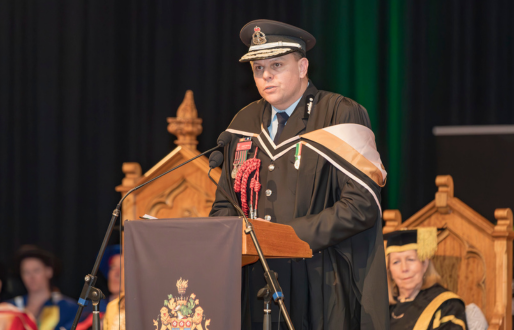
As a young student, early in my studies, I remember observing the graduation ceremonies as they were held on the lawns out in front of Booloominbah, and having a sense of its significance, and drawing on that for motivation for me to continue with my studies.
Then, when it was my turn to be seated here with my academic gown and hat, receiving my degree in front of my family, it meant so much. And I hope that today, all of you have felt something like that: that sense of accomplishment, the payoff for all the hard work, and the chance to share this moment and thank those loved ones who have supported you through the journey.
It is a significant achievement, and one worthy of celebration, and my congratulations to all of the graduates here today.
Today marks the completion of one journey, and the commencement of another. As you move into pursuing your careers, working, or undertaking further studies, it is an exciting time. Because while you might have a sense of the direction that you’re going to take, you don’t necessarily know where that journey’s going to end up.
What you do know is that the qualifications that you have gained will provide you with opportunities that you may not have otherwise had - either directly in your field of study or elsewhere. It also places on you a responsibility to think broadly about how you can apply the skills and knowledge that you have acquired to give back to society.
Just recently, at an Australian and New Zealand Emergency Management meeting, the Australian Disaster Resilience Index - which was developed here at the University of New England in partnership with Natural Hazards Research Australia - was discussed. This research has developed the first national snapshot of disaster resilience. It helps local, state, and national governments, and emergency services, to improve their communities’ resilience to natural hazards. It enables organisations to tailor programs and policies that strengthen disaster resilience, from national, state and local levels, right down to individual communities.
This is the kind of real-world impact you can have.
Academic study and research is about addressing the problems of today, and preparing for those of tomorrow, including many things which we cannot yet even imagine. With the pace of change and innovation, you are likely through the course of your careers to be dealing with many things that we haven’t even developed yet.
Through my work with Fire and Rescue NSW, I’m fortunate to see both sides: the academic research and its practical application. One of my previous roles was with our Fire Investigation and Research Unit. This unit specialises in determining fire causes, and liases closely with police and other investigators. Importantly, the unit also conducts research into fire and the behaviour of people and buildings during fire, and the associated impacts on performance-based building design.
This information is then used by fire engineers, fire code reform bodies, tertiary organisations, fire services, and designers of fire safety systems. The unit also focuses on faulty equipment and appliances that are in use in the community.
Currently, lithium ion batteries are the fastest-growing fire hazard in New South Wales, with our firefighters dealing with a lithium ion battery fire every day. This is not an issue, though, that we can effectively deal with from a firefighting perspective alone. As a result, we are partnering with Fair Trading, the Environmental Protection Authority, Transport for NSW, the Building Commission, and others to tackle the challenge holistically.
This is a strong example of the extremely impactful and life-saving difference that the application of science and research, along with policy development and collaboration, can have in today’s increasingly complex environment - skills that your cohort of graduates take out into the world today.
The transition to cleaner energy comes with significant opportunities, but also with significant obligations to ensure safety. We need to do all we can to make new energy sources safe as well as being sustainable. Fire and Rescue is currently leading a collaborative research program on the safety of alternate and renewable energy technologies, partnering with other services, government agencies, universities, and other research institutes from around the world.
The focus for Fire and Rescue NSW on energy is agnostic: we’re primarily focused on ensuring the safety of the community - working to make sure that clean energy is also safe energy - and this research is a crucial part of that adaptation.
It was once thought and hoped that engineering innovations would engineer and eradicate fire from the built environment. But I don’t need to tell you that has not happened. Instead, today with the developments in other areas, we have more fire risks in buildings than ever before.
An incident such as the Grenfell Tower fire tragedy in London - where 72 people died in a 24-storey building when combustible cladding caught fire - is the starkest of reminders of the challenges that can emerge.
But we can actively help prevent such tragedies by proactively addressing emerging safety risks that come with the rapid innovation in technology and the built environment, and ensuring that an ethical and professional approach is applied.
That prevention and improvement in safety will be achieved through the application of knowledge by people such as yourselves. The innovation that occurs may mean that your knowledge is used in ways that we haven’t yet anticipated, but the foundation that your education provides is what will enable you to meet these challenges.
My Bachelor of Natural Resources degree has proven to be useful, even if not applied exactly as it was originally intended. From shaping public safety policy through fire research, dealing with air and water pollution concerns from major fires and chemical recycling facilities, working with colleagues in the Environment Protection Authority on contamination issues, my understanding of physics and water engineering has helped me extinguish fires more effectively.
My understanding of thermodynamics and hydraulics also helped as well - to understand radiation properties and risk, and enabled our firefighters to work safely when they deployed following the earthquake and tsunami and subsequent nuclear reactor incident in Japan, which meant that we were one of only a few international teams who provided assistance to Japan in their time of need, in this case not only saving lives but having long-term strategic geopolitical impacts.
Subjects like soil and water engineering, water and wastewater engineering, remote sensing and GIS have all been directly relevant to my operational and management roles.
Now, standing in front of a group of some of our finest smart and competent graduates, it would be remiss of me to not make a recruitment plug. I recently attended one of our recruit firefighter graduations, and the extremely diverse backgrounds of our firefighters included people coming from backgrounds in nursing, architecture, science, finance, teaching, trades, policing, the military and child care, just to name a few.
As you head out into the workforce, consider the rewarding contribution that you could make to your community as a full-time firefighter - or, if you are wanting to work in your area of study and living in regional NSW, as a part-time paid firefighter. Our on-call firefighters are part-time and respond to emergency incidents from their home or work.
All of our firefighters, though, are highly skilled and trained in preventing and reducing risk and potential loss of life and property; working closely with communities to increase safety; undertaking all manner of rescues; dealing with hazardous materials incidents; and assisting other agencies with medical emergencies and large-scale natural disaster events.
No matter what the qualification you may have gained today, we have a use for you in Fire and Rescue NSW.
Now, it’s not all about recruitment, so with that aside, and whatever path you take from here, I hope that you will use your degree to make a real-world difference - whether that is making sure our agricultural production is able to be sustainable to feed and clothe the world, improving our environment, undertaking scientific research, or making sure that our businesses are well-run and profitable.
Wherever it takes you, I trust you will be able to look back fondly at your time at UNE and appreciate the value that an opportunity to learn in a regionally based, world-class institution provided.
All the best for your futures, and enjoy your journey.


