The Australian Disaster Resilience Index
The Australian Disaster Resilience Index (ADRI) is Australia’s first nationally standardised index of disaster resilience. By assessing resilience as a set of systemic capacities, we can better understand how different places and communities across Australia will be able to cope with and adapt to natural hazards such as bushfire, floods, storms, cyclones and heatwaves.
ADRI is peer-reviewed research translated into an interactive website. Explore the Australian Disaster Resilience Index
ADRI is being used by all levels of government, emergency service agencies, philanthropic groups, community organisations and industry groups for policy development, program support, risk assessment, community planning, project prioritisation, monitoring and evaluation and strategic planning.
NEMA’s Assistant Coordinator-General for Data and Analytics, Paul Gloyne, said in June 2025 at the launch of the latest version of ADRI that “This is an important development in our ongoing work to strengthen the resilience of communities by providing better data to inform decisions at all levels of government. Used in parallel with natural disaster hazard risk, ADRI supports a more targeted and coordinated approach to disaster risk reduction by highlighting the unique capacities and challenges faced by different communities. Its strength lies in transforming complex resilience data into accessible, evidence-based insights that can directly support policy development, funding, decisions, and on the ground planning.”
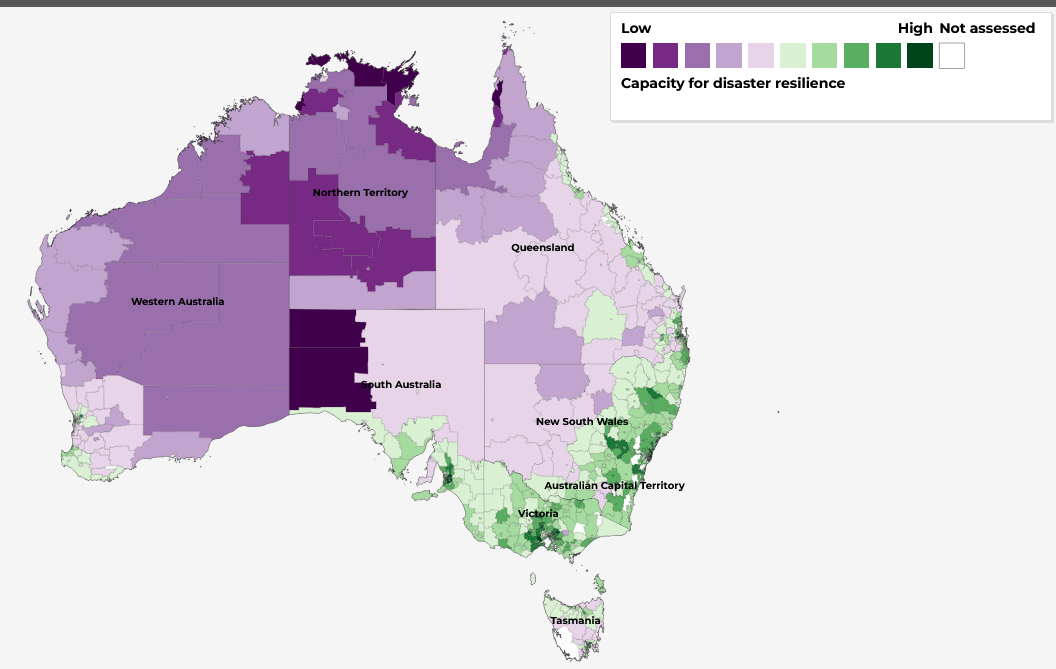
Image: Capacity for Disaster Resilience
Currently, approximately 340 organisations with around 724 registered users actively engage with the ADRI website, with over 70,400 unique views since the launch of ADRI in 2021. Monthly usage data shows the platform consistently attracts between 430 and 3100 unique visitors each month, with an average of 750 per month recorded in 2025.
Led by Associate Professor Melissa Parsons and a team of researchers from UNE’s Institute for Rural Futures and the Department of Geography and Planning, ADRI was first launched in 2020 following a 4-year research project.
Johan Boshoff and the team at UNE CASI developed the interactive ADRI website.
ADRI was subsequently updated in 2025, and released as ADRI-2.
ADRI was funded by the Bushfire and Natural Hazards CRC, Natural Hazards Research Australia and the National Emergency Management Agency (NEMA), supported by in-kind contributions from the University of New England.