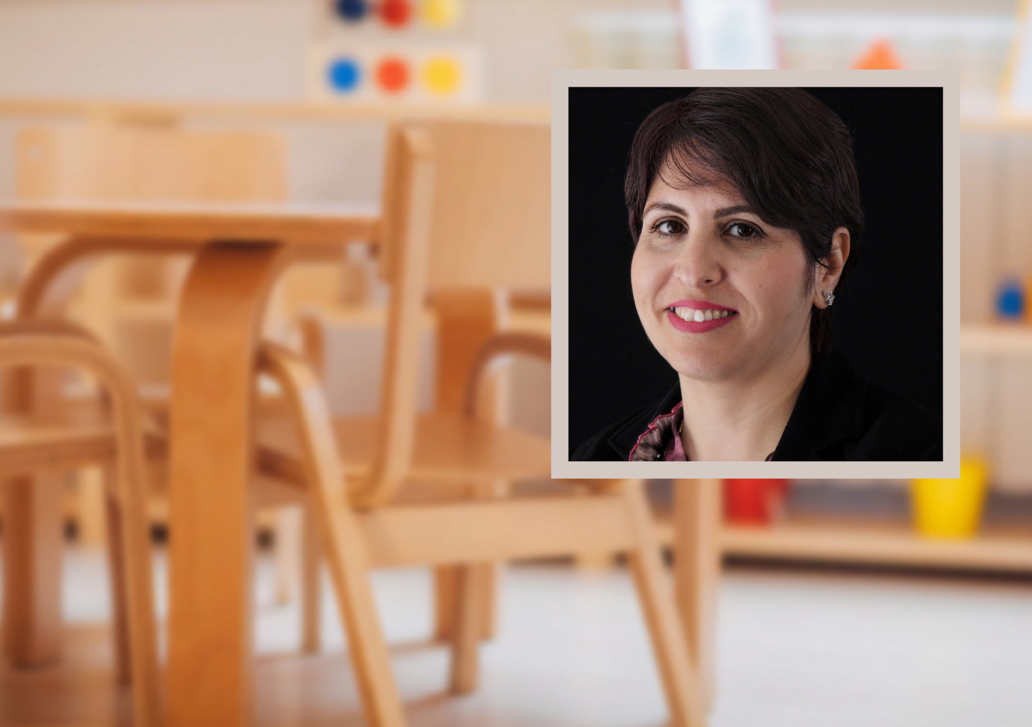
A University of New England early childhood education senior lecturer has had critical input into a proposed new national tool to measure children’s learning and progress in preschool.
Dr Somayeh Ba Akhlagh was the only educator from a regional university included on the 12-person Expert Advisory Panel for the Australian Government Department of Education over two years to refine and test the new national measure for Australian preschools.
Chosen from a EOI process, Somayeh was sought out for her focus and expertise on cultural diversity and responsive practice in early childhood settings, both here and internationally, including in her home country of Iran.
The Preschool Outcome Measure (POM) currently being piloted in preschools until the end of 2027 will benchmark children against new national learning progressions in executive function and oral language and literacy. The goal is to understand the children’s strengths and capabilities and areas where support is required, and to help with decisions for next steps in a child’s learning.
“The important thing for educators is that this tool is designed to support assessment for learning rather than assessment of learning,” Somayeh says. “This distinction is critical because the purpose of the tool is not to judge children, educators, or services, but to provide educators with meaningful information that can inform their teaching practices and support children’s learning and development.”
Somayeh says she was “surprised and delighted” to be selected for the panel, and relished the opportunity to provide a unique perspective.
“It was really good the Education Department included me on this Expert Advisory Panel so I could put my critical lens on as an educator, which was a great privilege, but also as a parent myself with children from a diverse cultural and language background.”
From my perspective, bringing together people with different professional, cultural, and geographical experiences strengthens the quality of decision-making. It ensures that national initiatives are not developed from a single viewpoint but are informed by the lived experiences and expertise of the communities they aim to support.
Somayeh even shared with the panel some of the personal experiences of her own children as new arrivals in Australia, who have not always been supported and encouraged in the education environment to share their language and culture.
“Cultural responsiveness is my passion, so it was really wonderful and critically important to be able to provide this perspective in the development and implementation of this tool,” she says.
The process to measure a child’s skills against national indicators during the Preschool Outcome Measure is designed to be implemented (with parental permission) unobtrusively, such as while watching preschool children at play.
But with her background as an educator in Iran, Somayeh understands first-hand how different a child's play environment can be in different countries and cultures, including the games they play and the play equipment they are familiar with.
“I was able to provide feedback on how the tool could be more inclusive and equitable, and help ensure that the tool recognised and respected the diverse cultural contexts in which Australian children learn and develop, rather than relying on a one-size-fits-all approach,” she says.
“I considered whether the process would be meaningful and appropriate for children and families from diverse cultural backgrounds, and whether any assumptions or biases might unintentionally disadvantage particular groups.”
During her own research, she has been surprised to find that not all early childhood centres, especially in regional areas, see the value in teaching cultural differences.
“This is how young children learn that everyone is different, in a way that fosters empathy and inclusiveness,” she says. “But I’ve had preschool teachers say to me, ‘Why do we need to teach about cultural differences, we don’t have children from different cultural backgrounds here.”
“It was really pleasing that diverse backgrounds were considered throughout the development of this tool, and a privilege to have played a major role in that.
“And for me, it was a really great professional experience. Through discussions and meetings, I gained insights into different perspectives, experiences and ways of thinking about early childhood policy and practice,” she says.
“I also developed a deeper understanding of how large-scale national initiatives are developed and implemented, including the collaboration required between the Australian Government, state and territory governments, and different sectors.
“I have been able to gain a greater insight into how complex it is to translate research, policy priorities, and diverse stakeholder perspectives into practical tools that can support children’s outcomes.”
Overall, Somayeh says the tool will help support both children and educators in early childhood education.
“By providing educators with meaningful information about children’s learning and development, the tool can help them plan more intentional, responsive, and effective learning experiences,” she says.
“I hope it will support educators to recognise each child’s strengths, identify areas where children may need additional support, and ensure that every child has opportunities to thrive and reach their full potential, regardless of their location, background, or circumstances.”
The new Preschool Outcome Measure will continue to be trialled in Australia through to the end of 2027, and the results will inform a future decision on outcomes measurement.


