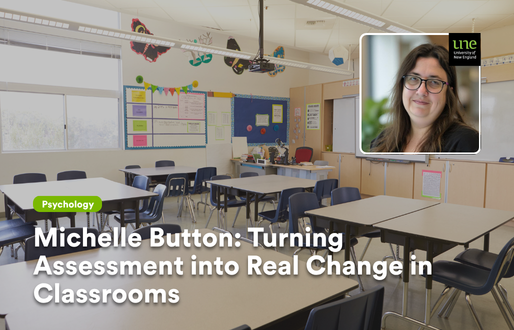
When Michelle Button talks about her work, she always comes back to the same idea. Assessment is only valuable if it leads to real change for students. As an Educational and Developmental Psychologist with more than 20 years’ experience, she has worked across schools, universities, not for profits and large mental health services, always with a focus on learning, development and wellbeing in education systems.
A significant part of Michelle’s career has involved working directly with schools to support students with learning difficulties, neurodevelopmental differences, emotional regulation challenges and complex developmental presentations. She has held senior leadership roles overseeing psychology teams and school based programs, and has been responsible for supervision, training and quality assurance across multidisciplinary services. She has also coordinated internship and registration programs and designed professional learning for psychologists, teachers and school leaders.
At UNE, Michelle brings this experience into her role as Unit Coordinator for PSYC537: Assessment and Intervention in School Psychology, one of the two core units in the Graduate Certificate in School Psychology.
From her perspective, the Graduate Certificate is a specialist qualification that bridges the gap between generalist clinical training and the specific demands of school psychology.
“The Graduate Certificate in School Psychology is for psychologists who want to work effectively within school and education settings,” she says. “It provides a clear and structured bridge between general psychological training and the competencies required to work confidently and ethically in schools.”
The course emphasises how learning, development, behaviour and mental health interact across childhood and adolescence. Students learn to see the full picture, rather than isolated test scores or single behaviours.
In PSYC537, Michelle guides students through the process of assessment, formulation and intervention in school contexts. They learn to:
- Select appropriate assessments for cognitive, learning, behavioural and emotional questions
- Interpret results in ways that are developmentally and culturally sensitive
- Integrate multiple sources of information, including teacher reports and observations
- Formulate in a way that makes sense within a school system
- Translate assessment data into recommendations that are practical and realistic
Michelle places particular emphasis on communication. She knows that the best assessment is of limited use if it cannot be understood or implemented by teachers and families. Student feedback consistently highlights the clarity of her explanations, the helpfulness of real life examples and the value of seeing how an experienced Educational and Developmental Psychologist thinks through complex cases.
“Students often comment that the weekly applied tasks and case based learning really help consolidate their skills,” she says. “They gain confidence not just in running assessments, but in knowing what to recommend and how to work collaboratively with schools.”
 When students explain why they chose UNE’s Graduate Certificate in School Psychology over other options, they often mention the same themes. They wanted something more substantial than a short professional development series. They valued the chance to learn from academics who have spent many years working inside education systems. They appreciated assessment tasks that look very much like the documents and decisions they will be responsible for in their roles.
Recent evaluations report high levels of satisfaction with the unit, noting strong academic support, clear teaching and the relevance of learning materials to real practice. Many graduates move directly into school based psychology roles, wellbeing teams or education focused internships. Others complete the Graduate Certificate while already employed as psychologists and report that it strengthens their assessment, report writing and collaboration with schools.
UNE’s long experience in distance education means the course is designed with working professionals in mind. The online delivery is structured and engaging but also flexible, allowing students to balance study with work, supervision and personal commitments. Because assessments are closely aligned to real tasks, students can often integrate their learning directly into their day to day work.
For early career psychologists deciding on a specialisation, Michelle describes school psychology as both demanding and deeply meaningful. It offers the chance to intervene at critical points in a young person’s educational journey and to help shape systems that support inclusion and wellbeing. At the same time, it requires comfort with complexity: navigating policies, limited resources and the priorities of many stakeholders.
Looking ahead, Michelle expects the role of school psychologists to grow in areas such as early identification, neurodevelopmental assessment, inclusion and whole school wellbeing. She believes that psychologists who understand learning and development within education systems, and who can work collaboratively across sectors, will be well placed to make a significant impact.
Outside of work, Michelle enjoys spending time with her family, being creative and maintaining a sense of balance. These are the routines that keep her grounded in a profession that can be both intense and deeply rewarding.
If you want to turn strong assessment skills into meaningful change for students and schools, explore the Graduate Certificate in School Psychology at UNE.


