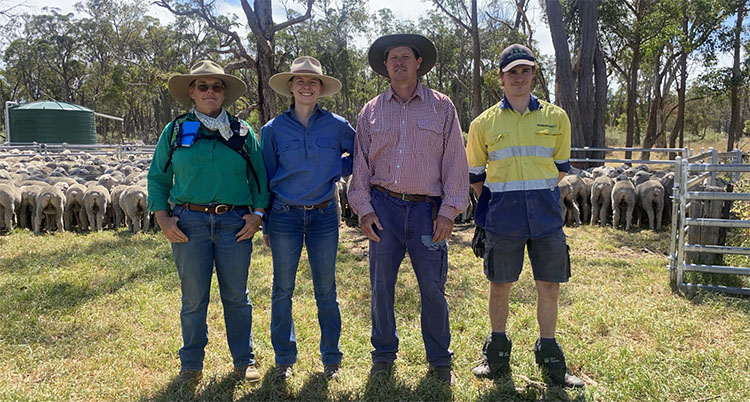
In a household of rural scientists, all working off-farm and intent on ensuring their operation is both profitable and sustainable, the dinner table conversation can be both lively and illuminating.
“We definitely don’t agree on everything,” says Jen Smith, who met her future husband Darren at UNE in 1987. They married in 1996 and son Lynden, now 27, and daughter Erin, now 26, came along during Jen’s subsequent PhD in livestock genetics (also from UNE).
“It’s a little easier when the vote is three to one, but more interesting when its two on two,” Jen says. “Not all decisions get made at once. Things may stay on the table, and we will come back to them multiple times.”
There’s input from the in-house pasture agronomist Lynden – who works for Nutrien Ag Solutions in Armidale; Erin, a junior research fellow at the Animal Genetics and Breeding Unit (AGBU) at UNE (who recently completed her PhD in livestock genetics at UNE), the steady financial stewardship and “expectation management” of Farrer Memorial Agricultural High School agriculture teacher Darren (who also obtained his Graduate Diploma of Education from UNE), and Jen, of course, who brings her skills as a “sheep person” and geneticist with the CSIRO at Chiswick, Armidale.
“Between us we have most bases covered, from the soils and pastures to animal health, nutrition and breeding; the farm and financial management; and links to education, research and development, innovation and industry connections,” says Jen.
“Having the base level of knowledge and systems thinking that comes with the UNE Bachelor of Rural Science sometimes makes the discussions very technical,” says Lynden. “But we all really love sheep and fine wool, so we share a common goal.”
The 40-hectare holding that Jen and Darren started out with in 1997 has since grown to 670 hectares. Having always worked off-farm, the couple appreciated the contributions of their offspring each weekend but Lynden and Erin’s decisions to follow in their Rural Science footsteps were very much their own.
“We grew up with both parents having done the same degree but knowing that we can take it down different career paths,” Erin says. “We each have our personal interests and it’s valuable that we not only understand how genetic evaluations work – which is very mathematical and scientific – but also understand the industry and the innovative tools that are available. If there’s something we need to know, we know where to go to find out. Together, I think that makes for a really strong team. And it helps that we all get along very well.”
That combined expertise and experience not only gives them a production edge but, the family says, a shared commitment to continuous improvement in the quest to grow beautiful wools that meet the exacting standards of Europe’s high-end fashion houses.
“The biggest challenge in the production of ultrafine wool is making it economically viable and sustainable in the long-term,” says Lynden. “While we’ve seen a decent uptick in prices recently, prices are perpetually changing.”
“Managing the cost of production is equally important as producing the best product possible,” adds Darren.
“The days of continuing to do the same thing your parents have done and your grandparents before them are gone,” says Lynden. “It now requires a level of innovation and progression to stay relevant and competitive.
“Mum and Dad have worked very hard to get the business to where it is. Erin and I are now looking at ways to add more. We bring youthful enthusiasm and there is a family-wide willingness to try new things and implement new technologies. However, there needs to be good reason to adopt a change. We don’t just jump on every new thing that comes along – there’s a process to gauge whether something new is valuable to our business.”
“We all believe in science and what it can do, but the problem-solving skills we learnt at UNE are also really important in farming today – that ability to pivot quickly to get a good outcome, for the animals and the business,” says Erin. “We are always striving to do better.”
According to Jen, their combined UNE qualifications have been vital to the family’s success.
“I don’t think we’d be where we are without them,” she says. “We wouldn’t have got the jobs we have, or the connections throughout industry, and without our off-farm jobs we wouldn’t have been able to afford the farm we have now. One of the best things about Rural Science was how the degree taught us to think about agriculture, as an ecosystem, and that’s made a huge difference to our business.”
“I’m proud of the fact that we’ve got a farm that’s all together and is moving forward,” says Darren. “And that all four of us are actively contributing.”


