
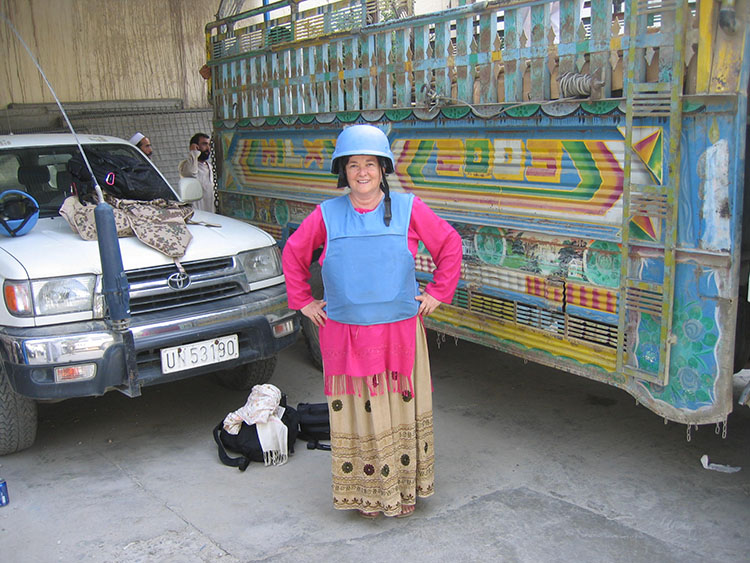
Learning is not always linear. And can take us places we never expected.
UNE studies helped former Registered Nurse and Army officer turned United Nations official Monique Fienberg to navigate unchartered, often dangerous territory in some of the world’s infamous trouble spots.
“After I left the Army, I worked for AusAID and then for almost two decades with the UN as a political affairs advisor, on crisis coordination and governance in war zones like the Balkans, Afghanistan, Sudan, Myanmar, Lebanon and Syria,” Monique says. “Wherever I was and in whatever role, I needed to understand the law – both national and international – and its implications for the tasks I was assigned.”
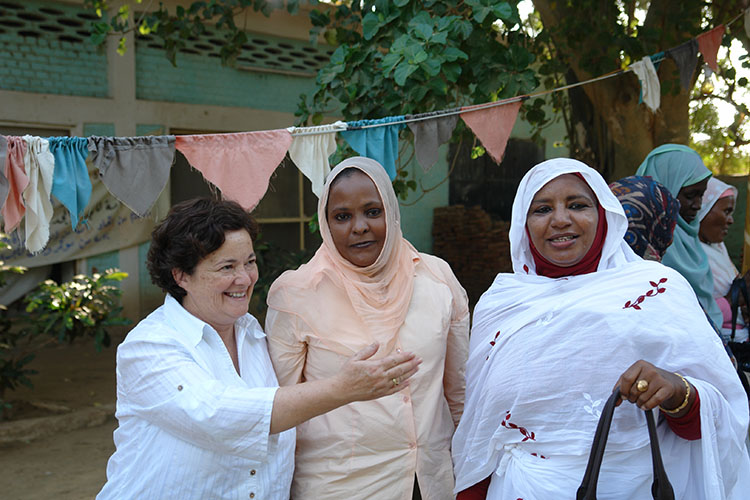 Monique supporting and Advising Women's Groups in Kassala, Sudan.
Following the war in Kosovo (1998-99), Monique contributed to peace-keeping operations. She became responsible for the Bureau for Detainees and Missing Persons and was Director of the Office for Human Rights and Community Affairs.
“It was a highly emotive time. There were about 4,500 missing persons from all ethnic communities, most of whom had been kidnapped and many killed and buried in mass graves. But because the families didn’t have their bodies, they didn’t believe they were dead.
“We worked with Professor Dame Sue Black’s renowned forensic anthropology unit from the University of Glasgow. We tried to match the post-mortem data with the information the families had provided. If we could, we returned the bodies to their families. This was important work done by the UN throughout the post-conflict Balkan states and, although a hard-nosed political scientist, I felt we were helping people to grieve and move on as well as gathering hard evidence for later ICTY (International Criminal Tribunal for the former Yugoslavia) prosecutions.”
That experience inspired Monique to enrol in the Juris Doctor* at UNE in 2007.
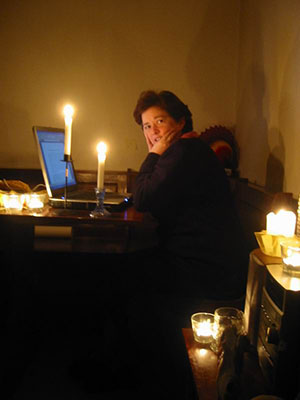 Just keeping up the study was challenging at times ~ Monique Fienberg
“I was able to apply what I was learning immediately,” she says. “Subjects like global law, jurisprudence and criminal law and procedure, enhanced my ability to give advice and write reports for Senior UN officials, including the Special Representative of the Secretary-General.”
But it wasn’t easy to keep her head down. “My academic record would say I was a very poor student, but I had a lot of difficulty sitting exams because most places didn’t have authorised exam sites. If they did, it was often very difficult to get to them.
“Just keeping up with the study was also challenging at times. I was working in unsafe, volatile locations, often by candlelight, and relying on batteries or generators to power my computer.”
The UNE law studies would accompany Monique’s overseas postings for 14 years.
During her second deployment to Afghanistan – the first was as Head of the UN Field Support Coordination Unit – Monique was a senior Stabilisation Adviser to the Provincial Reconstruction Team with the Australian Civilian Corps under the Australian Department of Foreign Affairs and Trade. Travelling with a group of Americans, their armoured vehicle was blown up by an improvised explosive device (IED). Fortunately, all passengers survived, and back home in Australia working for the Department of Defence Monique was able to complete her UNE studies in December 2020.
“It’s been exciting and demanding, and at times I have wondered ‘what the hell am I doing’, but I have no real complaints about my career or my university studies,” she says.
An unconventional university student – “I didn’t come from a background that had a great deal of respect for higher education, and I left school after Year 10” – Monique was one of the first in her family to complete a degree (in history and governance). In addition to the UNE Juris Doctor, she also has a graduate diploma in international law and two master’s qualifications from other Australian institutions.
“Once I started, I realised that university was the door to knowledge and knowledge is the foundation, for me at least, of success. UNE was extremely good to me and while I have never worked in a dedicated legal role, the Juris Doctor units I studied supported my work and have served me well ever since. Had I been considerably younger, I think I would have undertaken a law career.”
And Monique’s message for anyone embarking on law studies?
“Never give up. There will be times when some of you will struggle, but there are always means and ways to keep going, to achieve your goals. An understanding of the law is undoubtedly useful in a variety of professional roles not solely in a legal setting.”
*The Juris Doctor is no longer offered at UNE, however you can expand your legal expertise through a number of other UNE law courses. Go here for more information.


