
Tell us about you.
I grew up in Ethiopia, where many people regularly fell ill from malaria. From a young age, I was curious about why it was so common and what could be done to stop it. That probably sparked my interest in biology and ultimately led me to study malaria and other vector-borne diseases.
My work focuses on their ecology and biology, with an emphasis on surveillance systems and innovative control measures. I have contributed to research on mosquito ecology associated with large water infrastructure, pathogen transmission dynamics, early-warning surveillance tools and the evaluation of interventions, including Aedes control strategies.
How did you come to be completing your PhD at UNE?
I met my future supervisor, Dr Glenn Wilson, in Ethiopia during one of his visits. UNE’s PhD program had a strong reputation in ecological and environmental research, and I wanted a place where I could work closely with experts in vector ecology, gain rich field-based research experience, and receive the academic mentorship needed to strengthen my scientific skills. UNE offered exactly that combination and a scholarship.
The experience was both challenging and transformative. Conducting research on malaria disease ecology associated with African dams required long hours in the field and lab, balancing complex datasets and developing innovative approaches to understand mosquito behaviour and disease transmission. But it also sharpened my scientific thinking, strengthened my resilience, and taught me how to communicate complex ideas clearly. Working within UNE’s supportive academic environment – alongside supervisors and colleagues who genuinely cared about the work – helped me grow not just as a researcher, but as a problem-solver committed to public health impact.
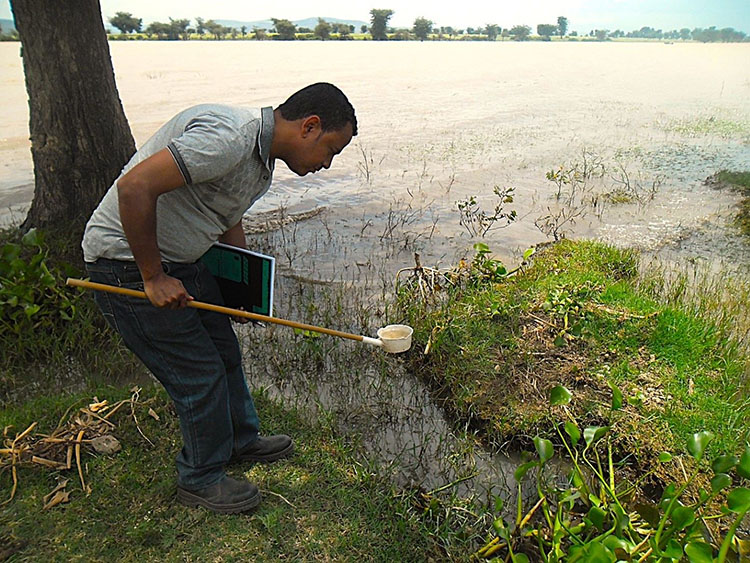 Image: Solomon in the field in Ethiopia.
Where has your research into the control of vector-borne diseases taken you?
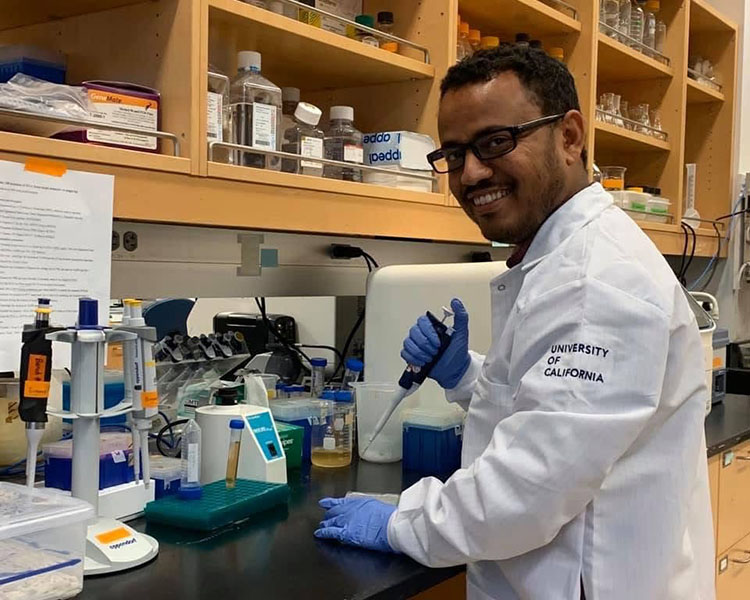
It took me across Africa and the United States, and into roles that bridge academic research, field implementation and public health leadership. I received a postdoctoral fellowship even before officially completing my PhD, in 2016, and moved to join the University of California, Irvine. There, I helped establish the International Center of Excellence for Malaria Research in sub-Saharan Africa and contributed to multiple projects on understanding the link between irrigation schemes and malaria and how to better manage water schemes to control malaria transmission. I also collaborated with the International Water Management Institute on a major study mapping and quantifying the malaria impact of large dams across sub-Saharan Africa.
After my postdoctoral work, I joined the West Valley Mosquito and Vector Control District in California as Scientific Director. I have published more than 40 scientific papers on mosquito ecology, surveillance and innovative control approaches.
What does your role as Scientific Director involve?
I lead all scientific and technical aspects of mosquito-borne disease surveillance and control in southern California. I oversee the design and implementation of our mosquito surveillance programs and those tracking West Nile virus and other arboviruses, and use data to guide timely and targeted control interventions.
I supervise a team of biologists, vector ecologists and lab associates, ensure the quality of field and laboratory operations, and introduce new tools and evidence-based strategies to improve the district’s response capabilities.
My role also involves providing scientific guidance to public health agencies, local governments and the community. I also manage research collaborations with universities and public health partners, evaluate emerging technologies, and help shape policy and operational decisions to strengthen regional preparedness.
Explain the responsibilities of the Chair of the American Committee of Medical Entomology (ACME).
It combines scientific leadership, community building and advocacy to advance the prevention and control of vector-borne diseases worldwide. I provide strategic leadership for one of the key scientific committees within the American Society of Tropical Medicine and Hygiene (ASTMH). ACME serves as a central hub for professionals working on vector biology, vector-borne diseases and entomology-driven public health solutions. I guide the committee’s priorities and coordinate activities to ensure that ACME continues to advance both the science and practical applications of medical entomology.
Organising scientific sessions and symposia at the ASTMH annual meeting helps to showcase cutting-edge research in vector ecology, surveillance and control. I also facilitate collaboration among scientists, public health professionals, and governmental and international partners involved in the research.
Mentoring early-career entomologists, promoting training opportunities and recognising outstanding contributions in the field helps to support professional development. I represent ACME within ASTMH leadership, ensuring that the perspectives of the medical entomology community are integrated into broader society initiatives.
What risks do mosquitoes pose globally? What are the latest and most promising control methods?
Mosquitoes are among the most significant vectors of human disease globally. They are responsible for transmitting malaria, dengue, Zika, chikungunya, yellow fever, and West Nile virus, among others, causing millions of infections and hundreds of thousands of deaths each year. Beyond their direct health impacts, mosquito-borne diseases impose heavy economic and social burdens, affecting productivity, healthcare systems and community well-being, particularly in tropical and subtropical regions. Climate change, urbanisation and human mobility have further expanded the range and seasonality of many mosquito species, increasing the risk of outbreaks in previously unaffected areas.
In terms of control, traditional methods such as source reduction through larval source management and insecticide treatment remain important, but innovative approaches are increasingly being applied, particularly to address invasive Aedes species that pose significant public health risks in many tropical regions and across the US. One promising method is the Sterile Insect Technique, which involves releasing sterilized male mosquitoes to suppress wild populations over time. When integrated with conventional control methods, this is a sustainable, evidence-based solutions.
Reflecting on your UNE studies, how did they prepare you for the career that has unfolded?
My UNE studies provided a strong foundation in both the theory and practice of vector ecology and disease control, which has been central to my career. They gave me the expertise, confidence and perspective needed to bridge the gap between scientific research and operational implementation, tackle complex challenges and contribute meaningfully to public health solutions globally. Beyond technical skills, UNE fostered a mindset of innovation and evidence-driven decision-making.
The program emphasised field-based research, data analysis and the design of rigorous scientific studies, allowing me to gain hands-on experience. Through close mentorship and collaboration with experts in the field, I developed critical skills in problem-solving, project management and scientific communication that have proven essential in both research and applied public health settings.


