
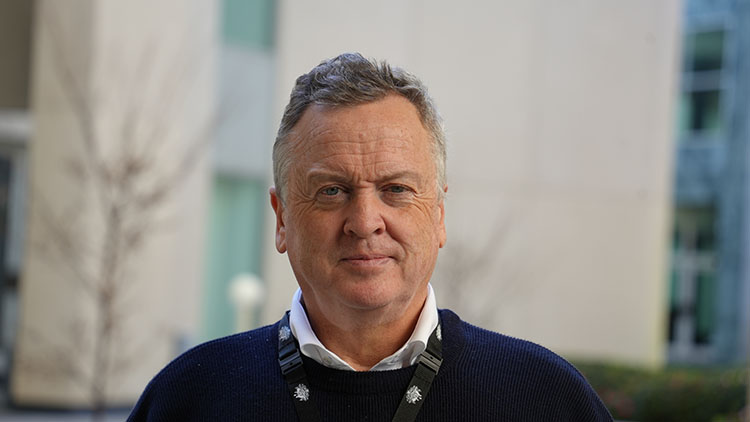
Gerard McManus - 2025 Distinguished Alumni Award
In recognition of his courageous defence of press freedom that established journalist shield laws and his distinguished career in journalism and political advisory roles.
A modern democracy depends on several basic tenets – freedom of speech and expression chief among them. Still, it’s not every day such principles are seriously challenged or publicly scrutinised.
For Gerard McManus, then a Herald Sun journalist, that day came in the County Court of Victoria in June 2007. The day he and fellow journalist Michael Harvey refused to name the insider who had revealed information about the Federal Government’s management of war veterans’ entitlements.
“It was a fairly innocuous story we produced in 2004, in truth,” says Gerard. “It was a cabinet leak about the [Howard] government short-changing veterans, not a big defence leak that put the country’s security in jeopardy. But the government was experiencing so many leaks at that time that they decided to make an example of us.”
When called to give evidence at the prosecution of a public servant charged with sharing the documents, Gerard and Michael remained tight-lipped. Both were convicted of contempt of court, fined $7,000 apiece but escaped prison sentences.
“We were never going to give up our sources – that’s the whole basis of a journalist’s code of ethics,”
“We were never going to give up our sources – that’s the whole basis of a journalist’s code of ethics,” Gerard says. “If we ended up in jail, we ended up in jail. Press freedom is fundamental to the way a democracy works.
“People across the political spectrum agreed the charges against us were an aberration of the law and I remain indebted to Michael for the extraordinary courage he demonstrated throughout the protracted legal proceedings. He is one of the most outstanding individuals and journalists I have ever met.”
The landmark 2007 court case prompted widespread debate about a reporter’s right to protect sources while holding truth to power. Four years later, it led to the introduction of national “shield laws” that today accord Australian journalists and their sources greater protection.
“It’s human nature for institutions in particular – whether a church, a hospital, a government department, a police force or a university – to want to protect their reputation first, before disclosure,” Gerard says. “It’s a journalist’s job to kick over the rocks and find information the public doesn’t know about, even if that upsets people or those people might lose their jobs.”
Described as “a journalist’s journalist”, Gerard is widely respected for his ethical standards and extensive knowledge of Australian media, having worked as a business editor, political editor, member of the federal parliamentary press gallery and media advisor. He was one of the first journalists on the scene of the Thredbo landslide in 1997 and has covered APEC summits, US Presidential visits, papal conclaves and countless Australian leadership spills, elections and budgets.
Now, the Walkley Award judge has been recognised with a UNE Distinguished Alumni Award for inspiring greater legal safeguards for journalists.
“I was always interested in politics and my Arts degree at UNE concentrated on history and politics,” Gerard says. “It opened up ways of looking at the world and was a good grounding for what I did later in life.
“Political journalism is a fast-moving feast of stories, and press galleries are very competitive spaces full of highly talented people.”
On the advice of the doyen of the Canberra press gallery, Laurie Oakes, Gerard made it his business to get to know everyone, including the freshest of faces. “I always gravitated towards mavericks and people with talent and integrity. There is always the possibility, in time, that the new MP will become the Treasurer or Foreign Minister or even Prime Minister or Opposition Leader. Eventually, your contacts and hard work give you an advantage over your colleagues.”
For the past 15 years Gerard has worked as a media advisor to Cabinet ministers Barnaby Joyce, Kelly O’Dwyer, Keith Pitt and most recently the Victorian Nationals Senator Bridget McKenzie.
“I have always endeavoured to be as open as possible to any query from a journalist … to assist them where I can, but also to assist the person I am working for in government,” he says. “Working with a Nationals senator, it’s important when we go into a rural town to give journalists access to this political power and influence.”
As for Bridget McKenzie’s resignation from the Morrison front bench in February 2020, in the wake of the sports grants controversy, Gerard respects her “act of complete integrity” when found to have breached the ministerial code of conduct.
“Every single graduate of a university like UNE will at times be challenged by their own professional standards, their own code of ethics, or the conflict between their own religious beliefs and the secular world. I’m no different. I have always sought to do what’s right, whatever the cost. Can I do that all the time? Of course not.”
And what of that most fragile of institutions, a free press, when newsrooms are being gutted or, as in rural Australia, lost entirely?
“Investigative journalism is still very important,” Gerard says. “This era of fake news is of great concern, but I also reject the cancel culture that shuts down or silences those with a competing or controversial view. It contributes to a collapse in civic discourse that is problematic.”


