Michele Bullock - 2025 Distinguished Alumni Award
In recognition of her historic appointment as Australia's first female Reserve Bank Governor and her exemplary four-decade career in public service.
Eight times a year the nation holds its collective breath as the Reserve Bank of Australia (RBA) meets to discuss interest rates. Inflation and employment levels, economic growth and the everyday lives of countless mortgage-holders hang on the deliberations.
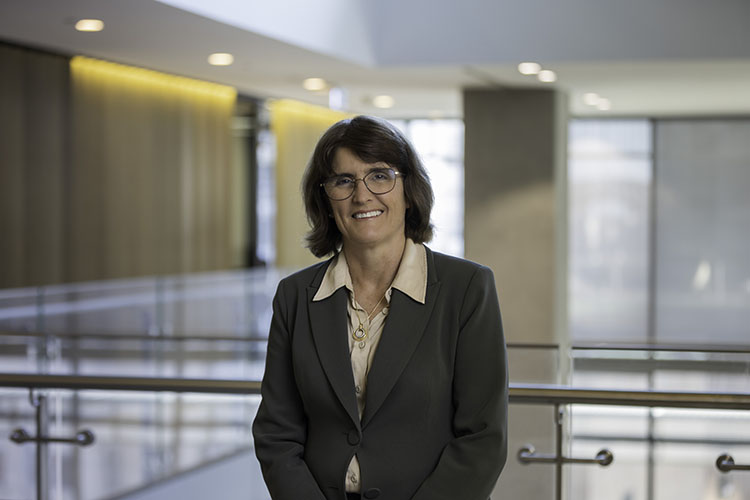
And presiding over these complex monetary decisions is RBA Governor Michele Bullock– one of the most powerful people in Australian economics and a 2025 UNE Distinguished Alumni Award winner.
“Our decision impacts everyone and it impacts people in different ways,” says Michele. “When interest rates were going up, people with mortgages were hurting. I feel that responsibility and want to make sure that we get the decision as right as we can, given what we know. It’s the board’s decision but I accept that I’m the face of it.”
Michele had made history as the first woman Deputy Governor of the RBA in 2022. When promoted to Governor a year later – another historic milestone – she inherited a central bank (which employs 1,500 people) still reeling from a major independent review of its operations and charged with implementing 51 recommendations relating to its policy framework, governance, leadership and culture.
“It was a time of major institutional reform,” says Dr Steven Kennedy, Secretary of the Department of the Prime Minister and Cabinet. “Michele’s leadership has been central to implementing these reforms, including increasing transparency and accountability through more frequent public communication and press conferences.”
That approach suited the openness and candour that typifies Michele’s leadership. A down-to-earthiness – “I often think how would I explain this to my Mum” – born of her country upbringing.
“I went to Armidale High School and mixed with everyone, from all socio-economic levels,” Michele says. “There were people whose parents worked at UNE, like my father, people whose parents were truck drivers, police officers and teachers.
“My parents brought me up to never think that because I was a woman I could never do anything. I always got on well with males and knew how to talk to them. It wasn’t until I started work that I began to realise that maybe there was a gender issue.”
Although Michele says she has never “felt held back”, there were occasions – like being questioned about marriage and children, and not being invited to a private, all-male gathering – that reflected prevailing attitudes.
Barely any women were represented at the section head level when Michele joined the RBA as an intern in the mid-1980s. Her subsequent “apprenticeship” spanned a wide range of senior positions, including Assistant Governor positions in currency, business services and the financial system. While leading the Financial System Group from 2016-2022 Michele played a key role in managing emerging cyber and technological risks to the financial sector.
By June 2025, women comprised 44% of RBA employees and held 40% of management roles and four of the seven Executive Committee positions.
“It [women’s workforce participation] is good for women, good for businesses, good for productivity and the economy, and good for society,” Michele told the Chief Executive Women Annual Dinner in April. “I hope that my role as Governor of the RBA gives encouragement to women coming up through the ranks of Australian businesses and the public service. You can do it.”
But while women’s labour participation has undoubtedly increased, there’s more work to be done.
Males still outnumber females two to one in high school and university economics courses, and Michele is concerned that women continue to underestimate their economics proficiency. She now advocates for them, determined to help build a pipeline of future women economists and business leaders.
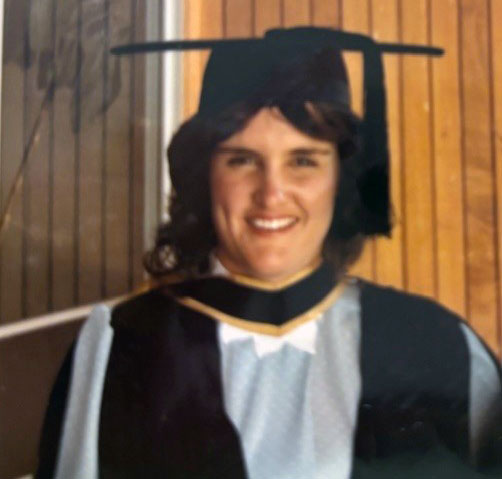 Michele at her graduation.
“As I’ve risen through the RBA ranks, I have leaned into that more,” she says. “The best bosses and mentors I had were inclusive leaders and we need people with all sorts of perspectives. In the economics profession, socio-economic diversity is also a challenge. Economics tends to get taught in private boys’ schools and less and less in public schools and less and less in girls’ schools. That’s partly what the RBA’s public education team is trying to address – to create a more diverse economics student population, so that the profession, as a whole, is more representative.”
Although she has worked exclusively for the RBA – for 40 years – Michele has a reputation for innovative policy and espouses an “open and dynamic” organisational culture. In the wake of the RBA review, she has sought to encourage more input from junior staff, to counter the “groupthink” criticism levelled at the bank, and remains chair of its Diversity and Inclusion Council, a role traditionally held by the Deputy Governor.
“I have always led by example, encouraging people to be honest and frank in respectful ways. It’s important that we find a balance between having people with corporate knowledge and bringing in new people with fresh ideas, who challenge us.”
Steady, thoughtful leadership is sure to be valued in the months ahead as Australia continues to grapple with inflation, a tight labour market, trade headwinds, the climate transition, demographic pressures and rapid technological change.
“Things are much more uncertain and unpredictable geopolitically,” Michele says of the economic volatility. “You never know what you are going to wake up to.”
But Steven Kennedy believes that in our RBA Governor the Australian public can always be assured of humility, ethical behaviour and authenticity – a person for whom leadership is “not about status but about responsibility and impact”.
“Michele is a living example of how a regional education can lead to national influence,” he says. “Her journey … serves as an inspiration to students and professionals alike, demonstrating how values-driven leadership can shape institutions and society for the better.”


