
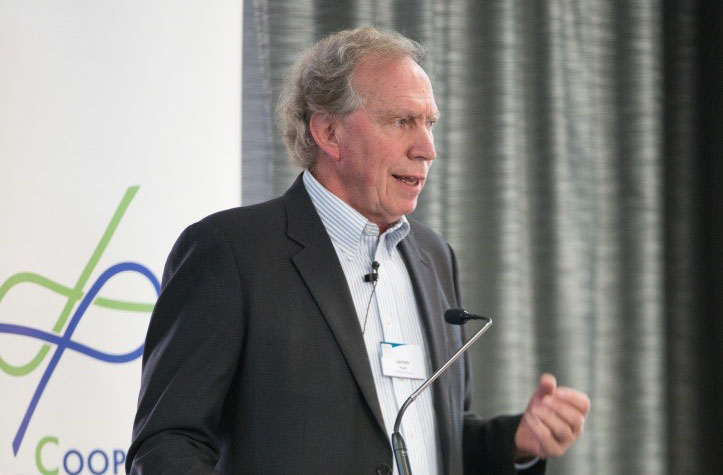
Emeritus Professor James Rowe OAM - 2025 Distinguished Alumni Award
In recognition of his leadership that helped transform Australia's sheep industry through innovative research and genomic technologies.
Many a Rural Science student has been influenced by the systems thinking espoused by legendary UNE agricultural scientist and educator Professor Bill McClymont. The philosophy that soils and plants and animals, producers and markets and politics interact in complex ways.
But few exponents exemplify this approach or its profound impact – on science, food and fibre production, and people – as 2025 UNE Distinguished Alumnus Emeritus Professor James Rowe OAM. A humble giant of industry and academia whose achievements in research and its practical applications are perhaps rivalled only by his outstanding leadership and mentoring of generations of students.
“Bill McClymont equipped me with the confidence to tackle tough research questions, but the understanding that while writing a paper was important, you’ve not really achieved anything until you’ve changed an agricultural practice,” says James. “He also taught me the critical importance of teamwork in solving multi-dimensional problems – all foundational skills that would be useful throughout my career.”
After completing his PhD at UNE in Animal Nutrition and Biochemistry in 1980 James worked as a Research Fellow in the Dominican Republic as a member of the United Nations Development Program. Then a stint with ICI’s Pharmaceuticals Division (now Astra Zeneca) focused on reducing methane production in ruminants, before James joined the WA Department of Agriculture, where he would eventually lead beef and dairy research from 1987-1994.
Returning to UNE to head the Department of Animal Science – and manage some of his former lecturers (from 1994-2001) – may have been daunting but proved the ideal preparation for the role that would define James’ illustrious career, as CEO of the Australian Sheep Industry Cooperative Research Centre (Sheep CRC) for almost 20 years. It was there that his entrepreneurial thinking and talent for uniting researchers, industry and collaborators under a shared vision would reap even bigger rewards.
From 2001-19 James’ leadership fostered cooperation, discoveries and innovations that delivered measurable results for wool and sheep-meat industries that were not always comfortable bedfellows.
“A hallmark of his time at the CRC was James’ emphasis on developing the know-how for farmers to implement the research outcomes in real farming situations,” says former CRC chair Professor John Keniry. “At times this required a very adept and determined approach to focus on whole animal outcomes, when the two industry-funded research organisations – Meat and Livestock Australia and Australian Wool Innovation – were often pushing for their own direct interests. I still meet many within the industry who refer to the CRC as the leader in transforming industry attitudes to research and adoption.”
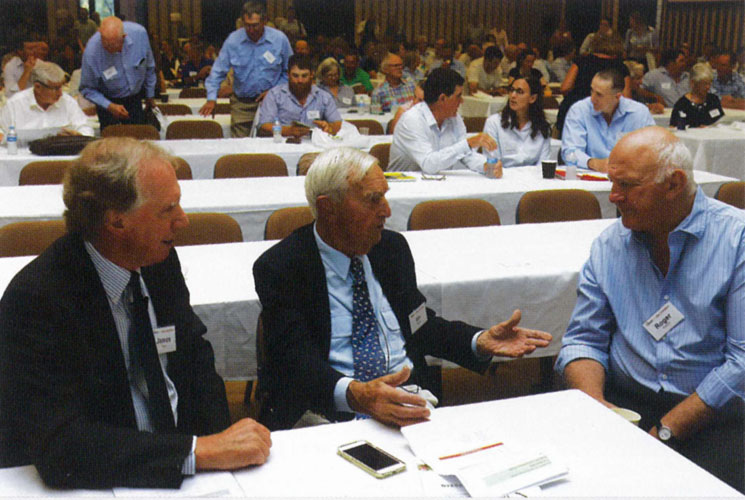
James Rowe with The Right Honourable Ian Sinclair and the Managing Director of Fletcher International Group Roger Fletcher OAM at the Sheep CRC 's Final Conference held in Dubbo NSW in 2019.
Significant improvements to wool quality, meat quality and farm economics are among the greatest accomplishments of a CRC that successfully integrated genomic technologies into commercial sheep breeding to boost productivity and profitability. The systems-thinking applied along the entire sheep value chain inspired innovative DNA tools, education and industry outreach that enabled producers to make faster, more accurate genetic gains in animal reproduction, nutrition and health – gains that saw the gross value of the Australian sheep industry increase in real terms by almost 50% from 2001-2019, despite a 40% decline in the size of the national flock.
Shepherding the CRC, weathering financial headwinds, settling stakeholder squabbles and achieving the group’s ambitious goals was no easy feat. The CRC comprised more than 20 or more national and international research, government and commercial partners, plus 80-odd PhD students who fondly recall James’ “if we can measure it, we can select for it” mantra and cut their teeth at the postgraduate conferences he oversaw.
Many cite their leader’s generosity, energy, wisdom and patience as critical to the CRC’s success and also those he mentored. “James [who received an OAM for service to science as a researcher and educator in 2021] had an exceptional gift for making students feel that their questions mattered and that their futures in agriculture were important ... that there are so many advancements still to make in their careers,” says fellow alumni, friend and grains farmer Bernard Perkins. “Many – like [UNE Professor in Meat Science] Dr Peter McGilchrist – are now leaders in their own right.”
Outcomes and accountability were central to James’ CRC mission. “It was vital for us to assemble a world-class team and to set the bar high,” he says. “I was constantly asking questions: ‘what do we need to do to remain relevant, what’s the probability that we will develop this new technology, who will use it and, if they do, how much will it cost them and how much more money will they make?’ I am someone who focuses on the long game – on making commitments but also delivering on them by working together in productive teams – and that requires trust. We had a very good run.”
A man famous for his South African anecdotes and good humour, even while juggling the competing priorities of multiple stakeholders, James developed a simple analogy for successful engagement and collaboration.
“It’s like sharing a taxi,” he says. “Before you hop in, you must ensure you are going to the same place – the exact same place – so there can be no misunderstandings. If you are agreed on the destination, then you don’t mind sharing the fare. You have skin in the game. Finally, and it’s something a lot of people don’t check properly – you’ve got to enjoy the company. It’s about knowing and trusting the people you’re travelling with and having a sense of humour about the trip. If you can tick all those boxes, you’ll enjoy the journey. I certainly have.”
And, along the way, James Rowe has chartered a new course.
“He has shaped careers but also a community of practice that continues to massively influence Australian agriculture, food and fibre production industries today,” says Bernard.


